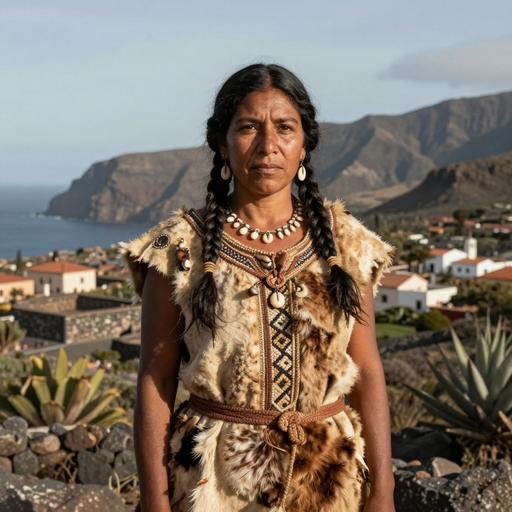
The Guanche people were the aboriginal inhabitants of the Canary Islands, an archipelago situated off the northwest coast of Africa. They are particularly associated with the island of Tenerife, though similar indigenous groups with cultural, linguistic, and ancestral ties, known as \Canarios," inhabited the other islands within the archipelago. The Guanche communities are primarily of Berber origin, having settled in the Canary Islands as early as the first millennium BCE. Their rich history, unique culture, and eventual interaction with European colonizers offer a fascinating glimpse into the pre-Hispanic era of the archipelago.
Origins and Settlement
Derived from the Berber populations of North Africa, the Guanche people are believed to have arrived on the islands via rudimentary boats. The reasons for their migration are not entirely clear, but it is speculated that they were escaping climatic changes, seeking economic prospects, or were displaced by other cultural dynamics occurring in North Africa at the time.
The Guanche people lived in relative isolation for centuries, which allowed for the development of a distinct culture that separated them from their Berber ancestors on the mainland. They primarily settled in caves or constructed simple stone homes. Their society was organized into tribes, each governed by a king-like leader known as a "mencey."
Society and Culture
The Guanche society was distinctly stratified and organized. The menceys, or local kings, governed different districts or territories each known as a "menceyato." These tribes were patriarchal and followed a class structure consisting of nobles, priests, and the common populace, who were engaged primarily in agriculture and pastoral activities.
Religion and Beliefs:
The Guanche religious system was polytheistic, based around a pantheon of gods that mirrored natural phenomena. The deity most commonly revered was Achamán on Tenerife, who was seen as the supreme being. Their belief system also included a dualistic concept of good and evil, and they practiced ritualistic ceremonies that were believed to commune with the divine.
They believed in an afterlife, as evidenced by their practices of mummification and burial rites. The Guanche mummies found in caves highlight their sophisticated embalming techniques, which have drawn parallels with ancient Egyptian practices.
Language:
The Guanche language, now extinct, was a Berber dialect. Unfortunately, much of it was lost due to the assimilation of the people into Spanish colonial culture and the subsequent predominance of the Spanish language. However, traces of Guanche words are preserved in place names and a few recorded phrases.
Economy and Subsistence:
The Guanche economy was primarily based on pastoralism, agriculture, and fishing. They cultivated crops like barley and wheat, and kept livestock including goats, pigs, and sheep. Bartering was a common practice, with skins, cereals, and other goods being exchanged between communities.
Art and Material Culture
The Guanches were skilled in pottery, and their ceramics reflect both functional and decorative purposes. It did not use a potter's wheel; instead, intricate items were hand-molded. Archeological discoveries have unearthed an array of pottery, tools, and other artifacts that indicate a rich material culture.
Interaction with Europeans
The arrival of Europeans began in earnest in the early 14th century, with the Spanish conquest starting in 1402. The conquest was completed in 1496 with the subjugation of Tenerife, marking the end of the Guanche society as a distinct entity. The Guanches showed fierce resistance against the Spanish conquistadors, especially during encounters in Tenerife, but they were eventually overpowered by superior military technology and tactics.
Upon conquest, the majority of the Guanche population was decimated due to warfare, enslavement, and diseases brought by Europeans. Surviving Guanches were assimilated into Spanish colonial culture over the subsequent decades. While direct descendants of the Guanche people remain today, their cultural practices and language have largely been lost due to this integration.
Legacy
The legacy of the Guanche people remains integral to the identity of the Canary Islands today. The islands' people, though predominantly Spanish-speaking, often reflect on their ethnogenesis, which consists of indigenous Guanche, Spanish, and African influences.
Modern Canarians celebrate their Guanche heritage through festivals, museums, and cultural events. Efforts have been made to preserve what remains of the Guanche culture, including restoring artifacts, studying mummy remains, and documenting oral traditions that survived colonial times.
In conclusion, the Guanche era represents a fascinating chapter in the history of the Canary Islands. Although much of their traditional way of life has vanished, the enduring spirit of the Guanches continues to be a point of cultural pride and historical intrigue. Their story highlights the complexities of human migration, adaptation, and the impacts of colonial encounters."