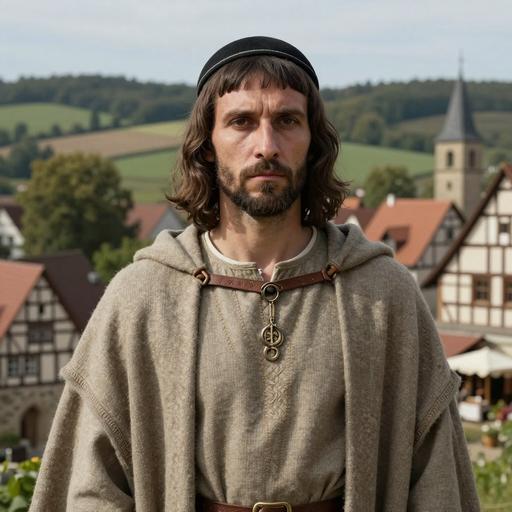
The Medieval German Jewish culture represents a fascinating and complex tapestry of religious, social, and economic life in Central Europe during the Middle Ages, roughly from the 10th to the 15th centuries. This era was marked by both flourishing periods of intellectual and cultural activity, as well as times of adversity, including persecution and forced migrations.
Historical Context and Demographics
The Jewish communities in medieval Germany emerged as part of the Ashkenazi Jewish culture. These communities began to form in regions such as the Rhineland and along the major rivers like the Rhine and Danube, which were part of the Carolingian Empire and later the Holy Roman Empire. Cities such as Mainz, Worms, and Speyer, collectively known as the \ShUM cities," were prominent centers of Jewish life and learning.
Religious and Intellectual Life
The religious life of medieval German Jews was centered around the synagogue and the study of traditional Jewish texts. The Talmud was a central focus, and the Tosafists, or medieval Talmudic commentators, made significant contributions to Jewish law and tradition. Figures like Rashi (Rabbi Solomon ben Isaac), a renowned commentator from Troyes, France, had a profound influence on Jewish scholarship in medieval Germany.
Aside from religious studies, the Jewish community engaged in various intellectual pursuits, including philosophy, medicine, and science. Despite restrictions against Jews attending Christian universities, they participated in a wider intellectual discourse, often engaging in interreligious dialogues with their Christian neighbors.
Social Structure and Community Life
Jewish communities were typically organized as self-governing entities under the leadership of local rabbis and lay leaders. These communities prized communal autonomy and maintained their own educational and judicial systems, including schools for boys (heder and yeshiva), which focused on teaching Torah and Talmud.
Families were the core of Jewish social structure, often extending to include a network of relatives who supported one another in times of need. Jewish festivals and rituals, such as Passover, Rosh Hashanah, and Yom Kippur, were vital to communal identity and cohesion. Marriage and family life were pillars of the community, governed by religious laws and customs.
Economic Life
Economic activity for Jews in medieval Germany was both diverse and restricted. Jews were often barred from owning land, which pushed them into trade, moneylending, and various crafts. They played a crucial economic role, particularly in moneylending, due to canonical laws that prohibited Christians from lending money at interest. This role was both lucrative and precarious, as it led to heightened tensions with their Christian neighbors, often serving as a pretext for pogroms and expulsion during times of economic strife.
Challenges and Persecutions
The relationship between Jews and their Christian neighbors oscillated between periods of coexistence and tension. Jews were subject to various restrictive laws and were often scapegoated during times of plague or economic turmoil. The Crusades, particularly the First Crusade in 1096, were disastrous for Jewish communities in the Rhineland, leading to massacres and forced conversions.
Blood libel accusations, demonization, and enforced segregation also marked this period. Jews were often required to wear distinguishing clothing or badges and were confined to ghettos in certain cities. These persecutions reached a tragic apex during the Black Death (1347-1351), when Jews were falsely accused of causing the plague and subsequently massacred or expelled from numerous regions.
Cultural Contributions
Despite the challenges, the medieval German Jewish communities contributed significantly to Jewish culture and the broader European cultural milieu. Jewish poetry, music, and art flourished in religious and ceremonial contexts. The creation of beautifully illuminated manuscripts, known as Haggadot, and other religious texts remains a testament to the rich cultural life of these communities.
Legacy
The legacy of the medieval German Jewish communities is profound, as they laid the foundations for the Ashkenazi traditions that would shape Jewish life in Europe for centuries. Their resiliency and contributions to religious scholarship, community organization, and cultural expression continue to be celebrated and studied today."