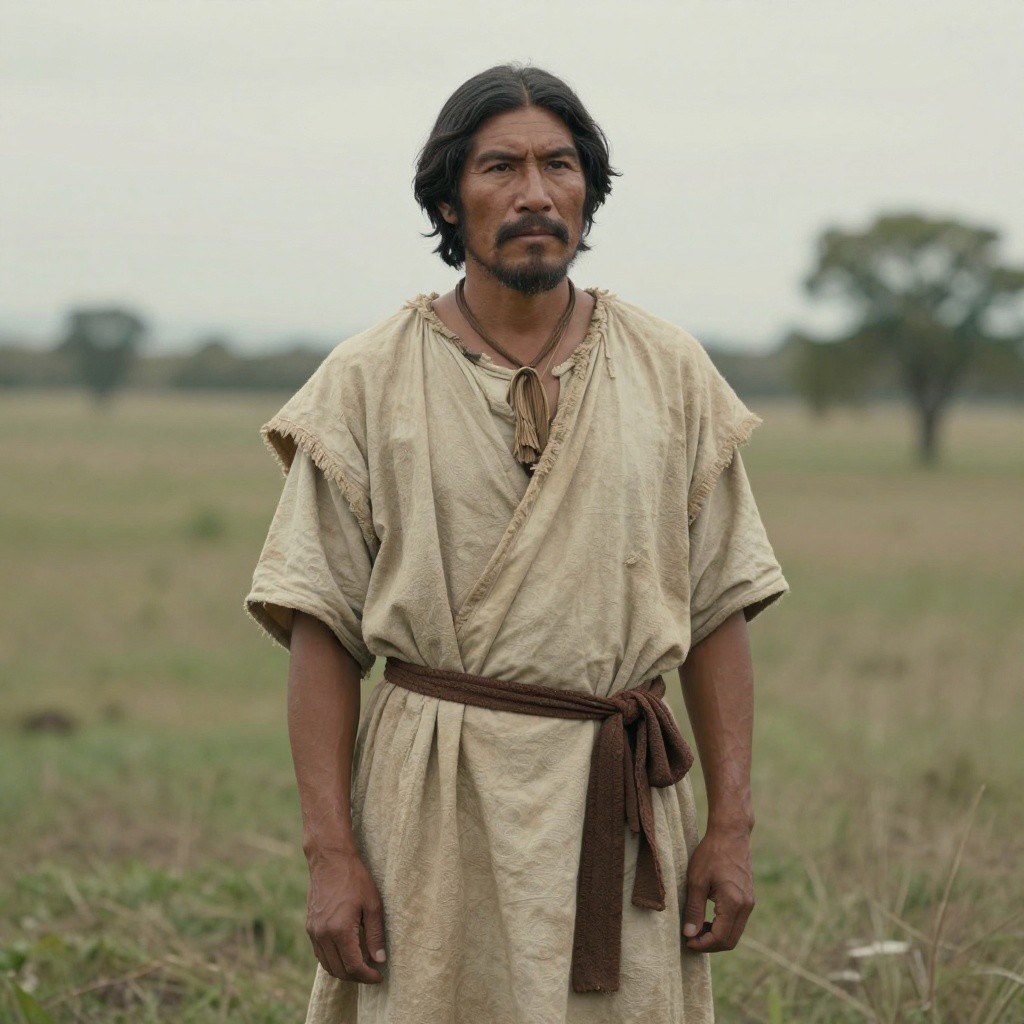
I15478 - A man buried in USA in the era

Download PDF creates a visual, rasterized copy. Use Print for selectable text and better assistive-technology support.

Menu
Currency
Main
Store
Blog

Loading Report

Preparing your ancestry journey

Connecting to ancient matches...

Preparing your report

Skip to main content
Portrait reconstruction of A man buried in USA in the  era
Ancient Individual

A man buried in USA in the era

A man buried in USA during the USA California 4900BP

A fragment of the ancient world, preserved across millennia in strands of DNA.

I15478
3112 BCE - 2884 BCE
Male
USA
Scroll to begin
Chapter I

Identity

The biological and cultural markers that define this ancient individual

Sample ID

I15478

Date Range

3112 BCE - 2884 BCE

Cultural Period

USA California 4900BP

Biological Sex

Male

mtDNA Haplogroup

Not available

Y-DNA Haplogroup

Q-M3

Chapter II

Place

Where this individual was discovered

Country USA
Locality Clark Estate (California, Santa Barbara)
Chapter III

Time

When this individual lived in the broader context of human history

I15478 3112 BCE - 2884 BCE
Chapter IV

Story

The narrative of this ancient life

Overview

“USA California 4900BP” designates a broad time-slice for prehistoric activity in California beginning around 365 CE and ending around 690 CE. Because no narrower cultural label is provided beyond the local timeframe, this entry focuses on general characteristics of mid-to-late Holocene Native lifeways in California.

Region & Environment

California’s environments range from coastal zones and estuaries to river valleys and uplands. In this period, abundant seasonal resources—such as aquatic foods and plant resources—supported recurring cycles of gathering, processing, and localized movements between resource-rich areas.

Historical Context

This timeframe belongs to the later prehistoric sequence of California, long before Euro-American colonization. Across the state, communities maintained complex knowledge of landscapes, including where and when different resources were available.

Populations & Lifeways

Native Californian populations were typically structured around family groups and broader social networks that coordinated access to resources. Lifeways commonly included a mix of harvesting, food processing (including technologies for preparing plant foods), fishing and hunting, and settlement use that could be seasonal or semi-permanent depending on the region.

Archaeology & Material Culture

Archaeological traces for this horizon often emphasize durable toolkits such as ground stone implements and other lithic technologies used in everyday food preparation and hunting. The “USA California 4900BP” label implies a time period rather than a single named material-culture complex, so diagnostic artifact types can vary by locality.

Culture & Society

Social life likely involved shared norms for resource use and kin-based or community-based cooperation, with gatherings that strengthened ties among groups. Archaeological patterns such as repeated occupation of certain areas and similarities in processing technologies can indicate regional cultural continuities, though specific social interpretations remain dependent on local evidence.

Legacy & Transition

This era sits within a longer Native Californian archaeological continuum. Later transitions—into the historic period—brought major changes in subsistence, settlement, and material life due to European contact and its consequences, but the mid-Holocene record preserves earlier strategies shaped by local ecologies.

Chapter V

Genetics

These comparisons show genetic similarity, not identity or origin. The populations listed are those whose genomes show statistical alignment to this ancient individual.

Similarity reflects shared history, not shared identity. These are analytical comparisons, not claims about who this person was.

Modern Genetic Admixture

This analysis compares the DNA profile with present-day reference populations, showing statistical similarity to modern reference populations from different regions. The excavation site records where this individual was found, not a fixed modern genetic identity.

America 89.8%
America 89.8%
Native American 89.8%
Asia 9.4%
Japanese & Korean 5.3%
Japanese 5.3%
Chinese & Southeast Asian 4.0%
Chinese 4.0%
Africa 0.9%
African Hunter-Gatherer 0.9%
Context

Related Samples

This individual exists within a broader network of ancient samples. No ancient genome stands alone.

Sample ID Culture/Period Date Location Action
I15478 3112 BCE Clark Estate (California, Santa Barbara), USA View
I17112 430 CE Tayopa (Sonora, Sahuaripa), Mexico View
Sample ID Culture/Period Date Location Action
I15478 3112 BCE Clark Estate (California, Santa Barbara), USA View
Sources

References

Scientific publications and genetic data that inform this profile.

G25 Coordinates

These coordinates represent a position in genetic space, a tool for comparison, not a conclusion. You can use these to perform custom admixture analysis in G25 Studio.

I15478,0.05189076,-0.31157638,0.1132895,0.09619866,-0.11053646,-0.01566006,-0.28184396,-0.33681546,-0.01156602,-0.01818456,0.00050468,-0.00110218,-0.00216264,0.02305284,-0.00809928,0.00215072,0.00440712,0.00417302,0.00422348,-0.00142804,7.972E-05,0.00426656,-0.0020413,-0.0033077,-0.00363775
Continue in G25 Studio
Use code for 30% off Expires Aug 05