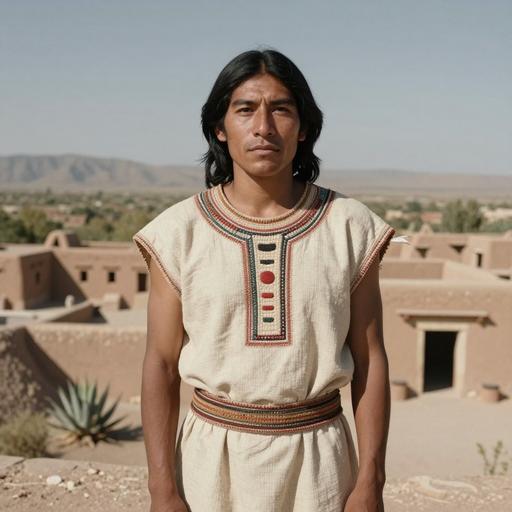
I22220 - A man buried in Mexico in the Medio Period era

Download PDF creates a visual, rasterized copy. Use Print for selectable text and better assistive-technology support.

Menu
Currency
Main
Store
Blog

Loading Report

Preparing your ancestry journey

Connecting to ancient matches...

Preparing your report

Skip to main content
Portrait reconstruction of A man buried in Mexico in the Medio Period era
Ancient Individual

A man buried in Mexico in the Medio Period era

A man buried in Mexico during the Casas Grandes (Medio Period)

A fragment of the ancient world, preserved across millennia in strands of DNA.

I22220
1301 CE - 1397 CE
Male
Mexico
Scroll to begin
Chapter I

Identity

The biological and cultural markers that define this ancient individual

Sample ID

I22220

Date Range

1301 CE - 1397 CE

Cultural Period

Casas Grandes (Medio Period)

Biological Sex

Male

mtDNA Haplogroup

C1b

Y-DNA Haplogroup

Q-BZ1021

Social Role

Farmer (AI estimate, era-typical)

Chapter II

Place

Where this individual was discovered

Country Mexico
Locality Paquimé (Chihuahua, Casas Grandes)
Chapter III

Time

When this individual lived in the broader context of human history

I22220 1301 CE - 1397 CE
Chapter IV

Story

The narrative of this ancient life

Region & Environment

Northern Mexico includes semi-arid basins, desert edges, and uplands where agriculture depended on seasonal rainfall and localized water management. Resource availability encouraged settlement near arable soils and dependable water sources, while hunting and gathering remained important supplements.

Historical Context

From about 1200–1450 CE, the Casas Grandes (Medio Period) is discussed in archaeological terms through changing styles of ceramics, architecture, and site organization. This phase followed earlier Mogollon-linked developments and contributed to the formation of more recognizable regional interaction networks in parts of northwest Mexico.

Populations & Lifeways

Communities supported themselves through mixed economies. Farming—where feasible—provided staples, while wild foods and game broadened diets and helped stabilize living patterns during fluctuating conditions. Settlement systems could include both smaller habitations and larger organized centers, with households producing much of what they needed and specialists possibly contributing certain craft goods.

Archaeology & Material Culture

Archaeological identification relies on ceramics and other durable remains, including storage and cooking vessels, stone tools, and architectural features. Changes during the Medio Period are often visible in pottery styles and construction practices, indicating how traditions were maintained and modified over time. Evidence for craft production and exchange is inferred conservatively from artifact styles and similarities across sites.

Culture & Society

Social organization is approached through how sites are planned and how material styles cluster. Distinctive ceramic and architectural conventions suggest shared cultural frameworks, while differences between sites can reflect varying access to resources, local autonomy, and participation in regional exchange.

Legacy & Transition

The Casas Grandes trajectory continued beyond 1450 CE, with subsequent phases showing further shifts in settlement patterns and material culture. The Medio Period thus represents a key middle interval in the long development of regional networks and community identities in northern Mexico.

Chapter V

Genetics

These comparisons show genetic similarity, not identity or origin. The populations listed are those whose genomes show statistical alignment to this ancient individual.

Similarity reflects shared history, not shared identity. These are analytical comparisons, not claims about who this person was.

Modern Genetic Admixture

This analysis compares the DNA profile with present-day reference populations, showing statistical similarity to modern reference populations from different regions. The excavation site records where this individual was found, not a fixed modern genetic identity.

America 88.3%
America 88.3%
Native American 88.3%
Asia 11.7%
Northern Asian 4.9%
Siberian 4.2%
Mongolian 0.7%
Chinese & Southeast Asian 4.8%
Tibetan 2.9%
Chinese 1.9%
Japanese & Korean 2.0%
Japanese 2.0%
Context

Related Samples

This individual exists within a broader network of ancient samples. No ancient genome stands alone.

Sample ID Culture/Period Date Location Action
I22220 Casas Grandes (Medio Period) 1301 CE Paquimé (Chihuahua, Casas Grandes), Mexico View
Sample ID Culture/Period Date Location Action
I22220 Casas Grandes (Medio Period) 1301 CE Paquimé (Chihuahua, Casas Grandes), Mexico View
Sources

References

Scientific publications and genetic data that inform this profile.

Scientific Publication

High levels of consanguinity in a child from Paquimé, Chihuahua, Mexico

Authors Sedig J, Snow M, Searcy M, Diaz JLP, LeBlanc S et al.
Abstract

This study reports results from the ancient DNA analysis of a unique child burial at Paquimé, northern Chihuahua, Mexico. Located between Mesoamerican and Ancestral Puebloan groups, Paquimé (also known as Casas Grandes) was a vibrant multicultural centre during the 13th-14th centuries AD. Archaeologists have long debated Paquimé's social organization. Our analysis of Burial 23-8 has revealed that this child, placed under the centre post of an important room, had parents who were close genetic relatives. We argue that this child's consanguinity and special depositional context resulted from an elite family's practice of aggrandizing social status.

G25 Coordinates

These coordinates represent a position in genetic space, a tool for comparison, not a conclusion. You can use these to perform custom admixture analysis in G25 Studio.

I22220,0.05194352,-0.3104131,0.10868058,0.08943142,-0.10666918,-0.016514,-0.2604,-0.31257886,-0.01136602,-0.01654712,-0.00080964,0.0006092,-0.0006603,0.02108808,-0.00867404,0.0043952,0.00511634,0.00543038,0.00466158,-0.00167146,-0.0019608,0.00374864,-0.00482042,0.0013468,0.00112261
Continue in G25 Studio
Use code for 30% off Expires Aug 05