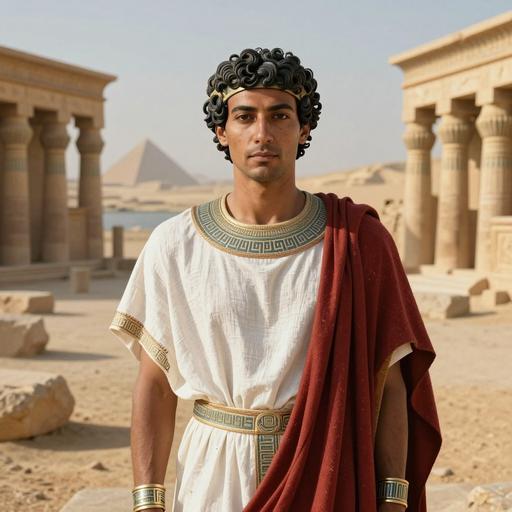
JK2888 - A man buried in Egypt in the Iron Age era

Download PDF creates a visual, rasterized copy. Use Print for selectable text and better assistive-technology support.

Menu
Currency
Main
Store
Blog

Loading Report

Preparing your ancestry journey

Connecting to ancient matches...

Preparing your report

Skip to main content
Portrait reconstruction of A man buried in Egypt in the Iron Age era
Ancient Individual

A man buried in Egypt in the Iron Age era

A man buried in Egypt during the The Ptolemaic Dynasty

A fragment of the ancient world, preserved across millennia in strands of DNA.

JK2888
151 BCE - 23 BCE
Male
Egypt
Scroll to begin
Chapter I

Identity

The biological and cultural markers that define this ancient individual

Sample ID

JK2888

Date Range

151 BCE - 23 BCE

Cultural Period

The Ptolemaic Dynasty

Biological Sex

Male

mtDNA Haplogroup

U6a2-a*

Y-DNA Haplogroup

E-V22

Social Role

Farmer (AI estimate, era-typical)

Chapter II

Place

Where this individual was discovered

Country Egypt
Locality Abusir-el Meleq
Coordinates 29.9000, 31.2000
Chapter III

Time

When this individual lived in the broader context of human history

JK2888 151 BCE - 23 BCE
Chapter IV

Story

The narrative of this ancient life

The Ptolemaic Dynasty was the Macedonian-ruled dynasty that controlled Egypt after the death of Alexander the Great’s successor systems, continuing until Egypt became part of the Roman world.

Region & Environment

Egypt’s Ptolemaic economy continued to depend on the Nile’s predictable seasonal flooding and the extensive irrigation required to farm the Valley and Delta. Water management and canal networks supported grain production, while the deserts and Red Sea routes influenced travel and resource extraction. Major urban centers and temple complexes were distributed in ways that reflected both agricultural geography and trade access.

Historical Context

From 305 to 30 BCE, the dynasty developed governance structures that drew on Hellenistic traditions while managing a deeply rooted Egyptian institutional landscape. Royal power was expressed through architecture, monumental art, and religious patronage, and administration relied on bureaucratic processes that integrated local realities.

The dynasty’s end came with Roman conquest, after which the Roman government inherited many existing infrastructures and land-management systems.

Chapter V

Genetics

These comparisons show genetic similarity, not identity or origin. The populations listed are those whose genomes show statistical alignment to this ancient individual.

Similarity reflects shared history, not shared identity. These are analytical comparisons, not claims about who this person was.

Modern Genetic Admixture

This analysis compares the DNA profile with present-day reference populations, showing statistical similarity to modern reference populations from different regions. The excavation site records where this individual was found, not a fixed modern genetic identity.

Asia 68.0%
Arab, Egyptian & Levantine 47.0%
Arabian 24.4%
Levantine 22.6%
Northern West Asian 21.0%
Mesopotamian 21.0%
Africa 24.7%
North African 17.9%
North African 14.5%
Egyptian 3.5%
Northern East African 6.7%
Ethiopian 6.7%
Europe 7.3%
Southern European 7.3%
Iberian 4.5%
Sardinian 2.8%

Closest Modern Populations

These are the modern populations showing the closest statistical alignment to A man buried in Egypt in the Iron Age era, ranked by genetic distance. Lower distance values indicate closer statistical similarity. Cross-region similarity can reflect shared ancestry, population movement, continuity, or later admixture.

1
Yemenite Ma'rib
3.8551
2
Yemenite Jew
4.0223
3
Yemenite Dhamar
4.1518
4
Yemenite Al Bayda
4.1713
5
Yemenite Al Jawf
4.2351
6
Yemenite Amran
4.3459
7
Saudia
4.6962
8
Saudib
5.0632
9
Bedouinb
5.0829
10
Yemenite Mahra
5.2420
Context

Related Samples

This individual exists within a broader network of ancient samples. No ancient genome stands alone.

Sample ID Culture/Period Date Location Action
JK2134 Third Intermediate Period in Egypt 787 BCE Abusir-el Meleq, Egypt View
JK2911 Third Intermediate Period in Egypt 779 BCE Abusir-el Meleq, Egypt View
JK2888 The Ptolemaic Dynasty 151 BCE Abusir-el Meleq, Egypt View
Sample ID Culture/Period Date Location Action
JK2888 The Ptolemaic Dynasty 151 BCE Abusir-el Meleq, Egypt View
Sources

References

Scientific publications and genetic data that inform this profile.

Scientific Publication

Ancient Egyptian mummy genomes suggest an increase of Sub-Saharan African ancestry in post-Roman periods

Authors Schuenemann VJ, Peltzer A, Welte B, van Pelt WP, Molak M et al.
Abstract

Egypt, located on the isthmus of Africa, is an ideal region to study historical population dynamics due to its geographic location and documented interactions with ancient civilizations in Africa, Asia and Europe. Particularly, in the first millennium BCE Egypt endured foreign domination leading to growing numbers of foreigners living within its borders possibly contributing genetically to the local population. Here we present 90 mitochondrial genomes as well as genome-wide data sets from three individuals obtained from Egyptian mummies. The samples recovered from Middle Egypt span around 1,300 years of ancient Egyptian history from the New Kingdom to the Roman Period. Our analyses reveal that ancient Egyptians shared more ancestry with Near Easterners than present-day Egyptians, who received additional sub-Saharan admixture in more recent times. This analysis establishes ancient Egyptian mummies as a genetic source to study ancient human history and offers the perspective of deciphering Egypt's past at a genome-wide level.

G25 Coordinates

These coordinates represent a position in genetic space, a tool for comparison, not a conclusion. You can use these to perform custom admixture analysis in G25 Studio.

JK2888,0.05165,0.14549,-0.04277,-0.10597,0.00259,-0.05039,-0.0077,-0.00314,0.05732,0.00646,0.01093,-0.01763,0.04057,0.00119,-0.00216,0.01603,-0.02582,0.00427,0.00928,0.01482,0.01987,0.01907,-0.01291,-0.00609,-0.00502
Continue in G25 Studio
Use code for 35% off Expires Aug 15