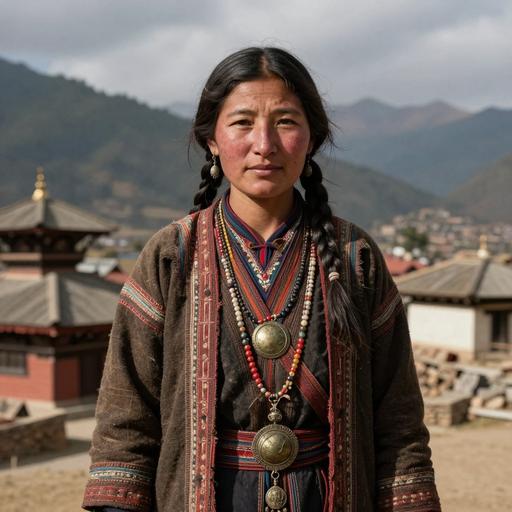
The Late Iron Age to Early Middle Kingdoms period in Mebrak, Mustang, Nepal, is a fascinating chapter in the region's history. This era represents a confluence of cultural, religious, and political developments, particularly influenced by Tibetan Buddhist traditions.
Geographical Context:
Mebrak is located in the Mustang district of Nepal, nestled in the rain shadow of the Himalayas, bordered by Tibet to the north. The region's rugged terrain, with its high-altitude deserts and deep river valleys, shaped its inhabitants' lifestyle and culture. This isolation allowed for the development of unique cultural and religious practices, although Mustang also acted as a corridor for trade and cultural exchange between the Indian subcontinent and Tibet.
Cultural and Religious Practices:
During this period, Tibetan Buddhism began to profoundly influence the region, merging with the existing Bon traditions to create a hybrid belief system. The dissemination of Buddhist teachings from Tibet brought new spiritual practices, art forms, and architectural styles. Monasteries and chortens (stupas) became prominent features across the landscape. These were not just religious centers but also places of learning and cultural preservation.
The art and iconography from this time reveal a strong Tibetan influence, characterized by intricate mandalas, thangkas (scroll paintings), and statues of Buddhist deities. Local artisans began incorporating these elements into their work, blending them with indigenous motifs and techniques, which can still be observed in the surviving relics and frescoes within the caves and monasteries.
Political Structure:
The political landscape of Mustang during this era was marked by the emergence of small kingdoms, where local chieftains or kings wielded significant power over their territories. These polities, often described as the Middle Kingdoms, were characterized by a feudal system where land and allegiance were exchanged for protection and governance. The rulers were typically patrons of the Buddhist monasteries, which further solidified the integration of Buddhism into the socio-political fabric of the region.
The interplay between religion and politics was complex; Buddhist monasteries often held considerable economic and political influence. These institutions acted as hubs for the dissemination of not only religious teachings but also technological and agricultural innovations, as monks and scholars traveled throughout the Tibetan plateau and beyond.
Economic Aspects:
Economic activity during this period was diverse. Mustang was a crucial link in trans-Himalayan trade routes, facilitating the exchange of salt, wool, grain, and other goods between Tibet, Nepal, and India. This trade enriched the local economies, leading to the growth of settlements and the establishment of vibrant market towns.
The local economy was also bolstered by agriculture and animal husbandry, with communities adapting ingenious farming techniques to make the most of the arid environment. Terrace farming allowed for the cultivation of barley, buckwheat, and other hardy crops. Yak and sheep rearing provided wool and meat, essential resources for survival in such a mountainous region.
Social Structure:
Social hierarchies were well-defined, with distinct roles based on class and occupation. At the top of the social pyramid were the royal families and nobility, followed by traders and landowners. Monks held a respected position due to their spiritual significance and educational roles. The common people, including farmers and herders, formed the backbone of society, supporting the more specialized roles above them.
Women in Mustang had a relatively significant degree of autonomy compared to other regions, often managing households and contributing to economic activities, particularly in trade and agriculture.
Legacy:
This era laid the foundation for the cultural and religious identity of Mustang, which remains vibrant to this day. The unique blend of Tibetan Buddhist and indigenous practices has persisted through the centuries, offering insight into the region’s historical evolution. Modern Mustang still celebrates its storied past with festivals, rituals, and a continued reverence for its monastic institutions, preserving the rich tapestry of traditions forged during the Late Iron Age to Early Middle Kingdoms period. The era stands as a testament to the resilience and adaptability of the Mustang people, enduring the challenges of their harsh environment while forging a distinct cultural identity.