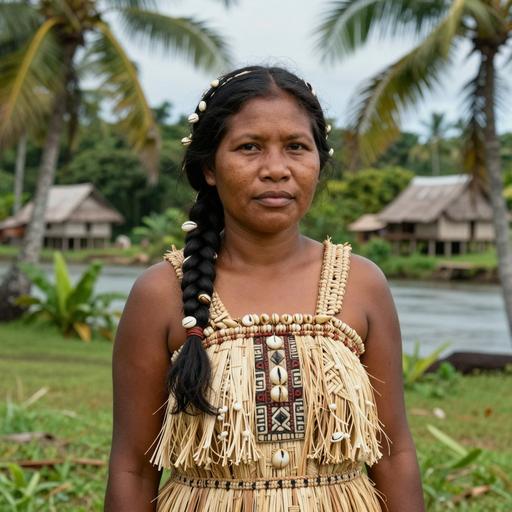
Around 2,700 years ago, the islands that comprise modern-day Vanuatu were inhabited by the Lapita people, ancestors of many contemporary Pacific Islander cultures. This era marked a significant phase in the Austronesian expansion across the Pacific, a period characterized by seafaring prowess, unique pottery designs, and complex societal structures.
Geography and Environment
Vanuatu, a Y-shaped archipelago in the South Pacific, was settled by these early Austronesians who navigated vast ocean distances in sophisticated outrigger canoes. The region's volcanic origin provided fertile land with rich soil, ideal for agriculture, and abundant marine resources. The islands’ varied topography, from rugged highlands to coral atolls, offered diverse ecological niches that influenced settlement patterns and subsistence strategies.
Culture and Society
Pottery and Material Culture
One of the most distinctive characteristics of the Lapita culture, which was flourishing around 700 BCE, was its pottery. The Lapita people are renowned for their intricately decorated ceramics, featuring geometric patterns and anthropomorphic motifs. These ceramics, made from clay and sand or crushed pottery shards, were crafted into various utilitarian forms such as bowls, cooking pots, and storage vessels.
Artifacts reveal a society that placed a high value on art and aesthetics, which also indicates a stratified society where artisans held a pivotal role. Pottery is a key archaeological marker for tracing the migration and exchange networks of the Lapita as they spread across the Pacific.
Subsistence and Economy
The economy of the Lapita people was primarily based on horticulture, supplemented by marine exploitation. They cultivated crops such as taro, yams, bananas, and breadfruit, employing shifting agriculture methods. Their diet was diversified with the hunting of native animals, fishing, and foraging of wild plants and fruits. The Lapita's sophisticated maritime skills allowed them to exploit a wide range of marine resources, using nets, spears, and lines.
Social Organization
The social structure of the Lapita people was likely organized into extended family groups or clans, with a hierarchy steered by chiefs or headmen. Village sites often consisted of clusters of stilt houses built along coastlines or riverbanks, reflecting their strong relationship with the sea. Social cohesion may have been reinforced through shared rituals, storytelling, and communal activities.
Beliefs and Rituals
Though direct evidence of religious practices is sparse, the Lapita people likely had a complex belief system revolving around ancestor worship and animism, as suggested by comparisons with modern Austronesian cultures. The storage and exchange of intricate pottery might have had ceremonial significance, and the ocean itself was possibly infused with spiritual importance, given its centrality to their way of life. Their navigational endeavors might have also been accompanied by spiritual rituals or offerings to the deities of the sea.
Technology and Innovation
Maritime technology was perhaps the most significant area of innovation. The Lapita people's outrigger canoes reveal advanced knowledge of wind patterns, ocean currents, and celestial navigation, allowing them to undertake long-distance voyages. Their ability to connect far-flung islands via sea routes facilitated a network of exchange that carried goods, ideas, and cultural practices across the Pacific.
In conclusion, Vanuatu 2,700 years ago was home to a society that was highly skilled in navigation, agriculture, and artistry. These early Austronesians, identified as the Lapita people, laid the foundation for subsequent Pacific cultures, leaving a legacy visible in the material culture and linguistic heritage that spans the Pacific Ocean to this day. Their adaptability and ingenuity in crafting a sustainable lifestyle in a diverse and challenging environment speak to the resilience and creativity of human cultures.