Menu
Store
Blog
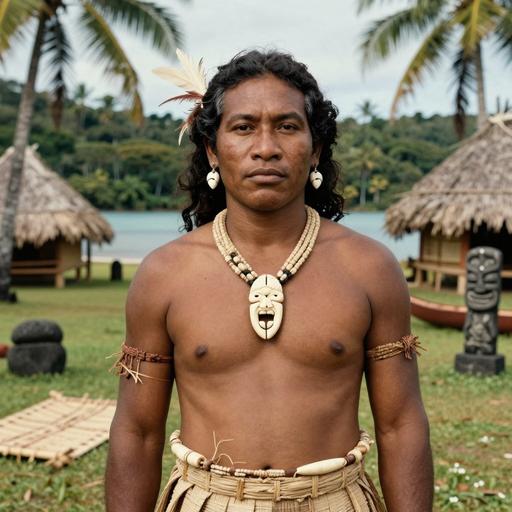
Portrait reconstruction of TAP002
Ancient Individual

A man buried in French Polynesia in the Modern era

TAP002
1657 CE - 1803 CE
Male
French Polynesia 200 Years Ago
French Polynesia
Scroll to begin
Chapter I

Identity

The biological and cultural markers that define this ancient individual

Sample ID

TAP002

Date Range

1657 CE - 1803 CE

Biological Sex

Male

mtDNA Haplogroup

B4a1a1m1

Y-DNA Haplogroup

C-M38

Cultural Period

French Polynesia 200 Years Ago

Chapter II

Place

Where this individual was discovered

Country French Polynesia
Locality French Polynesia. Ra'iatea
Chapter III

Time

When this individual lived in the broader context of human history

TAP002 1657 CE - 1803 CE
Chapter IV

Story

The narrative of this ancient life

Two hundred years ago, French Polynesia was a vibrant collection of islands in the central South Pacific, known for their rich cultural heritage and unique social structures. This period, circa the early 19th century, was a time of significant change and adaptation for the Polynesian societies inhabiting these islands, partly due to increasing European contact. The society and culture of this era can be understood through several key aspects:

  1. Social Structure and Governance: The society in early 19th-century French Polynesia was typically organized into hierarchical chiefdoms. Political power was centralized in the figure of an ariki, or high chief, who governed with the support of lesser chiefs or raatira. These chiefs held both political and religious authority, believed to be divinely sanctioned through their genealogy. Society was stratified, with clear distinctions between nobility, commoners, and sometimes slaves or war captives. Social mobility was restricted, but instances of merit-based elevation were possible through displays of bravery or skill.

  2. Economy and Subsistence: The economy in French Polynesia at the time was primarily based on subsistence agriculture, fishing, and the gathering of natural resources. The cultivation of crops like taro, yams, and breadfruit was common, often relying on sophisticated agricultural techniques such as terracing and irrigation. Coastal communities practiced fishing, using various traditional methods and tools such as nets, spears, and fish traps. The surplus from agriculture and fishing enabled the development of trade networks within and between islands.

  3. Cultural Practices and Beliefs: Polynesian culture was rich with oral traditions, music, dance, and elaborate art forms. Oral histories, known as ta'unga, were vital in passing down genealogies, myths, and knowledge. Dance and music were integral in social and religious life, serving both as entertainment and as expressions of spiritual beliefs. Traditional tattooing was a significant cultural practice, representing social status and cultural identity. Polynesian spirituality was animistic, with a pantheon of gods and spirits connected to natural elements and daily life, and their influence was sought through rituals and ceremonies.

  4. Architecture and Settlements: Architecture in this era was characterized by traditional Polynesian styles, utilizing locally available materials such as wood, pandanus leaves, and coconut fibers. The fare, or traditional house, was typically built on raised platforms and thatched with palm leaves. Villages were strategically located near resources and formed around communal spaces and spirit-based architectural structures like marae, which served as religious and ceremonial centers.

  5. European Contact and Changes: By the early 19th century, European explorers, missionaries, and traders had begun to visit French Polynesia more frequently, introducing new technologies, religious ideas, and goods. The arrival of missionaries had a profound impact, as many Polynesians converted to Christianity, leading to significant shifts in traditional religious practices and social norms. European contact also brought diseases to which indigenous populations had no immunity, causing demographic changes.

  6. Navigational Skills and Seafaring: Polynesians are renowned for their navigational prowess, and even 200 years ago, they utilized intricate knowledge of the stars, ocean currents, and bird flight patterns to travel between islands. This skill enabled them to sustain cultural exchanges and trade routes throughout the Pacific.

  7. Art and Craftsmanship: Artisanship flourished during this period, with traditional crafts such as wood carving, canoe building, and the creation of tapa (bark cloth) featuring prominently. These items were not only utilitarian but also held cultural significance, often decorated with symbolic patterns and motifs.

In summary, French Polynesia 200 years ago was a period of vibrant cultural expression, deep-rooted traditions, and burgeoning external influences, shaping a society that intricately balanced indigenous customs with new, incoming European elements. It was an era that laid much of the cultural foundation for modern French Polynesian identity.

Chapter V

Genetics

The genetic ancestry of this ancient individual

Ancient Genetic Admixture

This analysis compares the DNA profile of TAP002 with ancient reference populations, showing the genetic composition in terms of prehistoric ancestral groups.

Ancient Asians 78.9%
Ancient Oceanians 17.7%
Western Steppe Pastoralists 3.4%

Modern Genetic Admixture

This analysis compares the DNA profile with present-day reference populations, showing what percentage of genetic makeup resembles modern populations from different regions.

Asia 65.6%
Chinese & Southeast Asian 63.5%
Chinese 40.8%
Vietnamese 17.0%
Indonesian Khmer Thai Myanma 5.7%
Northern West Asian 1.1%
Mesopotamian 1.1%
Central Asian, Northern Indian & Pakistani 0.9%
Central Asian 0.9%
Oceania 17.2%
Melanesian 17.2%
Papuan 17.2%
Africa 11.0%
North African 7.8%
Egyptian 7.8%
West African 2.0%
Ghanaian, Liberian, Sierra Leonean 2.0%
Northern East African 1.1%
Ethiopian 1.1%
Europe 3.4%
Northwestern European 3.4%
Finnish 3.4%
America 2.9%
America 2.9%
Native American 2.9%

Closest Modern Populations

These are the modern populations showing the closest statistical alignment to A man buried in French Polynesia in the Modern era, ranked by genetic distance. Lower distance values indicate closer statistical similarity.

1
Thai
9.7241
2
Mon
10.0260
3
Aeta
10.0746
4
Batak
10.3292
5
Bajo
10.5480
6
Agta
11.1052
7
Burmese
11.7558
8
Maniq
11.7685
9
Malay
11.7689
10
Jamatia
11.9197
Chapter VI

Context

Other ancient individuals connected to this sample

Sources

References

Scientific publications and genetic data

Scientific Publication

Language continuity despite population replacement in Remote Oceania

Authors Posth C, Nägele K, Colleran H
Abstract

Recent genomic analyses show that the earliest peoples reaching Remote Oceania-associated with Austronesian-speaking Lapita culture-were almost completely East Asian, without detectable Papuan ancestry. However, Papuan-related genetic ancestry is found across present-day Pacific populations, indicating that peoples from Near Oceania have played a significant, but largely unknown, ancestral role. Here, new genome-wide data from 19 ancient South Pacific individuals provide direct evidence of a so-far undescribed Papuan expansion into Remote Oceania starting ~2,500 yr BP, far earlier than previously estimated and supporting a model from historical linguistics. New genome-wide data from 27 contemporary ni-Vanuatu demonstrate a subsequent and almost complete replacement of Lapita-Austronesian by Near Oceanian ancestry. Despite this massive demographic change, incoming Papuan languages did not replace Austronesian languages. Population replacement with language continuity is extremely rare-if not unprecedented-in human history. Our analyses show that rather than one large-scale event, the process was incremental and complex, with repeated migrations and sex-biased admixture with peoples from the Bismarck Archipelago.

G25 Coordinates

The G25 coordinates for sample TAP002 can be used for detailed admixture analysis in our G25 Studio tool.

TAP002,0.0067538,-0.3214985,-0.06386234,-0.00412852,0.11099078,-0.0151829,-0.00203736,-0.00149906,-0.01658638,-0.00971284,0.00795614,0.00112074,0.0038464,-0.0069147,0.00382268,0.00217692,0.0035092,-0.00289578,-0.00113652,-0.00804334,0.00926564,0.00858514,0.010457,0.00526834,0.00531701
Analyze in G25 Studio
Use code for 40% off Expires Feb 27