PC537 - A woman buried in Bahamas in the Pre-Columbian Caribbean era

Download PDF creates a visual, rasterized copy. Use Print for selectable text and better assistive-technology support.

Loading Report

Preparing your ancestry journey

Connecting to ancient matches...

Preparing your report

Skip to main content
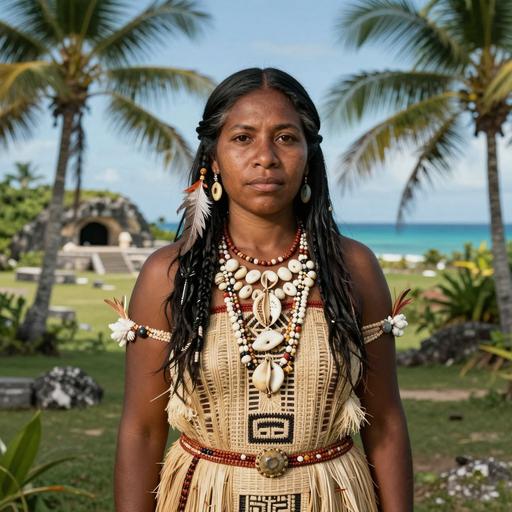
Portrait reconstruction of A woman buried in Bahamas in the Pre-Columbian Caribbean era
Ancient Individual

A woman buried in Bahamas in the Pre-Columbian Caribbean era

A woman buried in Bahamas during the Taino Culture, Bahamas

A fragment of the ancient world, preserved across millennia in strands of DNA.

PC537
892 CE - 1022 CE
Female
Bahamas
Scroll to begin
Chapter I

Identity

The biological and cultural markers that define this ancient individual

Sample ID

PC537

Date Range

892 CE - 1022 CE

Cultural Period

Taino Culture, Bahamas

Biological Sex

Female

mtDNA Haplogroup

B2

Y-DNA Haplogroup

N/A (Female)

Social Role

Gatherer (AI estimate, era-typical)

Chapter II

Place

Where this individual was discovered

Country Bahamas
Locality Eleuthera. Preacher's Cave
Chapter III

Time

When this individual lived in the broader context of human history

PC537 892 CE - 1022 CE
Chapter IV

Story

The narrative of this ancient life

Region & Environment

The Bahamas are low-lying islands in the Atlantic with warm, tropical climates and abundant marine resources. Limestone geology and shallow coastal zones shaped available building materials and the location of settlements near fresh water sources and productive fishing grounds. Environmental conditions encouraged a mixed economy combining cultivation with sea-based foraging.

Historical Context

From roughly 1200 to 1500 CE, Caribbean societies in the region developed within networks of craft and seafaring exchange. The label “Lucayan-Taino” is used to describe relationships among island populations across the northern Caribbean, though local histories varied by island and community. Archaeological evidence indicates flourishing ceramic-using lifeways prior to the major disruptions of the late 15th century.

Populations & Lifeways

Populations associated with this horizon were Indigenous, with lifeways centered on horticulture and fishing, supplemented by hunting and gathering. Community organization likely included villages with shared access to cultivated plots and coastal food sources. Household-level production—such as pottery making and food processing—would have been integral to daily routines.

Archaeology & Material Culture

The “Caribbean Ceramic” horizon is characterized by distinctive pottery traditions that can be recognized through vessel forms, decorative styles, and manufacturing techniques. Shell and bone artifacts, stone tools, and fishing-related items contribute additional evidence for subsistence strategies. Deposits such as midden accumulations help reconstruct food consumption and site use.

Culture & Society

Cultural identity in this period is visible in the shared technological traditions of ceramic production and in recurrent patterns of domestic activity. Pottery styles can signal community connections and shared aesthetic choices, while variations may reflect local preferences. Religious or political structures cannot be securely detailed from ceramics alone, but material patterns support the presence of enduring social communities on the islands.

Legacy & Transition

The 1200–1500 CE horizon documents Indigenous Caribbean life during the centuries immediately preceding European-led contact and its far-reaching impacts. Archaeological sequences in the Bahamas provide a foundation for understanding what changed after the late 15th century and how earlier traditions relate to later historical transformations. This era’s material record remains central for reconstructing pre-contact island society.

Chapter V

Genetics

These comparisons show genetic similarity, not identity or origin. The populations listed are those whose genomes show statistical alignment to this ancient individual.

Similarity reflects shared history, not shared identity. These are analytical comparisons, not claims about who this person was.

Modern Genetic Admixture

This analysis compares the DNA profile with present-day reference populations, showing statistical similarity to modern reference populations from different regions. The excavation site records where this individual was found, not a fixed modern genetic identity.

America 94.1%
America 94.1%
Native American 94.1%
Asia 5.3%
Japanese & Korean 3.7%
Japanese 3.7%
Northern Asian 1.6%
Siberian 0.8%
Mongolian 0.8%

Closest Modern Populations

These are the modern populations showing the closest statistical alignment to A woman buried in Bahamas in the Pre-Columbian Caribbean era, ranked by genetic distance. Lower distance values indicate closer statistical similarity. Cross-region similarity can reflect shared ancestry, population movement, continuity, or later admixture.
1
Piapoco
1.7895
2
Aymara
2.0174
3
Wichi
2.1813
4
Yukpa
2.2541
5
Bolivian Lapaz
3.0137
6
Karitiana
3.3678
7
Colla
3.4786
8
Cachi
4.0095
9
Mixe
4.3047
10
Surui
4.4339
Context

Related Samples

This individual exists within a broader network of ancient samples. No ancient genome stands alone.

Sample ID Culture/Period Date Location Action
PC537 Taino Culture, Bahamas 892 CE Eleuthera. Preacher's Cave, Bahamas View
PC537 892 CE Eleuthera. Preacher's Cave, Bahamas View
Sample ID Culture/Period Date Location Action
PC537 Taino Culture, Bahamas 892 CE Eleuthera. Preacher's Cave, Bahamas View
Sources

References

Scientific publications and genetic data that inform this profile.

Scientific Publication

Origins and genetic legacies of the Caribbean Taino

Authors Schroeder H, Sikora M, Gopalakrishnan S, Cassidy LM, Maisano Delser P et al.
Abstract

The Caribbean was one of the last parts of the Americas to be settled by humans, but how and when the islands were first occupied remains a matter of debate. Ancient DNA can help answering these questions, but the work has been hampered by poor DNA preservation. We report the genome sequence of a 1,000-year-old Lucayan Taino individual recovered from the site of Preacher's Cave in the Bahamas. We sequenced her genome to 12.4-fold coverage and show that she is genetically most closely related to present-day Arawakan speakers from northern South America, suggesting that the ancestors of the Lucayans originated there. Further, we find no evidence for recent inbreeding or isolation in the ancient genome, suggesting that the Lucayans had a relatively large effective population size. Finally, we show that the native American components in some present-day Caribbean genomes are closely related to the ancient Taino, demonstrating an element of continuity between precontact populations and present-day Latino populations in the Caribbean.

G25 Coordinates

These coordinates represent a position in genetic space, a tool for comparison, not a conclusion. You can use these to perform custom admixture analysis in G25 Studio.

PC537,0.0564329,-0.31621012,0.11163654,0.10123862,-0.1149615,-0.01166034,-0.30463158,-0.35845388,-0.0150917,-0.01695474,0.00081466,-0.00065794,-0.00129092,0.0256594,-0.0056706,8.734E-05,0.00611376,0.00341166,0.00069566,-0.0019167,-0.00124156,0.00804416,-0.00292418,-0.00485254,-0.00551733
Continue in G25 Studio
Use code for 35% off Expires Aug 21