TDA002 - A man buried in Brazil in the Archaic era

Download PDF creates a visual, rasterized copy. Use Print for selectable text and better assistive-technology support.

Menu
Currency
Main
Store
Blog

Loading Report

Preparing your ancestry journey

Connecting to ancient matches...

Preparing your report

Skip to main content
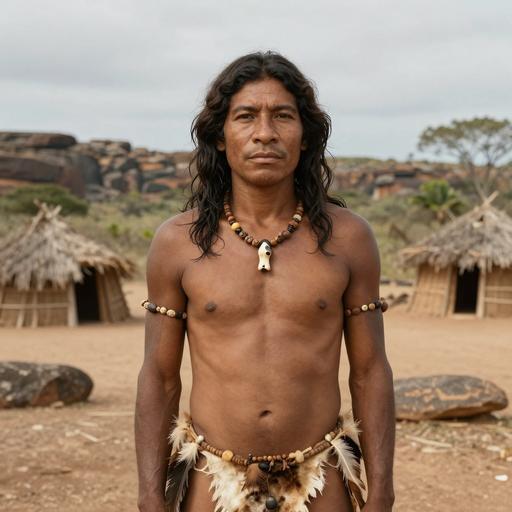
Portrait reconstruction of A man buried in Brazil in the Archaic era
Ancient Individual

A man buried in Brazil in the Archaic era

A man buried in Brazil during the Brazilian Archaic Lagoa de Encantada Hunter-Gatherer

A fragment of the ancient world, preserved across millennia in strands of DNA.

TDA002
2900 BCE - 2450 BCE
Male
Brazil
Scroll to begin
Chapter I

Identity

The biological and cultural markers that define this ancient individual

Sample ID

TDA002

Date Range

2900 BCE - 2450 BCE

Cultural Period

Brazilian Archaic Lagoa de Encantada Hunter-Gatherer

Biological Sex

Male

mtDNA Haplogroup

C1b

Y-DNA Haplogroup

Q-M3

Social Role

Hunter (AI estimate, era-typical)

Chapter II

Place

Where this individual was discovered

Country Brazil
Locality Pedra do Alexandre (Rio Grande du Norde, Carnauba dos Dantas)
Chapter III

Time

When this individual lived in the broader context of human history

TDA002 2900 BCE - 2450 BCE
Chapter IV

Story

The narrative of this ancient life

Overview

“Lagoa de Encantada” refers to a Brazilian Archaic hunter-gatherer tradition dated here to the middle Holocene. It is framed as pre-ceramic, with cultural identity expressed through patterns in settlement and lithic technologies rather than pottery.

Region & Environment

This era pertains to Brazil’s diverse interior and coastal-influenced environments, where wetlands, lakes, and forest edges created varied foraging opportunities. Such landscapes could offer seasonal concentrations of resources, enabling mobile groups to plan travel and harvesting around ecological rhythms.

Historical Context

During 8000–4000 BCE, hunter-gatherer populations adapted to post-glacial and Holocene environmental change. The archaeological record for this time window is often dominated by traces of short- to medium-term occupations, reflecting flexible use of resources rather than permanent agricultural settlement.

Populations & Lifeways

Lagoa de Encantada populations are generally understood as hunter-gatherers relying on locally available plant and animal foods. Their lifeways likely included mobility between resource zones, with repeated visits to particular places when conditions were favorable.

Archaeology & Material Culture

Because this is a pre-ceramic horizon in the dataset, the material record is expected to be dominated by lithic artifacts and ecofactual evidence (where preserved). Stone tool styles and production choices can indicate task organization—such as cutting, scraping, and processing—while site deposits (including possible hearths or refuse areas) reflect how foods were prepared.

Culture & Society

Archaic foraging societies likely maintained social networks that supported the exchange of materials and shared technological knowledge. The recurrence of particular lithic practices within a region—how tools are made and used—can serve as a proxy for community identity and learning.

Legacy & Transition

This pre-ceramic Archaic phase provides a baseline for understanding later developments in Brazilian prehistory, including the emergence of more place-intensive coastal adaptations and, eventually, broader changes in subsistence and technology. Transitions are visible archaeologically as shifting patterns in site use and artifact composition across subsequent millennia.

Chapter V

Genetics

These comparisons show genetic similarity, not identity or origin. The populations listed are those whose genomes show statistical alignment to this ancient individual.

Similarity reflects shared history, not shared identity. These are analytical comparisons, not claims about who this person was.

Modern Genetic Admixture

This analysis compares the DNA profile with present-day reference populations, showing statistical similarity to modern reference populations from different regions. The excavation site records where this individual was found, not a fixed modern genetic identity.

America 93.9%
America 93.9%
Native American 93.9%
Asia 4.7%
Northern Asian 3.8%
Siberian 2.6%
Mongolian 1.2%
Chinese & Southeast Asian 0.9%
Vietnamese 0.9%
Oceania 1.0%
Melanesian 1.0%
Papuan 1.0%
Context

Related Samples

This individual exists within a broader network of ancient samples. No ancient genome stands alone.

Sample ID Culture/Period Date Location Action
CAP007 Lagoa Santa Culture 8547 BCE Capelinha (Southeast Coast), Brazil View
CBE003 Sambaqui Culture of Cabeçuda 1685 BCE Cabeçuda (South Coast) , Brazil View
CBE004 Sambaqui Culture of Cabeçuda 1386 BCE Cabeçuda (South Coast) , Brazil View
CUB002 Sambaqui Culture of Cubatão 756 BCE Cubatão I (South Coast), Brazil View
CUB008 Sambaqui Culture of Cubatão 807 BCE Cubatão I (South Coast), Brazil View
EPS001 Sambaqui Culture of Limão 1442 CE Sambaqui do Limão (Southeast Coast), Brazil View
EPS002 Sambaqui Culture of Limão 811 BCE Sambaqui do Limão (Southeast Coast), Brazil View
EPS003 Sambaqui Culture of Limão 36 BCE Sambaqui do Limão (Southeast Coast), Brazil View
EPS004 Sambaqui Culture of Limão 76 CE Sambaqui do Limão (Southeast Coast), Brazil View
EPS005 Sambaqui Culture of Limão 50 BCE Sambaqui do Limão (Southeast Coast), Brazil View
EPS011 Sambaqui Culture of Limão 850 BCE Sambaqui do Limão (Southeast Coast), Brazil View
GA4002 Sambaqui Culture of Galheta IV 644 CE Galheta IV (South Coast), Brazil View
JBT001 Sambaqui Culture of Jabuticabeira II 720 BCE Jabuticabeira II (South Coast), Brazil View
JBT002 Sambaqui Culture of Jabuticabeira II 721 BCE Jabuticabeira II (South Coast), Brazil View
JBT009 Sambaqui Culture of Jabuticabeira II 455 BCE Jabuticabeira II (South Coast), Brazil View
JBT010 Sambaqui Culture of Jabuticabeira II 742 BCE Jabuticabeira II (South Coast), Brazil View
JBT011 Sambaqui Culture of Jabuticabeira II 700 BCE Jabuticabeira II (South Coast), Brazil View
JBT012 Sambaqui Culture of Jabuticabeira II 410 BCE Jabuticabeira II (South Coast), Brazil View
JBT013 Sambaqui Culture of Jabuticabeira II 723 BCE Jabuticabeira II (South Coast), Brazil View
JBT014 Sambaqui Culture of Jabuticabeira II 184 BCE Jabuticabeira II (South Coast), Brazil View
JBT015 Sambaqui Culture of Jabuticabeira II 364 BCE Jabuticabeira II (South Coast), Brazil View
JBT018 Sambaqui Culture of Jabuticabeira II 541 BCE Jabuticabeira II (South Coast), Brazil View
JBT019 Sambaqui Culture of Jabuticabeira II 553 CE Jabuticabeira II (South Coast), Brazil View
JBT020 Sambaqui Culture of Jabuticabeira II 403 BCE Jabuticabeira II (South Coast), Brazil View
JBT021 Sambaqui Culture of Jabuticabeira II 400 BCE Jabuticabeira II (South Coast), Brazil View
JBT022 Sambaqui Culture of Jabuticabeira II 700 BCE Jabuticabeira II (South Coast), Brazil View
JBT023 Sambaqui Culture of Jabuticabeira II 700 BCE Jabuticabeira II (South Coast), Brazil View
JBT025 Sambaqui Culture of Jabuticabeira II 719 BCE Jabuticabeira II (South Coast), Brazil View
JBT026 Sambaqui Culture of Jabuticabeira II 395 BCE Jabuticabeira II (South Coast), Brazil View
PAI001 Sambaqui Culture 7315 BCE Central, Loca do Suin, Brazil View
PLM001 Sambaqui Culture 1426 CE Palmeiras-Xingu (Southeast Amazonia), Brazil View
SAM014 Kaingang Burial Culture of Sambaqui 1699 CE Kaingang (Southeast Coast), Brazil View
TDA002 Brazilian Archaic Lagoa de Encantada Hunter-Gatherer 2900 BCE Pedra do Alexandre (Rio Grande du Norde, Carnauba dos Dantas), Brazil View
VSM001 Sambaqui Culture of Vau-Una 1318 CE Northeast, Vau - Sta.M.Vitória, Brazil View
Sample ID Culture/Period Date Location Action
TDA002 Brazilian Archaic Lagoa de Encantada Hunter-Gatherer 2900 BCE Pedra do Alexandre (Rio Grande du Norde, Carnauba dos Dantas), Brazil View
Sources

References

Scientific publications and genetic data that inform this profile.

Scientific Publication

Genomic history of coastal societies from eastern South America

Authors Ferraz T, Suarez Villagran X, Nägele K, Radzevičiūtė R, Barbosa Lemes R et al.
Abstract

Sambaqui (shellmound) societies are among the most intriguing archaeological phenomena in pre-colonial South America, extending from approximately 8,000 to 1,000 years before present (yr BP) across 3,000 km on the Atlantic coast. However, little is known about their connection to early Holocene hunter-gatherers, how this may have contributed to different historical pathways and the processes through which late Holocene ceramists came to rule the coast shortly before European contact. To contribute to our understanding of the population history of indigenous societies on the eastern coast of South America, we produced genome-wide data from 34 ancient individuals as early as 10,000 yr BP from four different regions in Brazil. Early Holocene hunter-gatherers were found to lack shared genetic drift among themselves and with later populations from eastern South America, suggesting that they derived from a common radiation and did not contribute substantially to later coastal groups. Our analyses show genetic heterogeneity among contemporaneous Sambaqui groups from the southeastern and southern Brazilian coast, contrary to the similarity expressed in the archaeological record. The complex history of intercultural contact between inland horticulturists and coastal populations becomes genetically evident during the final horizon of Sambaqui societies, from around 2,200 yr BP, corroborating evidence of cultural change.

G25 Coordinates

These coordinates represent a position in genetic space, a tool for comparison, not a conclusion. You can use these to perform custom admixture analysis in G25 Studio.

TDA002,0.05267084,-0.31501396,0.10999538,0.10135336,-0.10980258,-0.0130968,-0.29944816,-0.35376424,-0.01337994,-0.01848032,0.00020816,-0.0013608,-0.00231948,0.02528958,-0.00618204,0.00056756,0.0053399,0.00196108,0.00236056,-0.00195952,-0.00063206,0.00670522,-0.00217406,-0.0060682,-0.00776291
Continue in G25 Studio
Use code for 30% off Expires Aug 17