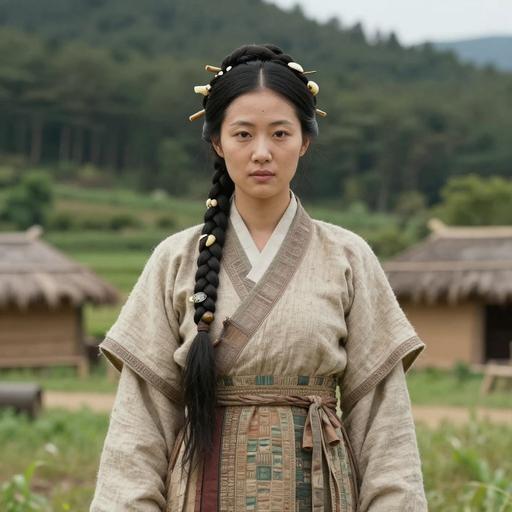
The Bronze Age in Korea, also referred to as the \Korea Bronze Age," spanned roughly from the around 1000 BCE to 300 BCE. This era marked significant advancements in technology, social organization, and cultural developments across the Korean Peninsula and parts of Manchuria, laying foundational elements for later periods.
Socio-political Structure
During the Korean Bronze Age, society began to show more complex levels of organization. Communities were typically agrarian, with evidence of rice cultivation becoming increasingly dominant, a vital contribution to social stability and growth. Villages started to evolve into larger settlements with distinct social hierarchies. The elite class likely controlled bronze production and distribution, which was crucial for maintaining power and influence. These leaders possibly functioned as war leaders, religious figures, or both, reflecting a system where authority was often military and spiritual.
Technological Advancements
The arrival and spread of bronze technology represented a transformative phase for Korea. Bronze, an alloy of copper and tin, was primarily used for tools, weapons, and ritual items, such as mirrors and bells. The metal's use helped improve agricultural productivity due to the superior tools available compared to those made solely from stone. These advancements undoubtedly played a role in the increased stability and growth of Bronze Age Korean societies.
Pottery and Material Culture
Bronze Age pottery in Korea is distinguished by its sophistication and variety. This period saw the transition from Neolithic-style comb-patterned pottery to more refined, wheel-thrown pieces. Many items were ornately decorated, suggesting they were not only utilitarian but also served ceremonial purposes or demonstrated personal status.
Bronze items themselves became significant cultural artifacts. Many bronze artifacts discovered in Korea include daggers, mirrors, and bells, showcasing a blend of functionality and artistry. The intricate designs on these items may hold symbolic meanings related to power, cosmology, or spiritual life.
Trade and Interaction
During this era, Korea was not an isolated culture; there was continuous interaction with neighboring regions, particularly China and Japan. The Korean Peninsula served as a corridor for the transfer of goods, ideas, technologies, and even people. This interaction is evidenced by similarities in material culture, such as bronze artifacts and pottery styles, found in Korea, the Chinese Liaoning region, and the Japanese archipelago.
Trade likely facilitated the spread of bronze technology and other cultural influences. Moreover, the influx of new ideas through trade and interaction might have spurred local innovations and adaptations, which defined the distinct character of Korean Bronze Age culture.
Religious and Ritual Practices
Religious beliefs during the Bronze Age in Korea were likely animistic, with a pantheon of spirits associated with natural elements such as mountains, rivers, and trees. Rituals may have played a significant role in community life, underpinning social cohesion and the authority of leaders. Evidence suggests that ritualistic items like bronze daggers and mirrors were used in ceremonies that possibly aimed to ensure agricultural fertility, protection against natural calamities, or the community’s well-being.
Burial Practices
Burial practices offer profound insights into the sociocultural dynamics of Bronze Age Korea. Reflecting the era’s social stratification, tombs ranged from simple pit burials to more elaborate dolmens. These monumental stone structures, prevalent in Korea, served as burial sites for elites and are often associated with grave goods, including bronze artifacts, pottery, and personal ornaments. Such findings indicate beliefs in an afterlife where social status persisted, emphasizing the importance of honoring ancestors and reinforcing societal hierarchies.
In summary, the Bronze Age in Korea was a period of vital transformation characterized by advancements in technology, the rise of more complex societal structures, and the enrichment of cultural practices. It set the stage for subsequent historical phases, profoundly impacting the trajectory of Korean civilization and its development."