Menu
Store
Blog
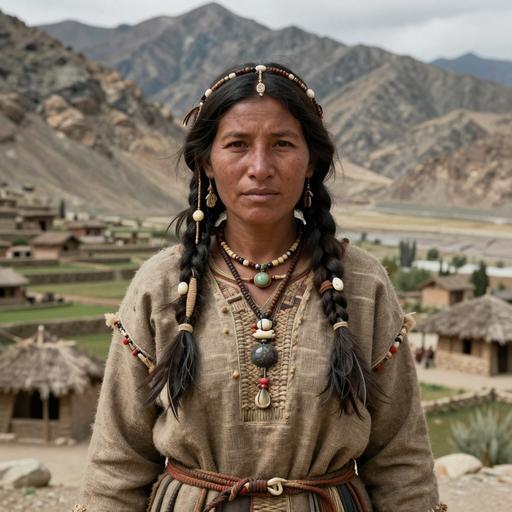
Portrait reconstruction of U1
Ancient Individual

A woman buried in Nepal in the Mesolithic era

U1
1550 BCE - 1325 BCE
Female
Late Chalcolithic Nepal
Nepal
Scroll to begin
Chapter I

Identity

The biological and cultural markers that define this ancient individual

Sample ID

U1

Date Range

1550 BCE - 1325 BCE

Biological Sex

Female

mtDNA Haplogroup

M9a1a1c1b1a

Cultural Period

Late Chalcolithic Nepal

Chapter II

Place

Where this individual was discovered

Country Nepal
Locality Mustang. Suila
Coordinates 29.0400, 83.9300
Chapter III

Time

When this individual lived in the broader context of human history

U1 1550 BCE - 1325 BCE
Chapter IV

Story

The narrative of this ancient life

The Late Chalcolithic period of Nepal, particularly focusing on the Mustang region and its connection to the Indus Valley Civilization, offers a fascinating insight into an era marked by significant cultural, technological, and social developments. This period approximately spans from 3300 BCE to 1300 BCE, and while it is predominantly associated with the Indian subcontinent, its influences reached numerous peripheral regions, including Nepal.

Geography and Environment

The Mustang region of Nepal, located within the trans-Himalayan area, presents a unique ecological zone characterized by its arid landscape, high-altitude plateaus, and proximity to significant river systems. During the Late Chalcolithic era, the environment would have been slightly more favorable compared to today, with climatic conditions supporting subsistence farming, hunting, and herding practices essential for early settlements.

Cultural Context

Connection to the Indus Valley Civilization

While the Indus Valley Civilization (IVC) is primarily centered around what is now Pakistan and northwest India, its cultural and trade influences reached neighboring regions, impacting areas such as Mustang. Artifacts and material culture from this period show similarities in pottery styles, urban planning concepts, and perhaps even administrative structures, suggesting interactions through trade or migration.

Local Culture

  1. Settlement Patterns:

    • The Mustang region likely contained small, scattered settlements predominantly located near water sources. These communities would have been semi-nomadic, combining agriculture with pastoralism.
    • Architectural evidence suggests the use of stone and mud-brick structures, with communal living spaces and basic fortifications for protection against the harsh environment and potential threats.
  2. Economy and Subsistence:

    • The inhabitants practiced a mixed economy involving agriculture (e.g., barley and millet cultivation) and pastoralism (e.g., sheep and goat rearing). This lifestyle was conducive to the region’s topography and climatic conditions.
    • Evidence of early barter systems suggests trade with neighboring regions to acquire resources not locally available, such as metals, beads, and luxury items.
  3. Technology:

    • The Chalcolithic era marked the transition from stone to metal tools. In Mustang, artifacts such as copper and bronze implements indicate an evolving tool-making industry that improved agriculture and craftsmanship.
    • Pottery from this period shows advancements in design and firing techniques, reflecting both local innovation and external influences.

Society and Religion

  1. Social Structure:

    • Society was likely organized around clan or tribal systems, with leadership roles possibly held by elders or chieftains. Social stratification may have been minimal, focusing more on communal cooperation.
    • Artifacts such as jewelry and ceremonial items suggest the presence of social rituals or status markers.
  2. Religion and Spirituality:

    • The religious practices of this period were likely animistic, with a focus on nature spirits, ancestors, and deities linked to natural phenomena. Sacred sites and rudimentary altars may have been common in communities.
    • Artifacts found in burial sites indicate beliefs in an afterlife, with goods placed alongside the deceased.

Artistic and Intellectual Developments

  1. Art and Craftsmanship:

    • The art of the Late Chalcolithic Mustang region incorporated both functional and decorative elements, evidenced by intricately designed pottery, metalwork, and stone carvings.
    • The aesthetic choices reflect a blend of local traditions and broader cultural exchanges with the Indus Valley and other neighboring civilizations.
  2. Intellectual Contributions:

    • The use of proto-writing or symbolism may have existed, although there is limited evidence to fully reconstruct communication methods. Simple pictographs or symbols used for trade or property markers are possible.

Decline and Legacy

The Late Chalcolithic period in Mustang and its peripheral connection to the Indus Valley Civilization represent a crucial developmental phase that laid foundational cultural aspects for subsequent eras. The decline of the Indus Valley Civilization around 1300 BCE coincides with transformative changes in regional trade networks and environmental shifts, prompting communities like those in Mustang to adapt or migrate.

The legacy of this era is observed in the continuing cultural exchanges across the Himalayan frontier and the diffusion of technological advancements and agricultural practices deeper into the South Asian subcontinent. Today, the region's archaeological sites offer invaluable insights into human adaptation and survival in challenging environments.

In conclusion, the Late Chalcolithic period in Mustang represents a fascinating interplay between local innovation and broader cultural influences from the Indus Valley, marking a significant chapter in the prehistoric era of Nepal.

Chapter V

Context

Other ancient individuals connected to this sample

Sources

References

Scientific publications and genetic data

Scientific Publication

Ancient genomes from the Himalayas illuminate the genetic history of Tibetans and their Tibeto-Burman speaking neighbors

Authors Liu CC, Witonsky D, Gosling A
Abstract

Present-day Tibetans have adapted both genetically and culturally to the high altitude environment of the Tibetan Plateau, but fundamental questions about their origins remain unanswered. Recent archaeological and genetic research suggests the presence of an early population on the Plateau within the past 40 thousand years, followed by the arrival of subsequent groups within the past 10 thousand years. Here, we obtain new genome-wide data for 33 ancient individuals from high elevation sites on the southern fringe of the Tibetan Plateau in Nepal, who we show are most closely related to present-day Tibetans. They derive most of their ancestry from groups related to Late Neolithic populations at the northeastern edge of the Tibetan Plateau but also harbor a minor genetic component from a distinct and deep Paleolithic Eurasian ancestry. In contrast to their Tibetan neighbors, present-day non-Tibetan Tibeto-Burman speakers living at mid-elevations along the southern and eastern margins of the Plateau form a genetic cline that reflects a distinct genetic history. Finally, a comparison between ancient and present-day highlanders confirms ongoing positive selection of high altitude adaptive alleles.

Use code for 35% off Expires Apr 19