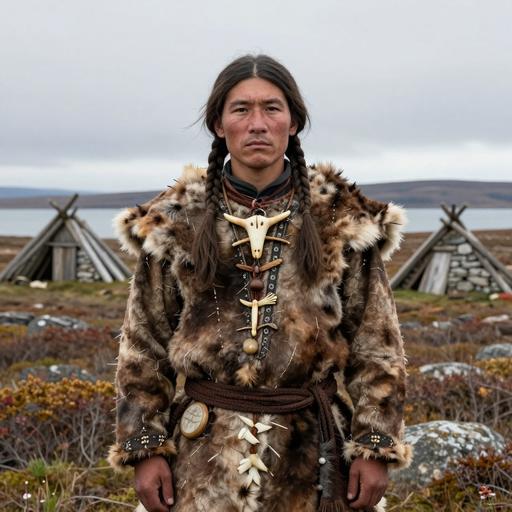
The Thule Culture is a significant and fascinating era in the anthropological and archaeological study of Arctic cultures, particularly in the regions that are now part of Northern Canada, Alaska, and Greenland. Originating around 1000 AD and thriving until approximately 1600 AD, the Thule Culture represents the ancestors of the modern Inuit. This culture is particularly noted for its adaptability and ingenuity in the harsh Arctic environment. Here's a detailed description of their lifestyle, technological advancements, social structures, and cultural practices:
Geographic Spread and Migration
The Thule people originated in western Alaska and gradually spread eastwards across the Canadian Arctic and into Greenland. This migration corresponds with a warming period that opened new territories for hunting and settlement, facilitating their movement across the Arctic landscape.
Subsistence and Economy
The Thule Culture is best characterized as a whaling society. The people were expert hunters who primarily relied on marine mammals, especially bowhead whales, for sustenance. They utilized large, open-skin boats called umiaks to hunt these whales. Seals, walrus, caribou, and fish also formed an essential part of their diet, supplemented by gathered resources such as berries and bird eggs.
Technological Advancements
Thule technology was highly adapted to their environment. They developed sophisticated tools and hunting equipment made from stone, bone, ivory, and driftwood. Harpoons with detachable heads, toggle technology, and sealskin floats exemplify their innovations in marine hunting. The Thule people also employed sleds pulled by teams of dogs, contributing to their mobility across the icy terrains.
Their dwellings were semi-subterranean structures, insulated with sod and snow to withstand the severe cold, featuring entry tunnels that retained heat. In the winter, they built igloos when traveling or hunting far from their permanent homes.
Social Structure and Organization
The Thule society was organized into small, family-based groups. These social units were often linked by kinship ties, which played a crucial role in resource sharing and group cohesion. Cooperation was essential, particularly in hunting large marine mammals, which required coordinated group efforts.
In terms of governance, leadership was largely based on consensus, and the influence of a leader depended on their skills, especially in hunting, and their ability to distribute resources fairly.
Artistic Expression and Beliefs
Art and symbolism were integral parts of Thule life, often intertwined with their spiritual beliefs. They crafted intricate carvings from ivory and bone, depicting animals, humans, and mythical figures, which held cultural and spiritual significance. These artifacts possibly served as amulets or storytelling tools, reflecting a deep connection to their environment and cosmology.
Their belief systems centered on animism, the idea that both living and non-living things possess spiritual essence. Shamanism played a role in guiding the community's spiritual practices, with shamans believed to communicate with the spirit world to ensure successful hunts and aid in healing.
Decline and Transition
The Thule Culture eventually transitioned into what is recognized today as the modern Inuit culture. This transition was influenced by climatic changes during the Little Ice Age (circa 1300-1850), which affected marine mammal populations and prompted shifts in settlement and hunting practices. Furthermore, contact with Europeans brought new challenges and opportunities that gradually transformed the Thule way of life.
Legacy
The legacy of the Thule Culture lives on in the traditions and cultural practices of the Inuit people. Their innovative adaptations to the Arctic environment continue to be celebrated and studied, offering valuable insights into human resilience and ingenuity.
Overall, the Thule Culture stands as a testament to human adaptation and survival skills in one of the planet's most forbidding climates, showcasing a harmonious interaction with the natural world and a rich cultural heritage that echoes through the Arctic regions to this day.