Introduction
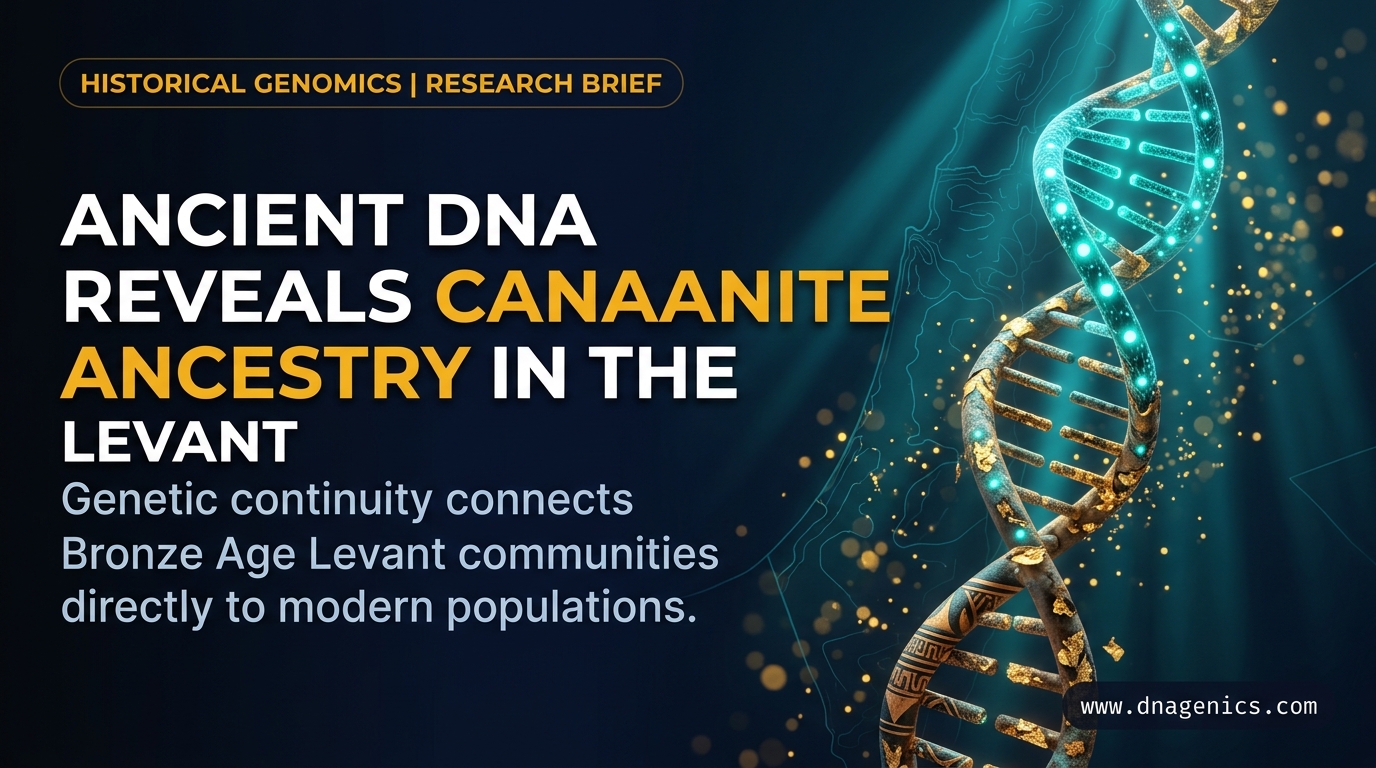
For a long time, the Canaanites were often described as a people who vanished from history. Ancient texts, later traditions, and dramatic conquest narratives helped create that impression. But DNA evidence now tells a much more complex story, one that connects Bronze Age communities of the southern Levant with many people living in the region today.
This matters because ancestry is not only about migration and replacement, it is also about continuity, mixture, and long-term survival. Ancient DNA from sites such as Sidon, Megiddo, and Baq'ah shows that the genetic legacy of the Bronze Age Levant remains deeply embedded in present-day populations. For anyone interested in DNA ancestry, haplogroups, migration history, or ancient DNA, the Canaanite story is a powerful example of how genetics can refine, and sometimes overturn, older historical narratives.
Key Discoveries / Main Points
- Ancient DNA continuity: Bronze and Iron Age individuals from the Levant share strong genetic links with modern Lebanese, Syrians, Palestinians, and Jordanians.
- Mixed origins: Canaanite genomes reflect a combination of local Levantine Neolithic ancestry and ancestry related to populations from the Zagros mountains and Caucasus.
- Population structure: Canaanite groups from different city-states were politically separate, but genetically very similar, suggesting a broadly shared population background.
- Modern ancestry patterns: In statistical models, much of the ancestry of present-day Levantine populations can be traced to Bronze Age Canaanite-related sources, often exceeding 80%.
- Enduring regional history: The findings support long-term demographic continuity in the Levant, even as languages, religions, and political powers changed over millennia.
What This Means for Your DNA
If you have family roots in the Levant, this research may help explain why ancestry tests often point to deep regional continuity rather than sharp boundaries between ancient peoples. In population genetics, the label “Canaanite” does not mean a single tribe or modern nation, it refers to a Bronze Age population profile sampled from ancient remains and compared statistically with later and present-day DNA. That means the result is about genetic affinity, not a direct label of identity.
For people from Lebanon, Syria, Palestine, Jordan, and neighboring regions, the practical takeaway is that many modern genomes still retain a large share of ancestry related to Bronze Age Levantine populations. This does not mean every person inherits the same story, and it does not erase later historical movements, such as Arab expansions, imperial-era admixture, or regional mobility. Instead, it shows that deep local ancestry remained strong enough to persist through centuries of change.
For DNA ancestry enthusiasts, this is a useful reminder that ancient DNA can reveal both continuity and mixture at the same time. A person may carry signals linked to later migrations and still be predominantly descended, in a statistical sense, from older regional populations. That is why ancestry DNA testing is most informative when it is combined with archaeology, history, and careful population-genetic interpretation.
Historical and Archaeological Context
The Canaanites were not one centralized kingdom, but a network of city-states across the Bronze Age Levant. Major centers such as Sidon, Megiddo, and other urban settlements traded with Egypt and Mesopotamia, shared cultural traits, and spoke related Semitic languages. Ancient diplomatic texts from the second millennium BC already recognized the region as Canaan, showing that the name was used long before later biblical traditions took shape.
Archaeologically, the Levant experienced major transitions across the Bronze and Iron Ages. Cities rose during the Early and Middle Bronze Ages, the Late Bronze Age collapse reshaped political life, and new groups and identities emerged in the centuries that followed. Yet the genetic data show that these cultural changes did not wipe out the underlying population base. Instead, the Canaanite-related ancestry found in ancient remains continued into the people of the Levant through later historical periods.
In Simple Terms: The people changed names, kingdoms, and religions over time, but many of their descendants stayed in the region. Ancient DNA shows that the Bronze Age population did not disappear, it became part of the ancestry of many modern Levantine groups.
The Science Behind It
This story comes from ancient DNA sequencing and statistical comparison of genomes from the Bronze and Iron Ages with those of present-day populations. Researchers analyzed 73 ancient genomes from several southern Levant sites, along with earlier genome data from Bronze Age Sidon. They then used population-genetic modeling, including tools such as coordinate-space analysis and mixture modeling, to estimate how these ancient individuals relate to one another and to later populations.
The key result is that the ancient Levantine samples cluster closely together genetically, despite coming from different city-states and time periods. Their ancestry can be modeled as a blend of local Neolithic Levantine farmers and an additional component related to populations farther east, broadly associated with the Zagros and Caucasus regions. In other words, Canaanite ancestry itself was already the product of older migration and mixture events.
When modern populations are compared with these ancient genomes, the statistical fit is strongest when a large portion of their ancestry is modeled as Canaanite-related. That does not mean modern people are unchanged from Bronze Age individuals, and it does not imply a one-to-one lineage. It does indicate that much of the deep ancestry in the region remained connected to the same ancient gene pool across thousands of years.
In Simple Terms: Scientists compare ancient and modern DNA like overlapping patterns. If a modern population shares a strong pattern with ancient Canaanite genomes, that means there is likely deep ancestral connection, even if later mixing also occurred.
Why It Matters
This research changes how we understand the relationship between history, identity, and population movement in the Levant. Instead of a story of total replacement, it supports a model of long-term continuity with layered admixture. That is a more realistic picture of human history, and it is one that ancient DNA is uniquely able to reveal.
It also shows why genetic ancestry research must be interpreted carefully. Labels such as Canaanite, Phoenician, Israelite, or Arab describe historical and cultural contexts, not simple genetic boxes. The future of population genetics will likely bring even finer resolution, with more ancient samples from the Levant and neighboring regions helping to separate local continuity from later migration events.
References / Further Reading
- Ancient genome studies of Bronze and Iron Age Levant populations
- Published ancient DNA analysis from Sidon and southern Levant sites
- Archaeological and historical research on Canaan, the Bronze Age Levant, and Levantine population history