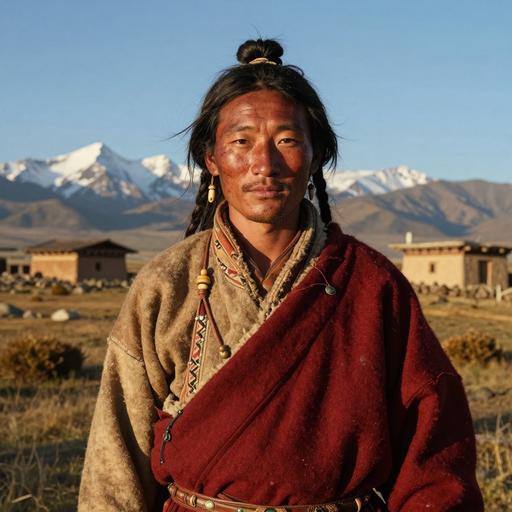
Genetic data from the 30 Pre_Tibetan individuals provide a window onto ancestry and population dynamics across the plateau. Y‑chromosome results are dominated by haplogroup O (16/21 male calls), a lineage common across East Asia and consistent with gene flow from lowland East Asian sources. Haplogroup D (4/21) appears as well and is notable because D is found at elevated frequencies in some Tibeto‑Burman speaking groups and among Himalayan highland populations; its presence here supports a long‑standing autochthonous highland component, though numbers are small. A single N lineage (1/21) hints at a minor northern or northeastern influence.
Mitochondrial diversity is primarily haplogroup M (7/12 female calls), an East Asian and broadly Asian maternal lineage, with additional mtDNA types A21 (2), D (2), F (1), and B (1). This maternal mix aligns with regional East Asian population structure and suggests both local continuity and periodic admixture.
Caveats: while 30 samples are informative, they are spread over nearly two millennia and multiple sites; temporal substructure can conceal shifts in ancestry. Low counts for specific lineages (e.g., D, N, several mtDNA types) mean conclusions about demographic processes and selection (including any genetic signals of high‑altitude adaptation) remain provisional. Integrating genome‑wide data, isotope studies, and expanded sampling will clarify migration pulses, sex‑biased admixture, and adaptation trajectories.