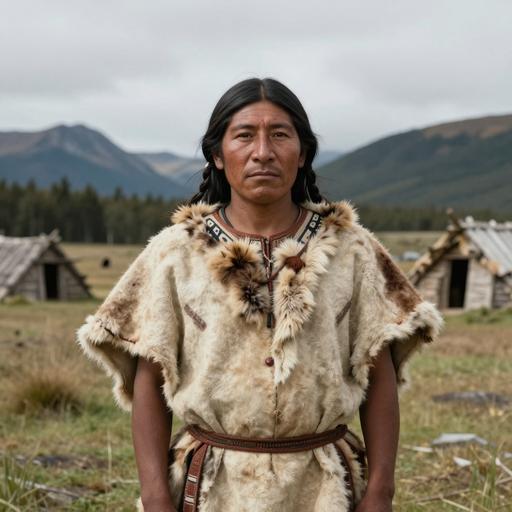
A man buried in Argentina in the Pre-Columbian South America era

Download PDF creates a visual, rasterized copy. Use Print for selectable text and better assistive-technology support.

Loading Report

Preparing your ancestry journey

Preparing the available report content...

Your report will open automatically.

Skip to main content
Reference library / Sample profile

A man buried in Argentina in the Pre-Columbian South America era

Explore the recorded context, genetic comparisons and research behind this reference sample.

ArgentinaNorth Tierra del Fuego Selknam Culture 500 Years Ago

A reference profile describes this sample. It does not establish a personal or family relationship.

AI portrait reconstruction for A man buried in Argentina in the Pre-Columbian South America era
AI-generated artistic reconstruction, not a photograph of the individual.
Record

Sample details

Recorded details and available lineage markers.

Individual

Indigenous Cultures of South America individual, Argentina

Sample ID: I12365

Date Range

1150 CE - 1270 CE

Cultural Period

North Tierra del Fuego Selknam Culture 500 Years Ago

Biological Sex

Male

mtDNA Haplogroup

C1c8

Y-DNA Haplogroup

Q-L53

Social Role

Hunter (AI estimate, era-typical)

Geography

Location

Where this individual was discovered

Country Argentina
Locality Tierra del Fuego (North). Margen Sur
Chronology

Date range

When this individual lived in the broader context of human history

Indigenous Cultures of South America individual, Argentina 1150 CE - 1270 CE
Context

Historical context

Background information associated with the reference record.

Region & Environment

Northern Tierra del Fuego is shaped by cold temperatures, strong winds, and maritime weather patterns. Such conditions encourage flexible movement and careful timing for hunting and foraging. Coastal and near-coastal zones would have provided access to marine foods, while inland areas offered additional hunting and gathering opportunities.

Historical Context

The period around 1500 CE lies within the Late Period of southern Indigenous prehistory, when cultural patterns are traced through archaeological assemblages. The Selknam designation is used for a recognized cultural pattern in Tierra del Fuego, though detailed historical narratives cannot be read directly from the material record alone. Interpretations therefore focus on what can be demonstrated archaeologically.

Populations & Lifeways

Selknam populations are characterized in broadly Fuegian terms as hunter-gatherers with mobility calibrated to seasonal resources. Diet likely combined marine procurement with terrestrial hunting and foraging. Everyday practices would have included repeated preparation of food and materials, producing archaeological traces at suitable locations.

Archaeology & Material Culture

Archaeological expectations for this horizon include stone-tool technologies used for cutting and processing, along with faunal remains that can inform about prey choices. Site organization and artifact distributions help identify where tasks took place, even when organic materials are poorly preserved. The cultural attribution to Selknam draws on patterning in assemblages rather than on textual evidence.

Culture & Society

Archaeological data can indicate continuity in practical traditions and shared technological choices across groups in the Fuegian complex. Social organization, ceremonial life, and other dimensions of culture cannot be reconstructed reliably from a single archaeological timeframe, but repeated patterns in material culture and activity areas point to learned practices maintained over time.

Legacy & Transition

Selknam-era deposits help document late Indigenous lifeways shortly before increasing historical impacts in the region. Comparing late archaeological horizons with earlier Fuegian and pre-Fuegian sequences supports evaluation of continuity and change in how people used the Tierra del Fuego environment.

Analysis

Genetic comparisons

These comparisons show genetic similarity, not identity or origin. The populations listed are those whose genomes show statistical alignment to this ancient individual.

Similarity reflects shared history, not shared identity. These are analytical comparisons, not claims about who this person was.

Modern Genetic Admixture

This analysis compares the DNA profile with present-day reference populations, showing statistical similarity to modern reference populations from different regions. The excavation site records where this individual was found, not a fixed modern genetic identity.

America 91.6%
America 91.6%
Native American 91.6%
Asia 7.9%
Northern Asian 6.5%
Mongolian 6.1%
Europe 0.5%
Eastern European 0.5%

Closest Modern Populations

These are the modern populations showing the closest statistical alignment to A man buried in Argentina in the Pre-Columbian South America era, ranked by genetic distance. Lower distance values indicate closer statistical similarity. Cross-region similarity can reflect shared ancestry, population movement, continuity, or later admixture.

1
Aymara
1.9907
2
Piapoco
2.3834
3
Bolivian Lapaz
2.5596
4
Yukpa
2.6904
5
Wichi
2.7458
6
Colla
3.1127
7
Mixe
3.4019
8
Cachi
3.4211
9
Mayan
4.2619
10
Huichol
4.3824
Context

Related Samples

This individual exists within a broader network of ancient samples. No ancient genome stands alone.

Individual Culture/Period Date Location Action
North Tierradel Fuego Selknam individual, Argentina North Tierra del Fuego Selknam Culture 500 Years Ago 1040 CE Tierra del Fuego (North). Margen Sur, Argentina View
Indigenous Cultures of South America individual, Argentina North Tierra del Fuego Selknam Culture 500 Years Ago 1150 CE Tierra del Fuego (North). Margen Sur, Argentina View
Tierradel Fuego Haush individual, Argentina Mitre Peninsula Haush Culture 400 Years Ago 1280 CE Tierra del Fuego. Mitre Peninusula. Caleta Falsa, Argentina View
Beagle Channel Late Horizon Yamana individual, Argentina Beagle Channel Yamana Culture 1500 Years Ago 260 CE Beagle Channel. Tierra del Fuego. Río Pipo, Argentina View
Buenos Aires individual, Argentina Laguna Toro Site 2400 Years Ago 740 BCE Southwest of Buenos Aires. Laguna Toro, Argentina View
Indigenous Cultures of South America individual, Argentina North Tierra del Fuego Selknam Culture 500 Years Ago 1200 CE Tierra del Fuego (North). Margen Sur, Argentina View
North Tierradel Fuego individual, Argentina North Tierra del Fuego La Arcillosa 2 Site 5800 Years Ago 4040 BCE Tierra del Fuego (North). La Arcillosa 2, Argentina View
Page 1
Individual Culture/Period Date Location Action
North Tierradel Fuego Selknam individual, Argentina North Tierra del Fuego Selknam Culture 500 Years Ago 1040 CE Tierra del Fuego (North). Margen Sur, Argentina View
Indigenous Cultures of South America individual, Argentina North Tierra del Fuego Selknam Culture 500 Years Ago 1150 CE Tierra del Fuego (North). Margen Sur, Argentina View
Indigenous Cultures of South America individual, Argentina North Tierra del Fuego Selknam Culture 500 Years Ago 1200 CE Tierra del Fuego (North). Margen Sur, Argentina View
Page 1
Sources

References

Scientific publications and genetic data that inform this profile.

G25 Coordinates

These coordinates represent a position in genetic space, a tool for comparison, not a conclusion. You can use these to perform custom admixture analysis in G25 Studio.

I12365,0.05703132,-0.31639062,0.11364258,0.09904616,-0.11625494,-0.01254012,-0.2980634,-0.35042984,-0.01396102,-0.01623664,0.00260744,-0.00070692,-0.00117866,0.02406858,-0.00640186,-0.00035962,0.00613838,0.00349666,0.00148816,-0.00147986,-0.00026162,0.00664486,-0.0023252,-0.00444976,-0.00504573
Continue in G25 Studio
Use code for 30% off • Expires Nov 16