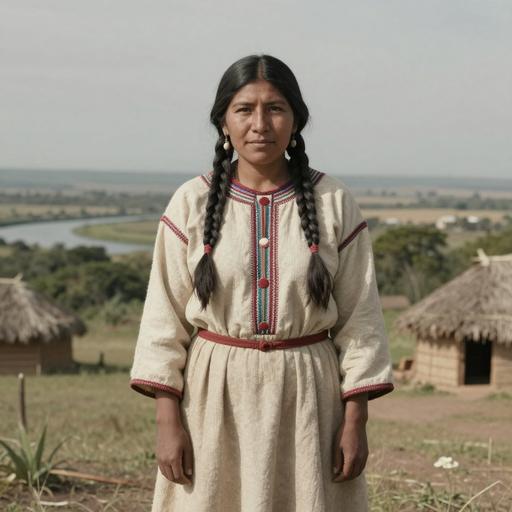
A woman buried in Argentina in the Ancient South America era

Download PDF creates a visual, rasterized copy. Use Print for selectable text and better assistive-technology support.

Loading Report

Preparing your ancestry journey

Preparing the available report content...

Your report will open automatically.

Skip to main content
Reference library / Sample profile

A woman buried in Argentina in the Ancient South America era

Explore the recorded context, genetic comparisons and research behind this reference sample.

ArgentinaLaguna Toro Site 2400 Years Ago

A reference profile describes this sample. It does not establish a personal or family relationship.

AI portrait reconstruction for A woman buried in Argentina in the Ancient South America era
AI-generated artistic reconstruction, not a photograph of the individual.
Record

Sample details

Recorded details and available lineage markers.

Individual

Buenos Aires individual, Argentina

Sample ID: I12376

Date Range

740 BCE - 200 BCE

Cultural Period

Laguna Toro Site 2400 Years Ago

Biological Sex

Female

mtDNA Haplogroup

A2-a

Y-DNA Haplogroup

Not available

Social Role

Hunter (AI estimate, era-typical)

Geography

Location

Where this individual was discovered

Country Argentina
Locality Southwest of Buenos Aires. Laguna Toro
Chronology

Date range

When this individual lived in the broader context of human history

Buenos Aires individual, Argentina 740 BCE - 200 BCE
Context

Historical context

Background information associated with the reference record.

Region & Environment

Tierra del Fuego sits at the far southern edge of South America, where cool ocean currents, strong winds, and rapidly changing weather strongly influence daily life. Coastal zones offered reliable access to marine foods, while inland areas supported seasonal movement and procurement. The archaeological record reflects how people organized their activities across this maritime and subarctic environment.

Historical Context

By roughly 400 BCE, the Fuegian region was occupied by Indigenous groups whose histories are documented primarily through archaeology rather than written sources. The period belongs to the later prehistoric development of southern maritime adaptations. Local traditions, including the Laguna Toro site horizon, fit within these long-running cultural patterns without requiring contact with distant states.

Populations & Lifeways

Populations are best approached as Indigenous hunter-gatherers with flexible settlement strategies. Lifeways likely emphasized marine and coastal resources, supplemented by hunting and foraging in suitable habitats. Site use patterns—such as repeated occupation of favorable locations—suggest seasonal rhythms and mobile coordination rather than permanent agricultural communities.

Archaeology & Material Culture

Archaeological evidence from this tradition is typically identified through assemblages such as stone tools, faunal remains, and features tied to repeated activities at coastal localities. Material culture reflects practical needs for butchering, processing, and transporting foods, as well as maintenance of daily gear. Organic materials may be present but are often preserved unevenly in the subantarctic environment, so interpretations rely heavily on durable artifacts and deposits.

Culture & Society

Within the “Fuegian Complex” framing, Laguna Toro represents a local expression of shared technological and subsistence practices across Tierra del Fuego. Social organization cannot be reconstructed in detail, but archaeological patterns can indicate community activity areas, learning and repetition of technique, and the use of well-situated sites that supported recurring tasks.

Legacy & Transition

Later centuries in Tierra del Fuego continued many of the same maritime-oriented lifeways, with archaeological sequences showing continuity alongside change in site use and material styles. The Laguna Toro horizon contributes to the baseline understanding of Fuegian prehistoric development that subsequent periods build upon.

Analysis

Genetic comparisons

These comparisons show genetic similarity, not identity or origin. The populations listed are those whose genomes show statistical alignment to this ancient individual.

Similarity reflects shared history, not shared identity. These are analytical comparisons, not claims about who this person was.

Modern Genetic Admixture

This analysis compares the DNA profile with present-day reference populations, showing statistical similarity to modern reference populations from different regions. The excavation site records where this individual was found, not a fixed modern genetic identity.

America 92.3%
America 92.3%
Native American 92.3%
Asia 7.5%
Chinese & Southeast Asian 4.3%
Tibetan 3.6%
Chinese 0.7%
Northern Asian 3.3%
Siberian 3.3%

Closest Modern Populations

These are the modern populations showing the closest statistical alignment to A woman buried in Argentina in the Ancient South America era, ranked by genetic distance. Lower distance values indicate closer statistical similarity. Cross-region similarity can reflect shared ancestry, population movement, continuity, or later admixture.

1
Aymara
2.0766
2
Piapoco
2.2403
3
Yukpa
2.4670
4
Bolivian Lapaz
2.6412
5
Wichi
2.8345
6
Colla
3.1041
7
Cachi
3.4183
8
Mixe
3.6202
9
Karitiana
4.1927
10
Mayan
4.3329
Context

Related Samples

This individual exists within a broader network of ancient samples. No ancient genome stands alone.

Individual Culture/Period Date Location Action
North Tierradel Fuego Selknam individual, Argentina North Tierra del Fuego Selknam Culture 500 Years Ago 1040 CE Tierra del Fuego (North). Margen Sur, Argentina View
Indigenous Cultures of South America individual, Argentina North Tierra del Fuego Selknam Culture 500 Years Ago 1150 CE Tierra del Fuego (North). Margen Sur, Argentina View
Tierradel Fuego Haush individual, Argentina Mitre Peninsula Haush Culture 400 Years Ago 1280 CE Tierra del Fuego. Mitre Peninusula. Caleta Falsa, Argentina View
Beagle Channel Late Horizon Yamana individual, Argentina Beagle Channel Yamana Culture 1500 Years Ago 260 CE Beagle Channel. Tierra del Fuego. Río Pipo, Argentina View
Buenos Aires individual, Argentina Laguna Toro Site 2400 Years Ago 740 BCE Southwest of Buenos Aires. Laguna Toro, Argentina View
Indigenous Cultures of South America individual, Argentina North Tierra del Fuego Selknam Culture 500 Years Ago 1200 CE Tierra del Fuego (North). Margen Sur, Argentina View
North Tierradel Fuego individual, Argentina North Tierra del Fuego La Arcillosa 2 Site 5800 Years Ago 4040 BCE Tierra del Fuego (North). La Arcillosa 2, Argentina View
Page 1
Individual Culture/Period Date Location Action
Buenos Aires individual, Argentina Laguna Toro Site 2400 Years Ago 740 BCE Southwest of Buenos Aires. Laguna Toro, Argentina View
Page 1
Sources

References

Scientific publications and genetic data that inform this profile.

G25 Coordinates

These coordinates represent a position in genetic space, a tool for comparison, not a conclusion. You can use these to perform custom admixture analysis in G25 Studio.

I12376,0.05623282,-0.31603512,0.11002064,0.09783302,-0.11215108,-0.01007128,-0.29944922,-0.35272674,-0.01489386,-0.016479,-0.0001212,-0.00050668,-0.00114974,0.02481,-0.00587986,0.00076312,0.0061135,0.00362714,0.0008999,-0.0020608,-0.00128024,0.007955,-0.00299624,-0.00438078,-0.00509507
Continue in G25 Studio
Use code for 30% off • Expires Nov 16