Menu
Store
Blog
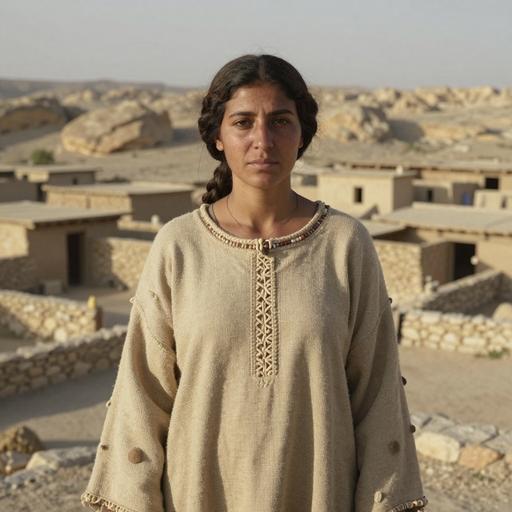
Portrait reconstruction of BAJ001
Ancient Individual

A woman buried in Jordan in the Neolithic era

BAJ001
7100 BCE - 6700 BCE
Female
Pre-Pottery Neolithic B Jordan
Jordan
Scroll to begin
Chapter I

Identity

The biological and cultural markers that define this ancient individual

Sample ID

BAJ001

Date Range

7100 BCE - 6700 BCE

Biological Sex

Female

mtDNA Haplogroup

N1b1a

Cultural Period

Pre-Pottery Neolithic B Jordan

Chapter II

Place

Where this individual was discovered

Country Jordan
Locality Ba’ja
Coordinates 30.4153, 35.4625
Chapter III

Time

When this individual lived in the broader context of human history

BAJ001 7100 BCE - 6700 BCE
Chapter IV

Story

The narrative of this ancient life

The Pre-Pottery Neolithic B (PPNB) period in Jordan, a sub-phase of the broader Neolithic era, marks a significant epoch in the development of human civilization in the Levantine region, encompassing present-day Jordan. The PPNB spans roughly from 8,500 to 6,500 BCE and follows the Pre-Pottery Neolithic A (PPNA) period. This era is characterized by remarkable advancements in agriculture, architecture, social organization, and technology, setting the stage for the rise of permanent settlements and more complex societies.

Agricultural Developments

The PPNB period witnessed a dramatic shift from hunting-gathering lifestyles to more sedentary, agriculture-based communities. In Jordan, this transformation was facilitated by the domestication and cultivation of key crops such as wheat, barley, lentils, and peas. The transition to agriculture allowed for more reliable food sources, population growth, and the establishment of permanent settlements. Livestock domestication also began during this period, albeit on a smaller scale, with species like sheep and goats playing a crucial role in subsistence strategies.

Settlements and Architecture

The PPNB era is noted for its large, permanent villages. In Jordan, notable sites such as 'Ain Ghazal near Amman and Basta reveal advanced architectural techniques. The settlements featured densely packed, multi-roomed rectangular structures, constructed with mud bricks and sometimes incorporating plastered walls and floors. These designs represented a significant shift away from the circular, single-room dwellings of the preceding PPNA period. The increased architectural complexity indicates a higher degree of social organization and the capability for cooperative construction efforts.

Social Organization and Culture

The PPNB period in Jordan highlights an increasingly complex social structure. The growth of villages indicates the emergence of social stratification and the division of labor. Artistic and cultural expressions also flourished during this time, evidenced by the creation of intricate figurines and other symbolic artifacts. The production of plastered human figures, particularly at sites like 'Ain Ghazal, suggests a rich ritualistic or religious life, with these artifacts likely playing a role in communal or spiritual activities.

Technological Innovations

Technological advancements were significant during the PPNB period. The development of more sophisticated flint tools and arrowheads was crucial for hunting and possibly warfare. The use of obsidian for tool-making, indicating long-distance trade networks, was present in several PPNB sites. This trade not only exchanged goods but also facilitated cultural and technological exchanges between disparate communities across the Levant.

Environmental Interaction

The PPNB communities in Jordan demonstrated an acute awareness of and adaptation to their environment. The period was marked by increased exploitation of natural resources and an understanding of agricultural cycles, which were vital in sustaining larger populations. Environmental management strategies, such as water conservation and utilization of diverse ecological zones, were crucial for the survival and prosperity of PPNB communities.

Challenges and Changes

Towards the end of the PPNB period, environmental changes, including climate fluctuations, likely impacted agricultural productivity and settlement patterns. This may have led to population movements, the reorganization of societal structures, and a transition to the subsequent Pottery Neolithic period, marked by new technologies and cultural practices.

In summary, the PPNB period in Jordan represents a transformative era in prehistoric human development. The advancements in agriculture, architecture, and societal organization set the groundwork for the development of more complex civilizations in the millennia that followed. The cultural and technological innovations of this period echo through history as foundational elements of settled human life in the Near East.

Chapter V

Genetics

The genetic ancestry of this ancient individual

Ancient Genetic Admixture

This analysis compares the DNA profile of BAJ001 with ancient reference populations, showing the genetic composition in terms of prehistoric ancestral groups.

Neolithic Farmers 90.0%
European Hunter-Gatherers 5.2%
Western Steppe Pastoralists 2.4%
Ancient Africans 2.3%

Modern Genetic Admixture

This analysis compares the DNA profile with present-day reference populations, showing what percentage of genetic makeup resembles modern populations from different regions.

Asia 64.3%
Arab, Egyptian & Levantine 60.0%
Levantine 39.0%
Arabian 21.0%
Northern West Asian 4.3%
Cypriot 3.7%
Anatolian 0.6%
Africa 23.9%
North African 23.9%
North African 14.2%
Egyptian 9.7%
Europe 11.9%
Southern European 11.9%
Sardinian 11.9%

Closest Modern Populations

These are the modern populations showing the closest statistical alignment to A woman buried in Jordan in the Neolithic era, ranked by genetic distance. Lower distance values indicate closer statistical similarity.

1
Yemenite Ma'rib
4.0230
2
Yemenite Jew
4.0806
3
Yemenite Al Jawf
4.2962
4
Yemenite Amran
4.3973
5
Yemenite Al Bayda
4.3974
6
Yemenite Dhamar
4.4037
7
Saudia
4.4413
8
Bedouinb
5.1274
9
Saudi
5.2082
10
Yemenite Mahra
5.2477
Chapter VI

Context

Other ancient individuals connected to this sample

Sources

References

Scientific publications and genetic data

Scientific Publication

Late Pleistocene human genome suggests a local origin for the first farmers of central Anatolia

Authors Feldman M, Fernández-Domínguez E, Reynolds L
Abstract

Anatolia was home to some of the earliest farming communities. It has been long debated whether a migration of farming groups introduced agriculture to central Anatolia. Here, we report the first genome-wide data from a 15,000-year-old Anatolian hunter-gatherer and from seven Anatolian and Levantine early farmers. We find high genetic continuity (~80-90%) between the hunter-gatherers and early farmers of Anatolia and detect two distinct incoming ancestries: an early Iranian/Caucasus related one and a later one linked to the ancient Levant. Finally, we observe a genetic link between southern Europe and the Near East predating 15,000 years ago. Our results suggest a limited role of human migration in the emergence of agriculture in central Anatolia.

G25 Coordinates

The G25 coordinates for sample BAJ001 can be used for detailed admixture analysis in our G25 Studio tool.

BAJ001,0.05801322,0.14667214,-0.04203496,-0.10456304,0.0029988,-0.04950364,-0.00776846,-0.00284094,0.05595194,0.00857166,0.01138832,-0.01773596,0.04124608,0.00120214,-0.00149146,0.01629582,-0.02507606,0.00401398,0.00691208,0.0162794,0.018958,0.01862098,-0.01178844,-0.00479718,-0.00578346
Analyze in G25 Studio
Use code for 40% off Expires Feb 27