Menu
Store
Blog
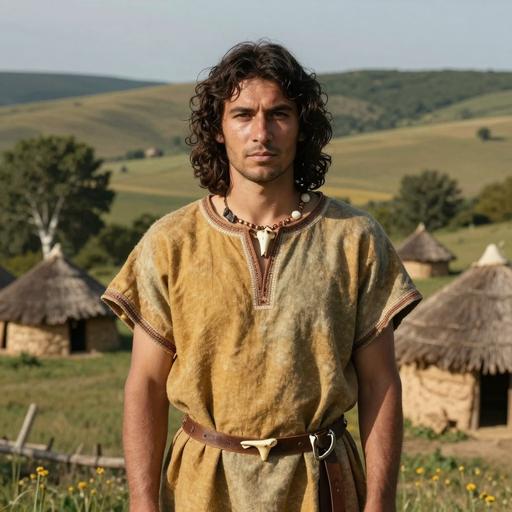
Portrait reconstruction of Bul8
Ancient Individual

A man buried in Bulgaria in the Early Bronze Age era

Bul8
3400 BCE - 1600 BCE
Male
Early Bronze Age Beli Breyag, Bulgaria
Bulgaria
Scroll to begin
Chapter I

Identity

The biological and cultural markers that define this ancient individual

Sample ID

Bul8

Date Range

3400 BCE - 1600 BCE

Biological Sex

Male

mtDNA Haplogroup

Not available

Y-DNA Haplogroup

I-P215

Cultural Period

Early Bronze Age Beli Breyag, Bulgaria

Chapter II

Place

Where this individual was discovered

Country Bulgaria
Locality Nova Zagora. Beli Breyag
Coordinates 42.4296, 25.8984
Chapter III

Time

When this individual lived in the broader context of human history

Bul8 3400 BCE - 1600 BCE
Chapter IV

Story

The narrative of this ancient life

The Early Bronze Age Beli Breyag culture in Bulgaria is a fascinating period that marks a significant transition from the late Neolithic and Chalcolithic periods into the early stages of the Bronze Age. This era, part of the broader Balkan Chalcolithic/Early Bronze Age cultures, represents a complex interplay of cultural, technological, and social developments that laid the foundation for subsequent societal advancements in the region.

Geographical Context: Beli Breyag is located in the northeastern part of Bulgaria, an area characterized by its varied landscape of mountains, plains, and river valleys. This diverse topography played a crucial role in the settlement patterns and the lifestyle of the Beli Breyag communities. Proximity to the Danube River and its tributaries provided fertile grounds for agriculture and facilitated trade and interaction with other cultures in the Balkans and beyond.

Archaeological Discoveries: Archaeological excavations in Beli Breyag have revealed a wealth of information about the Early Bronze Age settlements. The discovery of fortified settlements suggests a society increasingly concerned with territorial defense and possibly engaged in conflict or trade negotiations with neighboring groups. These communities typically consisted of semi-subterranean dwellings and above-ground structures, reflecting a blend of continuity and innovation in architectural practices from the earlier Neolithic period.

Material Culture: The material culture of Beli Breyag includes a wide array of artifacts, primarily ceramics, metal objects, and implements made from bone and stone. Pottery from this period often features intricate designs and demonstrates both local production techniques and influences from neighboring cultures. The advent of metallurgy marks this era as a transformative period, with the emergence of copper and early bronze tools, weapons, and ornaments. These advancements indicate increased specialization and the beginnings of complex trade networks.

Economy and Subsistence: The economy of Early Bronze Age Beli Breyag was predominantly agrarian, supported by the cultivation of cereals, legumes, and fruits, as well as animal husbandry involving cattle, sheep, and goats. The landscape's rich natural resources allowed for various subsistence strategies, including hunting, fishing, and foraging. Evidence of granaries and storage facilities points to the development of surplus production, which likely played a role in emerging social hierarchies and trade.

Social Structure and Leadership: Social organization during this time appears to have been increasingly hierarchical, with the development of leadership roles likely tied to control over resources, trade, and the newfound importance of metalwork. Burial practices, which include rich grave goods for certain individuals, suggest the presence of social stratification and the veneration of leaders or elites in the society. Such practices also indicate complex spiritual beliefs and ritualistic behaviors, possibly centering around ancestor worship and the afterlife.

Cultural Interactions and Influence: Beli Breyag's strategic position in the Balkans placed it at the crossroads of various cultural influences, fostering exchange and interaction with nearby regions such as the Carpathian Basin, the Aegean, and Anatolia. This resulted in a dynamic cultural milieu where local traditions blended with new ideas and technologies, evidenced by the diverse artifacts and architectural styles found at the site.

Legacy and Impact: The Early Bronze Age Beli Breyag culture represents an essential bridge between the prehistoric periods and more sophisticated societies that would eventually emerge in the southeastern part of Europe. The era's advancements in metallurgy, agriculture, and social organization laid the groundwork for future developments in the region, influencing later cultures and contributing to the broader narrative of European prehistory.

In summary, the Early Bronze Age Beli Breyag culture exemplifies the innovative spirit and adaptive strategies of prehistoric communities navigating the challenges and opportunities of a rapidly changing world. Through their material remains, we gain insight into the complexities of early human societies and their enduring impact on subsequent generations.

Chapter V

Genetics

The genetic ancestry of this ancient individual

Ancient Genetic Admixture

This analysis compares the DNA profile of Bul8 with ancient reference populations, showing the genetic composition in terms of prehistoric ancestral groups.

Neolithic Farmers 58.6%
Western Steppe Pastoralists 28.4%
Ancient Africans 13.0%

Modern Genetic Admixture

This analysis compares the DNA profile with present-day reference populations, showing what percentage of genetic makeup resembles modern populations from different regions.

Europe 89.9%
Southern European 85.1%
Iberian 39.4%
Italian 35.4%
Sardinian 10.3%
Northwestern European 4.8%
Oceania 4.3%
Melanesian 4.3%
Papuan 4.3%
Asia 3.0%
Japanese & Korean 2.3%
Japanese 2.3%
Arab, Egyptian & Levantine 0.7%
Arabian 0.7%
Africa 2.9%
West African 2.9%
Nigerian 2.9%

Closest Modern Populations

These are the modern populations showing the closest statistical alignment to A man buried in Bulgaria in the Early Bronze Age era, ranked by genetic distance. Lower distance values indicate closer statistical similarity.

1
Spanish Canarias
2.9872
2
Spanish Murcia
3.5094
3
Spanish Extremadura
3.5851
4
Portuguese
3.6273
5
Spanish Andalucia
3.7083
6
Spanish Galicia
3.7937
7
Spanish Castilla Y Leon
3.9880
8
Spanish Alacant
4.1156
9
Spanish Castilla La Mancha
4.2547
10
Spanish Cantabria
4.3648
Chapter VI

Context

Other ancient individuals connected to this sample

Sources

References

Scientific publications and genetic data

Scientific Publication

The genomic history of southeastern Europe

Authors Mathieson I, Alpaslan-Roodenberg S, Posth C
Abstract

Farming was first introduced to Europe in the mid-seventh millennium bc, and was associated with migrants from Anatolia who settled in the southeast before spreading throughout Europe. Here, to understand the dynamics of this process, we analysed genome-wide ancient DNA data from 225 individuals who lived in southeastern Europe and surrounding regions between 12000 and 500 bc. We document a west-east cline of ancestry in indigenous hunter-gatherers and, in eastern Europe, the early stages in the formation of Bronze Age steppe ancestry. We show that the first farmers of northern and western Europe dispersed through southeastern Europe with limited hunter-gatherer admixture, but that some early groups in the southeast mixed extensively with hunter-gatherers without the sex-biased admixture that prevailed later in the north and west. We also show that southeastern Europe continued to be a nexus between east and west after the arrival of farmers, with intermittent genetic contact with steppe populations occurring up to 2,000 years earlier than the migrations from the steppe that ultimately replaced much of the population of northern Europe.

G25 Coordinates

The G25 coordinates for sample Bul8 can be used for detailed admixture analysis in our G25 Studio tool.

Bul8,0.08199378,0.14362024,0.0371431,-0.01155284,0.04179592,-0.00185966,-0.00842798,0.0068631,0.03033504,0.0426486,-0.00423288,0.00578508,-0.01503608,-0.01413024,-0.00036108,-0.00066802,0.0062861,0.00062028,0.00020362,7.594E-05,0.00064362,-0.0004289,-0.00636492,-0.01000004,0.00372746
Analyze in G25 Studio
Use code for 40% off Expires Feb 26