Menu
Store
Blog
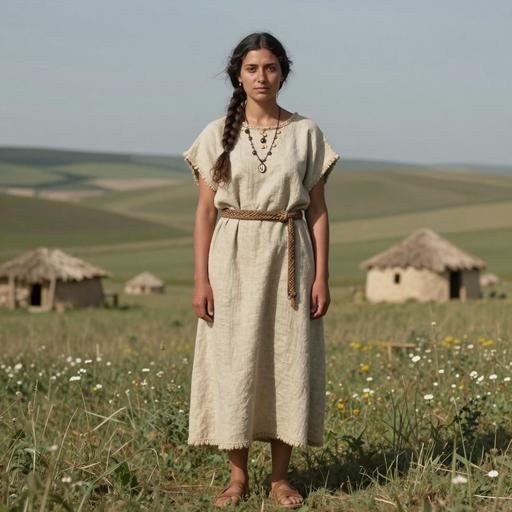
Portrait reconstruction of I12835
Ancient Individual

A woman buried in Bulgaria in the Early Bronze Age era

I12835
3092 BCE - 2921 BCE
Female
Early Bronze Age Ezero Culture, Bulgaria
Bulgaria
Scroll to begin
Chapter I

Identity

The biological and cultural markers that define this ancient individual

Sample ID

I12835

Date Range

3092 BCE - 2921 BCE

Biological Sex

Female

mtDNA Haplogroup

Not available

Cultural Period

Early Bronze Age Ezero Culture, Bulgaria

Chapter II

Place

Where this individual was discovered

Country Bulgaria
Locality Nova Zagora. Sabrano
Coordinates 42.4296, 25.8984
Chapter III

Time

When this individual lived in the broader context of human history

I12835 3092 BCE - 2921 BCE
Chapter IV

Story

The narrative of this ancient life

The Early Bronze Age Ezero Culture, which flourished in Bulgaria during the late third millennium BCE, represents a significant period in the prehistory of the Balkans. This culture is named after the Ezero tell, a prehistoric settlement mound located near the village of Ezero in southern Bulgaria. The Ezero Culture is a part of a broader cultural mosaic in the Balkans, characterized by its distinctive archaeological features, socio-economic systems, and cultural practices.

Geographic and Chronological Context

The Ezero Culture is predominantly situated in what is presently modern-day Bulgaria. This geographic territory encompasses the Thracian Plain and parts of the northern and western Balkan Mountains. Chronologically, it dates from approximately 3300 to 2700 BCE, overlapping with the tail end of the Chalcolithic period and extending into the Early Bronze Age. This era was a time of significant transformation as societies across the region underwent changes in social structure, technology, and trade practices.

Settlements and Architecture

The Ezero Culture is known for its tell settlements, which are large, artificial mounds created by the successive build-up of human habitation. These settlements are typically strategically positioned near water sources and fertile lands, indicative of a society heavily reliant on agriculture. The architecture of the Ezero Culture often includes fortified structures that suggest a need for defense, possibly against rival groups or as protection against larger organized marauding forces. The buildings within these tells were typically constructed using wattle-and-daub techniques, with wooden frameworks plastered with clay.

Economy and Subsistence

Economically, the Ezero Culture was predominantly agrarian, with subsistence strategies focused on both agriculture and animal husbandry. Archaeobotanical studies indicate the cultivation of cereals such as wheat and barley, alongside legumes and other crops. This agricultural base was complemented by the rearing of domesticated animals, including cattle, sheep, and goats. The presence of hunting tools and remnants of wild game also suggests that hunting coexisted as a supplementary activity.

Material Culture and Craftsmanship

Material remains from Ezero sites reveal a complex society with advanced metallurgy and pottery-making skills. The Ezero Culture was part of the broader Bronze Age transition that saw increased use of metals; copper and, subsequently, bronze artifacts become more prevalent. These include tools, weapons, and various ornaments. The pottery of the Ezero Culture is characterized by intricate geometric designs, often polished or burnished to a high shine, suggesting both utilitarian and ceremonial usage.

Social Structure and Cultural Practices

While specific details about the social structure of the Ezero Culture remain scarce, the presence of fortified settlements hints at organized social hierarchies with leadership that could coordinate large-scale construction and defense efforts. Burial practices, though not extensively documented, tend to align with those of the broader Balkan region, showing variation from simple inhumations to more elaborate burials that could indicate differences in social status.

Trade and Interaction

The Ezero Culture was not an insular society; rather, it engaged in interactions with neighboring cultures in the Balkans and beyond. This is evidenced by the exchange of goods such as metal objects, pottery styles, and possibly ideas and religious practices. The strategic location of Ezero settlements facilitated trade between regions, assisting in the dissemination of technological innovations and cultural influences.

Decline and Legacy

The transition from the Ezero Culture to later cultural phases remains subject to scholarly debate. Factors contributing to its decline could include environmental changes, resource depletion, or shifts in trade routes that made sustaining large settlements challenging. However, elements of the Ezero Culture likely persisted into subsequent cultural phases, influencing the development of later Thracian societies.

In summary, the Early Bronze Age Ezero Culture of Bulgaria represents a pivotal period in the historical and cultural development of the Balkans. Through its fortified settlements, agricultural advancements, metallurgy, and trade networks, it contributed to the broader tapestry of prehistoric European cultures, providing valuable insights into the complexities of early agrarian societies.

Chapter V

Genetics

The genetic ancestry of this ancient individual

Ancient Genetic Admixture

This analysis compares the DNA profile of I12835 with ancient reference populations, showing the genetic composition in terms of prehistoric ancestral groups.

Neolithic Farmers 48.4%
European Hunter-Gatherers 32.0%
Western Steppe Pastoralists 12.7%
Ancient Asians 6.9%

Modern Genetic Admixture

This analysis compares the DNA profile with present-day reference populations, showing what percentage of genetic makeup resembles modern populations from different regions.

Europe 92.2%
Southern European 89.0%
Balkan 29.9%
Iberian 24.8%
Italian 24.7%
Sardinian 9.5%
Northwestern European 3.3%
Scandinavian 3.3%
Asia 6.7%
Northern West Asian 5.7%
Cypriot 5.7%
Chinese & Southeast Asian 1.0%
Indonesian Khmer Thai Myanma 1.0%
Africa 1.1%
North African 0.8%
North African 0.8%

Closest Modern Populations

These are the modern populations showing the closest statistical alignment to A woman buried in Bulgaria in the Early Bronze Age era, ranked by genetic distance. Lower distance values indicate closer statistical similarity.

1
French Corsica
3.1976
2
Spanish Menorca
3.5124
3
Spanish Murcia
3.6071
4
Italian Trentino Alto Adige
3.6252
5
Italian Lombardy
3.6351
6
Italian Bergamo
3.6722
7
Swiss Italian
3.6740
8
Italian Veneto
3.6897
9
Italian Emilia
3.7934
10
Spanish Baleares
3.8372
Chapter VI

Context

Other ancient individuals connected to this sample

Sources

References

Scientific publications and genetic data

Scientific Publication

The genomic history of southeastern Europe

Authors Mathieson I, Alpaslan-Roodenberg S, Posth C
Abstract

Farming was first introduced to Europe in the mid-seventh millennium bc, and was associated with migrants from Anatolia who settled in the southeast before spreading throughout Europe. Here, to understand the dynamics of this process, we analysed genome-wide ancient DNA data from 225 individuals who lived in southeastern Europe and surrounding regions between 12000 and 500 bc. We document a west-east cline of ancestry in indigenous hunter-gatherers and, in eastern Europe, the early stages in the formation of Bronze Age steppe ancestry. We show that the first farmers of northern and western Europe dispersed through southeastern Europe with limited hunter-gatherer admixture, but that some early groups in the southeast mixed extensively with hunter-gatherers without the sex-biased admixture that prevailed later in the north and west. We also show that southeastern Europe continued to be a nexus between east and west after the arrival of farmers, with intermittent genetic contact with steppe populations occurring up to 2,000 years earlier than the migrations from the steppe that ultimately replaced much of the population of northern Europe.

G25 Coordinates

The G25 coordinates for sample I12835 can be used for detailed admixture analysis in our G25 Studio tool.

I12835,0.11511074,0.13092232,0.0256286,-0.01792988,0.04400428,-0.00523236,0.00207616,0.00679974,0.01890924,0.03473464,-0.00426242,0.00818448,-0.01412254,-0.00158034,-0.0093221,0.00133282,0.0117645,-0.00078834,0.00161828,0.00076102,-0.00014348,0.0021342,-0.00428354,-0.01353492,0.00199649
Analyze in G25 Studio
Use code for 40% off Expires Feb 26