Menu
Store
Blog
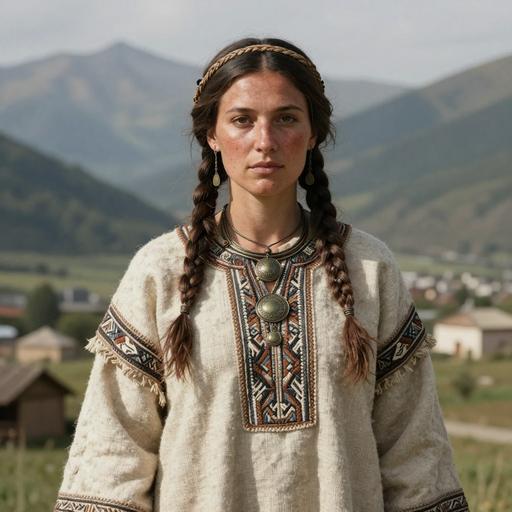
Portrait reconstruction of DA160
Ancient Individual

A woman buried in Russia in the Late Antiquity era

DA160
450 CE - 850 CE
Female
Alan Culture, Russia
Russia
Scroll to begin
Chapter I

Identity

The biological and cultural markers that define this ancient individual

Sample ID

DA160

Date Range

450 CE - 850 CE

Biological Sex

Female

mtDNA Haplogroup

U4d3

Cultural Period

Alan Culture, Russia

Chapter II

Place

Where this individual was discovered

Country Russia
Locality Caucasus
Coordinates 42.8617, 44.1851
Chapter III

Time

When this individual lived in the broader context of human history

DA160 450 CE - 850 CE
Chapter IV

Story

The narrative of this ancient life

The Alans were an ancient nomadic people whose origins can be traced back to the Iranian-speaking tribes of the Central Asian steppes. Their culture emerged around the first century AD and played a significant role in the history and ethno-cultural landscape of Eastern Europe, particularly what is now southern Russia, during the late Antiquity and early Middle Ages. The Alans were largely influenced by the Scythians, another nomadic Iranian people, with whom they shared several cultural and social traits.

Geographical Spread and Overview

The Alans originally inhabited areas around the Don and Volga rivers, and their influence extended into the North Caucasus region. Over time, their presence spread further westward into Eastern Europe due to their migratory lifestyle. By the fourth century AD, they had expanded into the territories of present-day Ukraine, Romania, and Hungary due to the pressures of migration and invasions such as the Huns. Some groups even ventured as far as Gaul and Hispania.

Social Structure and Lifestyle

The Alans, much like their Scythian predecessors, were primarily a nomadic people whose social structure was based around clan affiliations and a tribal federation. They were renowned horsemen, a trait that was pivotal to their way of life. They relied heavily on their cavalry for both military and livelihood purposes, using horses for warfare, hunting, and herding. The Alans practiced a pastoral lifestyle, relying on the herding of animals such as sheep, cattle, and horses, and supplemented their diet with hunting.

Alanic society was patriarchal, with leadership typically vested in male warriors who held significant sway in matters of war and tribal governance. Chiefs or kings often emerged from these ranks, leading the confederation in battles and negotiations with other tribes and settled nations.

Cultural Practices and Beliefs

The Alans had a rich spiritual life that was largely influenced by their Iranian roots. They practiced a polytheistic religion that worshipped natural forces and deities akin to those of other Iranian peoples. There is evidence to suggest that they revered sky gods and considered fire sacred. Over time, as they came into contact with the Roman Empire and later the Byzantine Empire, some Alan tribes began to convert to Christianity, though Zoroastrian influences remained present.

Culturally, the Alans are known for their intricate metalwork, particularly in the creation of weapons and horsegear, which demonstrates their skills in craftsmanship. Their art often reflected a synthesis of nomadic Iranian styles with elements from the cultures they encountered, revealing the Alans' adaptability and receptivity to external influences.

Military Prowess

The Alans were noted for their formidable military skills, particularly their cavalry. They became famous for their use of heavily armored cataphracts and archery. Their tactics and skills were influential enough that they were often sought after as mercenaries and allies by other powers, including the Roman Empire. The Alans played significant roles in various military coalitions and were influential in the course of later Roman and early medieval European history.

Legacy and Influence

The impact of the Alan culture can be felt across various domains. In the Caucasus, particularly in Ossetia, the legacy of the Alans is strongly preserved. The Ossetians are considered their direct descendants, and they continue to speak an Iranian language, reflecting the ancient language of the Alans. Some scholars suggest that Alans influenced the development of knightly institutions and chivalric traditions in medieval Europe given their prominence as warriors and horsemen.

In summary, the Alans were a distinctive cultural group whose legacy is a testament to the complexity and interconnectivity of Eurasian historical dynamics. With their nomadic prowess, cultural adaptability, and significant historical migrations, the Alans contributed to shaping the histories and cultures of the regions they touched, from the steppes of Russia to the plains of Western Europe.

Chapter V

Genetics

The genetic ancestry of this ancient individual

Ancient Genetic Admixture

This analysis compares the DNA profile of DA160 with ancient reference populations, showing the genetic composition in terms of prehistoric ancestral groups.

Neolithic Farmers 51.0%
European Hunter-Gatherers 23.4%
Western Steppe Pastoralists 12.9%
Ancient Asians 9.7%
Ancient Native Americans 3.1%

Modern Genetic Admixture

This analysis compares the DNA profile with present-day reference populations, showing what percentage of genetic makeup resembles modern populations from different regions.

Asia 78.1%
Northern West Asian 78.1%
Caucasian 46.7%
Mesopotamian 22.0%
Anatolian 8.3%
Cypriot 1.1%
Europe 21.4%
Southern European 18.9%
Italian 11.0%
Balkan 7.0%
Sardinian 0.9%
Northwestern European 2.5%
Africa 0.5%
West African 0.5%
Nigerian 0.5%

Closest Modern Populations

These are the modern populations showing the closest statistical alignment to A woman buried in Russia in the Late Antiquity era, ranked by genetic distance. Lower distance values indicate closer statistical similarity.

1
Balkar
1.3235
Chapter VI

Context

Other ancient individuals connected to this sample

Sources

References

Scientific publications and genetic data

Scientific Publication

137 ancient human genomes from across the Eurasian steppes

Authors Damgaard PB, Marchi N, Rasmussen S
Abstract

For thousands of years the Eurasian steppes have been a centre of human migrations and cultural change. Here we sequence the genomes of 137 ancient humans (about 1× average coverage), covering a period of 4,000 years, to understand the population history of the Eurasian steppes after the Bronze Age migrations. We find that the genetics of the Scythian groups that dominated the Eurasian steppes throughout the Iron Age were highly structured, with diverse origins comprising Late Bronze Age herders, European farmers and southern Siberian hunter-gatherers. Later, Scythians admixed with the eastern steppe nomads who formed the Xiongnu confederations, and moved westward in about the second or third century BC, forming the Hun traditions in the fourth-fifth century AD, and carrying with them plague that was basal to the Justinian plague. These nomads were further admixed with East Asian groups during several short-term khanates in the Medieval period. These historical events transformed the Eurasian steppes from being inhabited by Indo-European speakers of largely West Eurasian ancestry to the mostly Turkic-speaking groups of the present day, who are primarily of East Asian ancestry.

G25 Coordinates

The G25 coordinates for sample DA160 can be used for detailed admixture analysis in our G25 Studio tool.

DA160,0.1085862,0.08962008,-0.02459298,-0.01964262,-0.03432834,-0.00476756,0.00694776,-0.00731466,-0.05213828,-0.02514442,-0.0021553,0.0101443,-0.017433,0.00179112,0.00526438,-0.01799762,0.0087889,-0.00648152,-0.0101498,0.00958908,0.0123685,0.00012658,-0.00094672,-0.00730688,-0.00204716
Analyze in G25 Studio
Use code for 40% off Expires Feb 27