Menu
Store
Blog
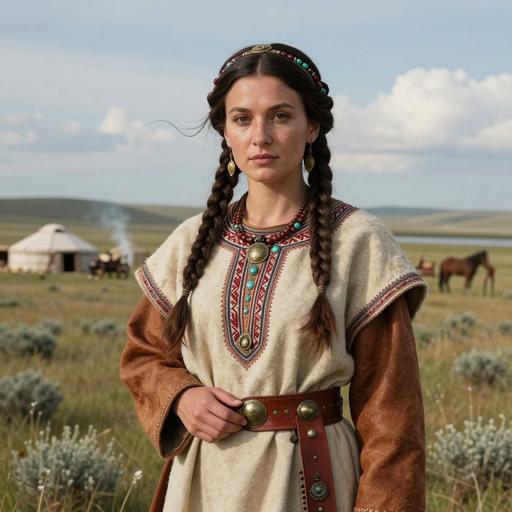
Portrait reconstruction of DA139
Ancient Individual

A woman buried in Russia in the Iron Age era

DA139
800 BCE - 100 CE
Female
Sarmatian Culture, Russia
Russia
Scroll to begin
Chapter I

Identity

The biological and cultural markers that define this ancient individual

Sample ID

DA139

Date Range

800 BCE - 100 CE

Biological Sex

Female

mtDNA Haplogroup

U2e1h1a7

Cultural Period

Sarmatian Culture, Russia

Chapter II

Place

Where this individual was discovered

Country Russia
Locality Caspian steppe
Coordinates 47.2934, 39.5460
Chapter III

Time

When this individual lived in the broader context of human history

DA139 800 BCE - 100 CE
Chapter IV

Story

The narrative of this ancient life

The Sarmatian culture refers to a significant cultural and historical phenomenon associated with the Sarmatians, a group of Iranian nomadic tribes that occupied a vast region stretching from the Danube River in the west to the Volga River in the east, covering parts of modern-day Russia, Ukraine, and Kazakhstan. The Sarmatians flourished from the 5th century BCE until around the 4th century CE. Their culture is notable for its influence on the social, military, and artistic practices in the regions they inhabited and interacted with.

Origins and Ethnogenesis

The Sarmatians were part of the broader group of Iranian peoples who migrated from Central Asia, likely around the late 5th century BCE. They were closely related to the Scythians, another prominent group of Iranian nomads, with whom they shared many cultural elements. Ethnogenesis of the Sarmatians is believed to have been a complex process involving the amalgamation of local tribes with incoming Iranian elements.

Social Structure

The Sarmatian society was primarily nomadic and pastoral, with a social structure reflective of their lifestyle. They were organized into tribes led by chieftains or kings, and their society was stratified into a hierarchy of nobles, warriors, common herdsmen, and slaves. Women in Sarmatian culture often held significant roles, with evidence suggesting that some women could become warriors or hold leadership positions, a feature that has contributed to the myth of the Amazons.

Economy and Lifestyle

The Sarmatian economy was largely based on animal husbandry, with horses, cattle, and sheep being the mainstay of their livelihood. Horses, in particular, were of paramount importance, not only economically but also culturally. The Sarmatians were esteemed horsemen, and their cavalry became renowned throughout the ancient world.

Their nomadic lifestyle meant that they lived in portable homes, such as yurts or tent-like structures. They practiced a form of transhumance, moving seasonally to find pastures for their herds.

Military Prowess

Sarmatians are perhaps best known for their military skills, particularly their heavy cavalry. They were among the earliest to use heavy armor for both horses and riders, a practice that influenced later European and Asian cavalry tactics. The Sarmatian warriors were equipped with long lances, swords, and scale armor, making them formidable opponents in battle.

They frequently engaged in warfare and raids, which extended their influence across Eastern Europe. Their military prowess made them valuable allies and mercenaries to various powers, including the Roman Empire.

Art and Material Culture

Sarmatian art is characterized by its animal motifs, intricate metalwork, and jewelry, with gold and silver being widely used. Their arts and crafts display a high degree of skill, particularly in metalworking and embroidery. Artifacts often feature stylized depictions of animals, drawing from a shared artistic tradition with other steppe cultures.

Religion and Beliefs

The religious beliefs of the Sarmatians included a pantheon of deities common to Iranian peoples, with reverence for natural features such as rivers and mountains. They likely practiced animism and ancestor worship, as suggested by burial practices and grave goods found in their kurgans (burial mounds).

Interactions and Legacy

The Sarmatians interacted with many contemporary civilizations, including the Greeks, Persians, and Romans. These interactions facilitated cultural exchanges, visible in settlements that exhibit a blend of Sarmatian and local elements. Their influence on the Roman military, particularly the evolution of cavalry tactics and equipment, is a notable aspect of their legacy.

In conclusion, the Sarmatian culture represents a vibrant and dynamic chapter in the history of Eastern Europe and the Eurasian steppes. Their contributions to military tactics, art, and the social role of women set them apart as a unique and influential culture in the ancient world. Today, their legacy can be recognized in archaeological findings that continue to provide insights into their way of life and societal organization.

Chapter V

Genetics

The genetic ancestry of this ancient individual

Ancient Genetic Admixture

This analysis compares the DNA profile of DA139 with ancient reference populations, showing the genetic composition in terms of prehistoric ancestral groups.

Western Steppe Pastoralists 33.5%
European Hunter-Gatherers 32.6%
Neolithic Farmers 20.7%
Ancient Asians 10.4%
Ancient Africans 2.9%

Modern Genetic Admixture

This analysis compares the DNA profile with present-day reference populations, showing what percentage of genetic makeup resembles modern populations from different regions.

Asia 49.2%
Northern West Asian 33.9%
Caucasian 33.7%
Central Asian, Northern Indian & Pakistani 11.8%
Pakistan 10.5%
Central Asian 1.3%
Northern Asian 3.5%
Siberian 3.5%
Europe 46.6%
Northwestern European 29.6%
English 20.9%
Scandinavian 4.3%
Finnish 2.3%
Northwestern European 2.1%
Eastern European 17.0%
America 2.9%
America 2.9%
Native American 2.9%
Oceania 1.2%
Melanesian 1.2%
Papuan 1.2%

Closest Modern Populations

These are the modern populations showing the closest statistical alignment to A woman buried in Russia in the Iron Age era, ranked by genetic distance. Lower distance values indicate closer statistical similarity.

1
Tajik Yaghnobi
6.3672
2
Pamiri Rushan
6.3865
3
Pamiri Shugnan
7.1805
4
Tatar Mishar
7.2895
5
Lezgin
7.4682
6
Turkish Deliorman
7.6547
7
Tatar Kazan
7.7233
8
Andian B
7.7256
9
Kumyk
7.7612
10
Kaitag
7.7931
Chapter VI

Context

Other ancient individuals connected to this sample

Sources

References

Scientific publications and genetic data

Scientific Publication

137 ancient human genomes from across the Eurasian steppes

Authors Damgaard PB, Marchi N, Rasmussen S
Abstract

For thousands of years the Eurasian steppes have been a centre of human migrations and cultural change. Here we sequence the genomes of 137 ancient humans (about 1× average coverage), covering a period of 4,000 years, to understand the population history of the Eurasian steppes after the Bronze Age migrations. We find that the genetics of the Scythian groups that dominated the Eurasian steppes throughout the Iron Age were highly structured, with diverse origins comprising Late Bronze Age herders, European farmers and southern Siberian hunter-gatherers. Later, Scythians admixed with the eastern steppe nomads who formed the Xiongnu confederations, and moved westward in about the second or third century BC, forming the Hun traditions in the fourth-fifth century AD, and carrying with them plague that was basal to the Justinian plague. These nomads were further admixed with East Asian groups during several short-term khanates in the Medieval period. These historical events transformed the Eurasian steppes from being inhabited by Indo-European speakers of largely West Eurasian ancestry to the mostly Turkic-speaking groups of the present day, who are primarily of East Asian ancestry.

G25 Coordinates

The G25 coordinates for sample DA139 can be used for detailed admixture analysis in our G25 Studio tool.

DA139,0.11059766,0.0622269,0.01721334,0.03438244,-0.01944886,0.01318162,0.00510326,-0.00183974,-0.02723744,-0.02870384,0.00215818,0.00048514,0.00226778,-0.00771702,0.00189832,-0.00334744,-0.00647484,-0.0003625,-0.00541358,-0.00705806,0.0004618,0.0032137,-0.00346636,0.0084357,-0.00239032
Analyze in G25 Studio
Use code for 40% off Expires Feb 27