Menu
Store
Blog
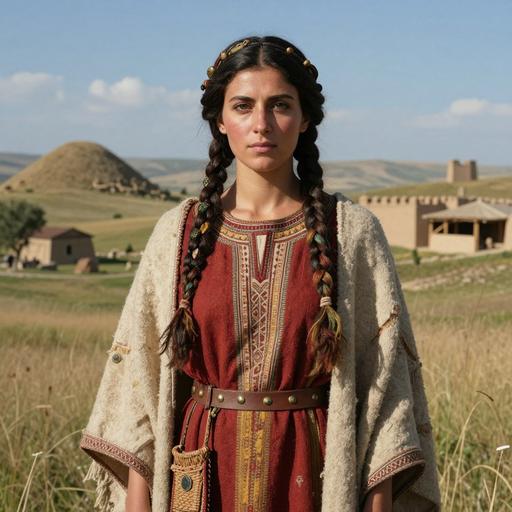
Portrait reconstruction of Gordion002
Ancient Individual

A woman buried in Turkey in the Iron Age era

Gordion002
323 BCE - 31 BCE
Female
Central Anatolian Iron Age Culture (Gordion)
Turkey
Scroll to begin
Chapter I

Identity

The biological and cultural markers that define this ancient individual

Sample ID

Gordion002

Date Range

323 BCE - 31 BCE

Biological Sex

Female

mtDNA Haplogroup

K1a3

Cultural Period

Central Anatolian Iron Age Culture (Gordion)

Chapter II

Place

Where this individual was discovered

Country Turkey
Locality Gordion (Central, Ankara)
Coordinates 39.6525, 31.9967
Chapter III

Time

When this individual lived in the broader context of human history

Gordion002 323 BCE - 31 BCE
Chapter IV

Story

The narrative of this ancient life

The Central Anatolian Iron Age culture, particularly epitomized by the region of Gordion and the ascendancy of the Phrygians, represents a vibrant tapestry of socio-political, economic, and artistic developments. Occupying the vast Anatolian plateau, the Phrygians were a significant force that shaped the cultural and historical landscape during the early first millennium BCE.

Geographical and Historical Context

Location: The Phrygians, originally Indo-European migrants, settled in central Anatolia, with Gordion, near modern-day Ankara, serving as their political and cultural epicenter. Gordion's strategic location along the Sakarya River facilitated its role as a hub for trade and cultural exchange, linking it to other contemporaneous civilizations such as the Hittites, Lydians, Greeks, and Assyrians.

Historical Background: The Iron Age in Anatolia followed the collapse of the Hittite Empire around the 12th century BCE. The Phrygians emerged as a prominent power in the region during the early part of the first millennium BCE, achieving their zenith around the 9th to 8th centuries BCE. This era is primarily defined by the legendary King Midas, who is often associated with the wealth and prosperity of Phrygian Gordion.

Political Structure

The Phrygian society was likely organized into a monarchy, with King Midas being the most famous ruler due to both historical accounts and Greek mythology. The Phrygians held substantial influence over their subjects and managed a society characterized by a hierarchical structure. This governance allowed them to maintain control over a diverse population and manage the complexities of a trading society.

Economy and Trade

The economy of Phrygian Gordion was robust and heavily reliant on agriculture, animal husbandry, and trade. The fertile lands of central Anatolia supported abundant grain production, while livestock, particularly sheep and goats, was vital for meat, milk, and wool.

Trade Networks: The Phrygians' strategic geographic position facilitated trade with neighboring regions, allowing the exchange of goods such as timber, textiles, and metalwork. Gordion served as a vibrant marketplace, connecting the Aegean, Anatolian, and Near Eastern worlds, which further stimulated its economy and cultural exchange.

Material Culture

Architecture: The architecture in Gordion was noted for its megaron structures—rectangular buildings with a central hearth, thought to have served both residential and ceremonial purposes. The construction techniques illustrated advanced knowledge of engineering and urban planning, with evidence of substantial city walls for defense and communal storage facilities.

Artistry and Craftsmanship: Phrygian artistry reflected a mix of indigenous influences and external interactions. The Phrygians excelled in metalwork, pottery, and textiles. Their artisans produced intricate bronze and iron artifacts, as well as ornately woven Phrygian carpets and tapestries which were highly valued in trade.

Tumulus Tombs: Phrygian burial practices included the construction of large tumulus tombs, most notably the “Midas Mound” or Tumulus MM at Gordion. These earth-covered burial mounds demonstrated both engineering prowess and the socio-political importance of elite individuals. The tombs often contained a wealth of grave goods, reflecting status and beliefs in an afterlife.

Religion and Beliefs

The Phrygian pantheon was dominated by the Mother Goddess, Cybele, reflecting the culture's syncretic nature. Ritualistic practices and beliefs showed significant influence from neighboring cultures. Phrygian religious life was intricately tied to their arts and politics, with priestly classes holding considerable power and influence.

Linguistic and Cultural Influence

The Phrygian language is an Indo-European tongue thought to be closely related to Greek. Although not as well-documented as Hittite, inscriptions have proven valuable in understanding the language and its script. Their mythological and cultural narratives, as inherited by the Greeks, ensured the longevity of the Phrygian legacy, particularly through figures like Midas.

Decline and Legacy

By the late 7th century BCE, Phrygia faced decline, attributed to various factors like Cimmerian invasions and eventual subjugation by the Lydians, followed by Persians. Despite this decline, the cultural and political legacy of the Phrygians, as well as their contributions to art, language, and mythology, persisted in the broader tapestry of ancient Anatolian culture.

In summary, the Central Anatolian Iron Age culture of the Phrygians at Gordion encompasses a noteworthy period marked by cultural richness, complexity in social and political structures, and significant contributions to art and economy. The Phrygians forged a cultural identity that resonated long beyond their political dominance, embodying a critical chapter in the ancient history of Anatolia.

Chapter V

Context

Other ancient individuals connected to this sample

Sources

References

Scientific publications and genetic data

Scientific Publication

Spatial and temporal heterogeneity in human mobility patterns in Holocene Southwest Asia and the East Mediterranean

Authors Koptekin D, Yüncü E, Rodríguez-Varela R
Abstract

We present a spatiotemporal picture of human genetic diversity in Anatolia, Iran, Levant, South Caucasus, and the Aegean, a broad region that experienced the earliest Neolithic transition and the emergence of complex hierarchical societies. Combining 35 new ancient shotgun genomes with 382 ancient and 23 present-day published genomes, we found that genetic diversity within each region steadily increased through the Holocene. We further observed that the inferred sources of gene flow shifted in time. In the first half of the Holocene, Southwest Asian and the East Mediterranean populations homogenized among themselves. Starting with the Bronze Age, however, regional populations diverged from each other, most likely driven by gene flow from external sources, which we term "the expanding mobility model." Interestingly, this increase in inter-regional divergence can be captured by outgroup-f3-based genetic distances, but not by the commonly used FST statistic, due to the sensitivity of FST, but not outgroup-f3, to within-population diversity. Finally, we report a temporal trend of increasing male bias in admixture events through the Holocene.

Use code for 40% off Expires Feb 27