Menu
Currency
Main
Store
Blog

Loading Report

Preparing your ancestry journey

Connecting to ancient matches...

Preparing your report

Skip to main content
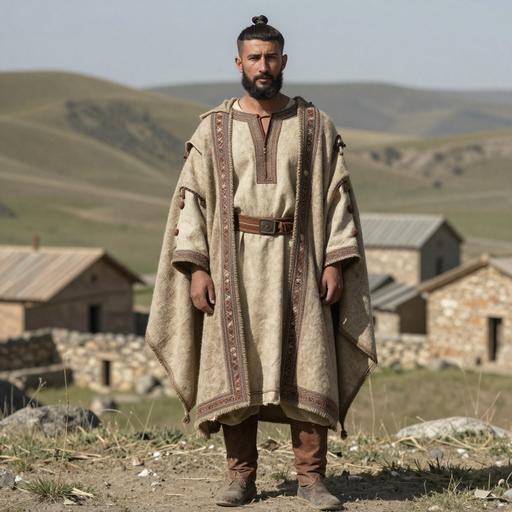
Portrait reconstruction of A man buried in Georgia in the Bronze Age era
Ancient Individual

A man buried in Georgia in the Bronze Age era

A man buried in Georgia during the Didnauri Culture of Georgia

A fragment of the ancient world, preserved across millennia in strands of DNA.

geo006
1043 BCE - 839 BCE
Male
Georgia
Scroll to begin
Chapter I

Identity

The biological and cultural markers that define this ancient individual

Sample ID

geo006

Date Range

1043 BCE - 839 BCE

Cultural Period

Didnauri Culture of Georgia

Biological Sex

Male

mtDNA Haplogroup

X2

Y-DNA Haplogroup

R-M269

Chapter II

Place

Where this individual was discovered

Country Georgia
Locality Didnauri (Samreklo)
Coordinates 41.4300, 46.1950
Chapter III

Time

When this individual lived in the broader context of human history

geo006 1043 BCE - 839 BCE
Chapter IV

Story

The narrative of this ancient life

The Didnauri culture is a relatively lesser-known archaeological culture that flourished in the region of present-day Georgia, in the South Caucasus, during the early Georgian era. This rich cultural heritage is being gradually uncovered through various archaeological endeavors, revealing significant insights into the early Georgian civilizations.

Geographical Context

The Didnauri culture is primarily identified through archaeological sites located in the southeastern parts of Georgia, particularly in the regions surrounding the modern town of Dedoplistskaro in the Kakheti province. Nestled between the Greater and Lesser Caucasus mountain ranges, this area is characterized by its diverse topography, which includes fertile plains, rolling hills, and strategic river valleys—a setting that significantly influenced the lifestyle and development of the Didnauri people.

Chronology

The Didnauri culture thrived during the Early Bronze Age, approximately between the 4th and 3rd millennia BCE. This period is crucial in Georgian prehistory, bridging the gap between Neolithic settlements and more complex societal structures that emerged later in the Bronze Age.

Societal Structure

While specific details about the societal structure of the Didnauri culture are still being uncovered, existing archaeological evidence suggests a community that was organized, with clear social hierarchies beginning to take shape. The presence of large burial mounds, or kurgans, indicates the possible existence of elite or ruling classes. These mounds are often accompanied by rich grave goods, suggesting ceremonial practices and beliefs related to the afterlife.

Economy and Trade

The economy of the Didnauri culture was primarily agrarian, with the cultivation of crops and the domestication of animals forming the backbone of daily life. The strategic positioning of their settlements along vital trade routes implies that the Didnauri people engaged in trade with neighboring cultures. The exchange of goods such as obsidian, metal artifacts, and pottery pieces indicates a wide network of interaction and cultural exchange.

Material Culture

Material culture from this era showcases the craftsmanship and technological advancements of the Didnauri people. Archaeological finds include intricately decorated pottery, tools, and weapons made from bronze, indicating a well-developed metallurgical tradition. The pottery often bears intricate geometric patterns and designs, reflecting both aesthetic sensibilities and technological proficiency.

Architectural Achievements

The Didnauri culture is noted for its architectural innovations, particularly in the construction of fortified settlements. The recently excavated Didnauri site revealed the remnants of a massive defensive wall, constructed with great precision using large stone blocks and mud bricks, signifying the importance of communal protection and organized labor capabilities.

Religious and Funerary Practices

Religious beliefs and funerary practices of the Didnauri people are primarily inferred from burial sites. The presence of kurgans and the careful arrangement of graves suggests a belief in an afterlife and the significance of ceremonial rites. The burial goods often include personal ornaments, weapons, and pottery, indicating a belief in an equipped journey in the afterlife.

Cultural Legacy

Although much of the Didnauri culture remains shrouded in mystery, its discoveries contribute valuable insights into the broader narrative of early Georgian history and the development of complex societies in the Caucasus. The culture's advancements in metallurgy, trade, and societal organization laid foundational elements that influenced subsequent cultures in the region.

Conclusion

The Didnauri culture represents a formative chapter in the early history of Georgia, offering a glimpse into the lives of its ancient inhabitants. Ongoing archaeological research continues to illuminate this fascinating culture, enriching our understanding of the roots of Georgian civilization and its enduring legacy in the region. As more discoveries are made, the Didnauri culture will undoubtedly continue to captivate historians and archaeologists alike, cementing its place in the annals of Georgian and Caucasian history.

Context

Related Samples

This individual exists within a broader network of ancient samples. No ancient genome stands alone.

Sample ID Culture/Period Date Location Action
BOG019 Turkey Central Bogazkoy-Hattusa Roman Imperial 100 CE Boğazköy-Ḫattuša (Çorum, Boğazkale), Turkey View
BOG020 Turkey Central Bogazkoy-Hattusa Roman Imperial 130 CE Boğazköy-Ḫattuša (Çorum, Boğazkale), Turkey View
BOG024 Turkey Central Bogazkoy-Hattusa Roman Imperial 130 CE Boğazköy-Ḫattuša (Çorum, Boğazkale), Turkey View
BOG028 Modern Turkish (Boğazköy-Hattuša) 1000-1900 CE 1000 CE Boğazköy-Ḫattuša (Çorum, Boğazkale), Turkey View
CTG025 Bronze Age Aegean Culture of Aydin 2015 BCE Çine-Tepecik (Aydın, Çine), Turkey View
G23 Early Bronze Age Theopetra Culture 2343 BCE Theopetra Cave (Thessaly), Greece View
G31 Early Helladic Perachora 2700 BCE Perachora Cave (Corinthia), Greece View
G37 Early Bronze Age Sarakenos Cave Culture 2476 BCE Boeotia, Sarakenos Cave (Thessalia-Central Greece, Stereas Elladas), Greece View
G62 Early Helladic Perachora 2700 BCE Perachora Cave (Corinthia), Greece View
G65 Early Helladic Perachora 2700 BCE Perachora Cave (Corinthia), Greece View
G66 Early Helladic Perachora 2700 BCE Perachora Cave (Corinthia), Greece View
G76a Early Helladic Perachora 2570 BCE Perachora Cave (Corinthia), Greece View
geo005 Didnauri Culture of Georgia 1260 BCE Didnauri (Samreklo), Georgia View
geo006 Didnauri Culture of Georgia 1043 BCE Didnauri (Samreklo), Georgia View
geo015 Kura-Araxes Culture 3017 BCE Doghlauri (Shida Kartli, Kareli), Georgia View
geo017 Doghlauri culture of Georgia 1375 BCE Doghlauri (Shida Kartli, Kareli), Georgia View
geo029 Didnauri Culture of Georgia 1222 BCE Didnauri (Samreklo), Georgia View
Gordion002 Central Anatolian Iron Age Culture (Gordion) 323 BCE Gordion (Central, Ankara), Turkey View
gur016 Nazarlebi Culture of Georgia 1500 BCE Nazarlebi (Eastern Georgia, Kakheti, Shiraki Plain), Georgia View
gur017 Nazarlebi Culture of Georgia 1500 BCE Nazarlebi (Eastern Georgia, Kakheti, Shiraki Plain), Georgia View
gur019 Nazarlebi Culture of Georgia 1500 BCE Nazarlebi (Eastern Georgia, Kakheti, Shiraki Plain), Georgia View
mus005 Central Anatolian Pre-Pottery Neolithic 7457 BCE Musular (Aksaray, Gülağaç), Turkey View
mus006 Central Anatolian Pre-Pottery Neolithic 7311 BCE Musular (Aksaray, Gülağaç), Turkey View
sha003 Bronze Age Shah Tepe 3200 BCE Shah Tepe (Kerman, Arzuiyeh), Iran View
sha004 Bronze Age Shah Tepe 3489 BCE Shah Tepe (Kerman, Arzuiyeh), Iran View
sha006 Bronze Age Shah Tepe 3200 BCE Shah Tepe (Kerman, Arzuiyeh), Iran View
sha007 Bronze Age Shah Tepe 3369 BCE Shah Tepe (Kerman, Arzuiyeh), Iran View
sha008 Bronze Age Shah Tepe 3200 BCE Shah Tepe (Kerman, Arzuiyeh), Iran View
sha009 Bronze Age Shah Tepe 3346 BCE Shah Tepe (Kerman, Arzuiyeh), Iran View
sha010 Bronze Age Shah Tepe 3200 BCE Shah Tepe (Kerman, Arzuiyeh), Iran View
sha012 Bronze Age Shah Tepe 3200 BCE Shah Tepe (Kerman, Arzuiyeh), Iran View
ksha014 Bronze Age Shah Tepe 3200 BCE Shah Tepe (Kerman, Arzuiyeh), Iran View
ulu117 Early Bronze Age Ulucak Culture 4000 BCE Ulucak Höyük (İzmir, Kemalpaşa), Turkey View
zrj003 Shamakhi Culture 205 CE Shamakhi, Azerbaijan View
Sample ID Culture/Period Date Location Action
geo005 Didnauri Culture of Georgia 1260 BCE Didnauri (Samreklo), Georgia View
geo006 Didnauri Culture of Georgia 1043 BCE Didnauri (Samreklo), Georgia View
geo029 Didnauri Culture of Georgia 1222 BCE Didnauri (Samreklo), Georgia View
Sources

References

Scientific publications and genetic data that inform this profile.

Scientific Publication

Spatial and temporal heterogeneity in human mobility patterns in Holocene Southwest Asia and the East Mediterranean

Authors Koptekin D, Yüncü E, Rodríguez-Varela R, Altınışık NE, Psonis N et al.
Abstract

We present a spatiotemporal picture of human genetic diversity in Anatolia, Iran, Levant, South Caucasus, and the Aegean, a broad region that experienced the earliest Neolithic transition and the emergence of complex hierarchical societies. Combining 35 new ancient shotgun genomes with 382 ancient and 23 present-day published genomes, we found that genetic diversity within each region steadily increased through the Holocene. We further observed that the inferred sources of gene flow shifted in time. In the first half of the Holocene, Southwest Asian and the East Mediterranean populations homogenized among themselves. Starting with the Bronze Age, however, regional populations diverged from each other, most likely driven by gene flow from external sources, which we term "the expanding mobility model." Interestingly, this increase in inter-regional divergence can be captured by outgroup-f3-based genetic distances, but not by the commonly used FST statistic, due to the sensitivity of FST, but not outgroup-f3, to within-population diversity. Finally, we report a temporal trend of increasing male bias in admixture events through the Holocene.

Use code for 25% off Expires Jul 12