Menu
Store
Blog
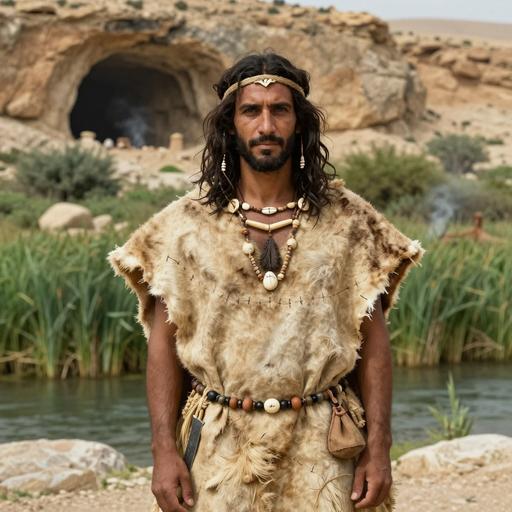
Portrait reconstruction of I1685
Ancient Individual

A man buried in Israel in the Epipaleolithic era

I1685
12000 BCE - 9500 BCE
Male
Natufian Culture in Israel
Israel
Scroll to begin
Chapter I

Identity

The biological and cultural markers that define this ancient individual

Sample ID

I1685

Date Range

12000 BCE - 9500 BCE

Biological Sex

Male

mtDNA Haplogroup

J2a2

Y-DNA Haplogroup

E-M35

Cultural Period

Natufian Culture in Israel

Chapter II

Place

Where this individual was discovered

Country Israel
Locality Raqefet Cave
Coordinates 32.6500, 35.0670
Chapter III

Time

When this individual lived in the broader context of human history

I1685 12000 BCE - 9500 BCE
Chapter IV

Story

The narrative of this ancient life

The Natufian culture represents a significant prehistoric era that thrived in the Levant region, particularly in what is now modern-day Israel, from approximately 15,000 to 11,500 years ago. This period is fundamentally important in understanding the transition from nomadic hunter-gatherer societies to more sedentary, agricultural communities. The Natufians are often credited with laying the groundwork for the development of agriculture and the rise of the Neolithic way of life.

Geographic Setting

The Natufian culture was primarily centered in the Levant, covering areas that include modern-day Israel, Palestine, Jordan, Lebanon, and Syria. This region's diverse environment, which included coastal plains, mountainous terrains, and fertile river valleys, provided a rich tapestry of habitats that supported a variety of plant and animal life, crucial for a foraging lifestyle.

Cultural Characteristics

Settlement Patterns

One of the defining features of the Natufian culture was their semi-sedentary lifestyle. The Natufians established some of the earliest known semi-permanent settlements. Archaeological sites such as Ain Mallaha (Eynan) and Jericho illustrate their complex settlements, which included circular or semi-circular stone dwellings with carefully constructed walls and paved floors.

Subsistence Strategies

The Natufians were primarily hunter-gatherers, relying heavily on hunting gazelles and other game, as well as gathering wild cereals, nuts, and fruits. However, they exhibited pre-agricultural practices, such as the harvesting and storage of wild grains, which suggest an incipient form of agriculture. The presence of sickle blades with \sickle sheen," a glossy polish from cutting plant stems, indicates the collection of cereals.

Tools and Technology

Natufian toolkits reflect their adaptation to a changing environment and their complex subsistence strategies. They used microlithic technology, creating small, sharp flint tools that were often composite, meaning several pieces were mounted into a handle or shaft to create implements such as sickles, knives, and harpoons. Ground stone tools like mortars and pestles, used for processing plant materials, were also prevalent.

Social Structure and Art

The Natufian society likely exhibited a more complex social structure than previous hunter-gatherer groups, possibly including distinctions based on status or role. Evidence of this complexity can be seen in their burial practices. Natufian burials often contained grave goods such as shell ornaments, stone tools, and animal bones, suggesting differential treatment of individuals.

Artistic expression is evident in their use of decorative objects and possibly symbolic art, such as engraved stones and bone carvings. Shells from distant marine environments found at inland sites imply trade networks or exchange systems.

Ritual and Spiritual Life

The Natufian culture is notable for its elaborate burials, which provide insights into their spiritual and ritualistic life. Burials sometimes included special arrangements, grave goods, and in some cases, removal of skulls, which may have held a significant ritual or symbolic meaning. These practices might suggest ancestor worship or belief in an afterlife.

Climatic Influences

The Natufian era corresponds with the Late Epipaleolithic period, a time of climatic instability at the end of the last Ice Age. The onset of the Younger Dryas, a cold and dry climatic event around 12,900 to 11,700 years ago, likely posed challenges to their subsistence practices, potentially prompting innovations in plant cultivation and animal domestication.

Legacy and Transition to Agriculture

The Natufian culture is crucial to understanding the origins of agriculture. The behavioral and technological innovations during this time set the stage for the Neolithic Revolution. The transition from foraging to farming in the subsequent Pre-Pottery Neolithic period may have been a direct response to environmental pressures and the cumulative cultural adaptations developed by the Natufians.

In conclusion, the Natufian culture marks a pivotal chapter in human history, bridging the gap between nomadic lifestyles and settled agricultural societies. Their advanced settlement patterns, subsistence strategies, social complexity, and cultural innovations profoundly influenced the course of human development in the region."

Chapter V

Genetics

The genetic ancestry of this ancient individual

Ancient Genetic Admixture

This analysis compares the DNA profile of I1685 with ancient reference populations, showing the genetic composition in terms of prehistoric ancestral groups.

Neolithic Farmers 87.5%
Western Steppe Pastoralists 5.5%
Ancient Native Americans 3.8%
Ancient Asians 3.2%

Modern Genetic Admixture

This analysis compares the DNA profile with present-day reference populations, showing what percentage of genetic makeup resembles modern populations from different regions.

Asia 46.2%
Arab, Egyptian & Levantine 36.4%
Arabian 19.6%
Levantine 16.8%
Northern West Asian 8.6%
Cypriot 8.6%
Chinese & Southeast Asian 1.1%
Chinese 1.1%
Africa 32.7%
North African 31.2%
North African 23.7%
Egyptian 7.5%
Northern East African 1.5%
Ethiopian 1.5%
Europe 21.1%
Southern European 21.1%
Iberian 14.3%
Italian 6.9%

Closest Modern Populations

These are the modern populations showing the closest statistical alignment to A man buried in Israel in the Epipaleolithic era, ranked by genetic distance. Lower distance values indicate closer statistical similarity.

1
Tunisian Rbaya
3.3346
2
Saudib
4.1277
3
Egyptian Copt
4.8438
4
Yemenite Dhamar
4.8809
5
Yemenite Al Bayda
5.3615
6
Yemenite Amran
5.8495
7
Egyptian
5.8706
8
Yemenite Ma'rib
5.9173
9
Bedouinb
5.9856
10
Yemenite Al Jawf
6.4130
Chapter VI

Context

Other ancient individuals connected to this sample

Sources

References

Scientific publications and genetic data

Scientific Publication

Genomic insights into the origin of farming in the ancient Near East

Authors Lazaridis I, Nadel D, Rollefson G
Abstract

We report genome-wide ancient DNA from 44 ancient Near Easterners ranging in time between ~12,000 and 1,400 bc, from Natufian hunter-gatherers to Bronze Age farmers. We show that the earliest populations of the Near East derived around half their ancestry from a 'Basal Eurasian' lineage that had little if any Neanderthal admixture and that separated from other non-African lineages before their separation from each other. The first farmers of the southern Levant (Israel and Jordan) and Zagros Mountains (Iran) were strongly genetically differentiated, and each descended from local hunter-gatherers. By the time of the Bronze Age, these two populations and Anatolian-related farmers had mixed with each other and with the hunter-gatherers of Europe to greatly reduce genetic differentiation. The impact of the Near Eastern farmers extended beyond the Near East: farmers related to those of Anatolia spread westward into Europe; farmers related to those of the Levant spread southward into East Africa; farmers related to those of Iran spread northward into the Eurasian steppe; and people related to both the early farmers of Iran and to the pastoralists of the Eurasian steppe spread eastward into South Asia.

G25 Coordinates

The G25 coordinates for sample I1685 can be used for detailed admixture analysis in our G25 Studio tool.

I1685,0.00057568,0.13551308,-0.04525216,-0.09858704,-0.0003963,-0.04955588,-0.01408352,-0.00082736,0.0603061,-0.00031512,0.01218276,-0.02291948,0.0490048,0.00090838,0.00917006,0.00978056,-0.01816138,-0.00029334,-0.01262968,0.02007106,0.01077134,0.00464728,0.00262714,0.00395116,-0.00882871
Analyze in G25 Studio
Use code for 40% off Expires Feb 26