Menu
Store
Blog
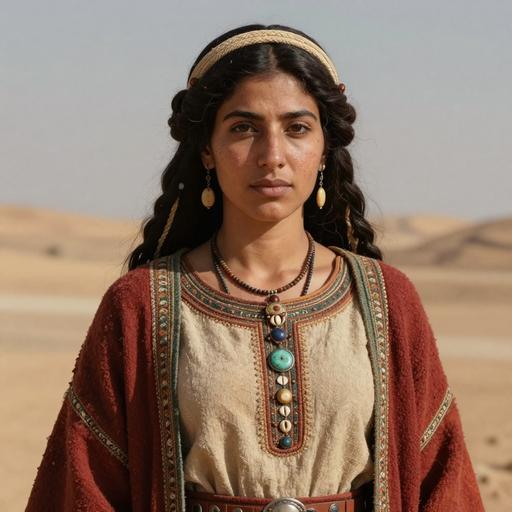
Portrait reconstruction of I3986
Ancient Individual

A woman buried in Jordan in the Late Bronze Age to Iron Age era

I3986
1550 BCE - 1150 BCE
Female
Iron Age Jordan
Jordan
Scroll to begin
Chapter I

Identity

The biological and cultural markers that define this ancient individual

Sample ID

I3986

Date Range

1550 BCE - 1150 BCE

Biological Sex

Female

mtDNA Haplogroup

U3a2a

Cultural Period

Iron Age Jordan

Chapter II

Place

Where this individual was discovered

Country Jordan
Locality Baq'ah
Coordinates 32.4487, 35.7039
Chapter III

Time

When this individual lived in the broader context of human history

I3986 1550 BCE - 1150 BCE
Chapter IV

Story

The narrative of this ancient life

The Iron Age in Jordan, part of the larger Iron Age Levant, is a fascinating period in the history of the ancient Near East, spanning roughly from 1200 to 539 BCE. This era is characterized by significant cultural, political, and technological developments, and it forms a critical bridge between the end of the Bronze Age and the beginning of classical antiquity.

Historical Context

The onset of the Iron Age in Jordan aligns with widespread changes across the entire region of the Levant, driven by the collapse of the Bronze Age civilizations. This era saw the emergence of new political entities and the restructuring of existing ones, alongside shifts in trade routes and cultural exchanges. The instability from the Bronze Age collapse, including invasions, migrations, and the decline of major powers like Egypt and the Hittites, set the stage for the rise of new kingdoms and city-states in the region, such as Ammon, Moab, and Edom.

Political Landscape

  1. Ammon: Located in the central region of modern-day Jordan around present-day Amman, the kingdom of Ammon was one of the prominent Iron Age states. The Ammonites are frequently mentioned in biblical texts, and archaeological evidence suggests they were a well-organized society with significant urban development, characterized by fortified cities and centralized governance.

  2. Moab: Situated to the east of the Dead Sea, Moab was a powerful kingdom with a distinct cultural identity. Known from both biblical accounts and the Mesha Stele (an important Moabite stone inscription), the Moabites were engaged in frequent conflicts with neighboring Israelites yet also engaged in trade and cultural exchange.

  3. Edom: Located further south, in a region now crossing into southern Jordan, Edom was known for its strategic position on trade routes, including the ancient King’s Highway. The Edomites were renowned for their skills in metallurgy and contributed to regional trade networks, particularly with copper production.

Economic and Technological Developments

The introduction and widespread usage of iron fundamentally changed the economic landscape of the region. Iron tools and weapons offered advantages over the previously predominant bronze, giving rise to improved agricultural techniques and military capabilities. Jordan’s Iron Age culture saw advancements in technology that included the smelting and working of iron, which facilitated enhanced productivity and trade.

Trade networks expanded significantly, connecting the indigenous populations of Iron Age Jordan with far-reaching regions such as Egypt, Mesopotamia, and the Arabian Peninsula. This era witnessed a flourishing exchange of goods like metals, textiles, and pottery, alongside cultural and technological ideas.

Cultural Aspects

Culturally, the Iron Age in Jordan is marked by the preservation and innovation of religious practices, art, and social organization. The pottery styles from this period, for example, are varied and marked by regional influences, indicating a vibrant exchange of artistic ideas. Additionally, the architecture of the time included fortified cities and religious structures, reflecting both strategic needs and the cultural importance of worship.

The religion of Iron Age Jordan was polytheistic, with deities often shared among neighboring cultures. Local gods such as Milcom of the Ammonites, Chemosh of the Moabites, and Qos of the Edomites were worshipped alongside a suite of other regional deities, reflecting the interconnectedness of the Levantine cultures.

Archaeological Evidence

Extensive archaeological excavations throughout modern Jordan have uncovered a wealth of information about this era. Key sites supporting our understanding include:

  • Amman Citadel: Positioned in the heart of present-day Jordan, this site offers insights into the fortifications and urban planning of ancient Ammon.
  • Dhiban (Dibon): Associated with the Moabites, this site has revealed insights into the administrative and military capabilities of the kingdom.
  • Buseirah: Often identified with ancient Edom, it provides evidence of the region's metallurgical prowess.

In conclusion, the Iron Age in Jordan reflects a dynamic period of political power struggles, technological innovation, and cultural expression. The interrelations among the various Levantine states during this era highlight the complexity and interconnectedness of ancient Middle Eastern civilizations, illustrating a rich tapestry of human development that set the foundation for future historical progressions.

Chapter V

Genetics

The genetic ancestry of this ancient individual

Ancient Genetic Admixture

This analysis compares the DNA profile of I3986 with ancient reference populations, showing the genetic composition in terms of prehistoric ancestral groups.

Neolithic Farmers 81.4%
European Hunter-Gatherers 16.6%
Ancient Asians 2.0%

Modern Genetic Admixture

This analysis compares the DNA profile with present-day reference populations, showing what percentage of genetic makeup resembles modern populations from different regions.

Asia 81.8%
Arab, Egyptian & Levantine 61.4%
Levantine 45.9%
Arabian 15.5%
Northern West Asian 18.4%
Mesopotamian 13.4%
Anatolian 5.0%
Central Asian, Northern Indian & Pakistani 2.0%
Pakistan 2.0%
Europe 17.5%
Southern European 17.5%
Italian 9.1%
Sardinian 8.4%
Africa 0.8%
North African 0.8%
Egyptian 0.8%

Closest Modern Populations

These are the modern populations showing the closest statistical alignment to A woman buried in Jordan in the Late Bronze Age to Iron Age era, ranked by genetic distance. Lower distance values indicate closer statistical similarity.

1
Samaritan
2.7571
2
Lebanese Christian
3.4757
3
Cochin Jews Paradesi
3.7945
4
Palestinian Beit Sahour
4.0143
5
Karaite Iraq
4.1392
6
Palestinian
4.3283
7
Lebanese Druze
4.3626
8
Jordanian
4.4157
9
Druze
4.5368
10
Lebanese Muslim
4.5934
Chapter VI

Context

Other ancient individuals connected to this sample

Sources

References

Scientific publications and genetic data

Scientific Publication

The Genomic History of the Bronze Age Southern Levant

Authors Agranat-Tamir L, Waldman S, Martin MAS
Abstract

We report genome-wide DNA data for 73 individuals from five archaeological sites across the Bronze and Iron Ages Southern Levant. These individuals, who share the "Canaanite" material culture, can be modeled as descending from two sources: (1) earlier local Neolithic populations and (2) populations related to the Chalcolithic Zagros or the Bronze Age Caucasus. The non-local contribution increased over time, as evinced by three outliers who can be modeled as descendants of recent migrants. We show evidence that different "Canaanite" groups genetically resemble each other more than other populations. We find that Levant-related modern populations typically have substantial ancestry coming from populations related to the Chalcolithic Zagros and the Bronze Age Southern Levant. These groups also harbor ancestry from sources we cannot fully model with the available data, highlighting the critical role of post-Bronze-Age migrations into the region over the past 3,000 years.

G25 Coordinates

The G25 coordinates for sample I3986 can be used for detailed admixture analysis in our G25 Studio tool.

I3986,0.07570136,0.14356752,-0.0554817,-0.08986684,-0.01266446,-0.04141478,-0.00269698,-0.0106808,0.02002592,0.0065864,0.00779638,-0.01287936,0.01811018,0.0013908,-0.01006034,0.01441276,-0.01179334,0.00305876,0.00442902,0.0033619,0.00835046,0.01134174,-0.00407242,-0.000752,-0.00060656
Analyze in G25 Studio
Use code for 40% off Expires Feb 27