Menu
Store
Blog
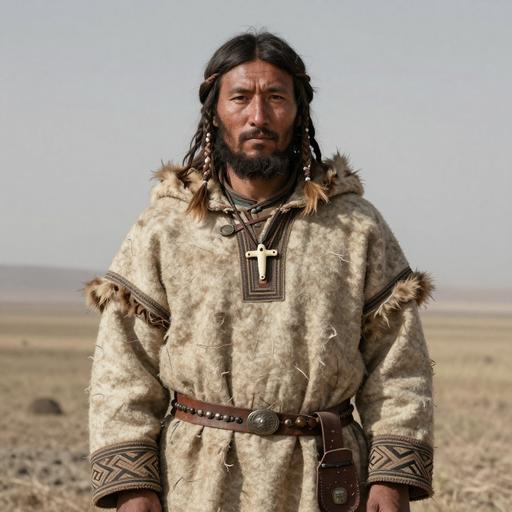
Portrait reconstruction of KHU001
Ancient Individual

A man buried in Mongolia in the Middle Late Bronze Age era

KHU001
2000 BCE - 700 BCE
Male
Middle to Late Bronze Age Zavkhan, Mongolia
Mongolia
Scroll to begin
Chapter I

Identity

The biological and cultural markers that define this ancient individual

Sample ID

KHU001

Date Range

2000 BCE - 700 BCE

Biological Sex

Male

mtDNA Haplogroup

C4a1a

Y-DNA Haplogroup

Q-L330

Cultural Period

Middle to Late Bronze Age Zavkhan, Mongolia

Chapter II

Place

Where this individual was discovered

Country Mongolia
Locality Zavkhan. Khukh Khoshuunii Boom
Coordinates 49.7038, 96.3620
Chapter III

Time

When this individual lived in the broader context of human history

KHU001 2000 BCE - 700 BCE
Chapter IV

Story

The narrative of this ancient life

The Middle to Late Bronze Age Zavkhan culture emerged in what is now the Zavkhan Province of northwestern Mongolia, part of the expansive Eurasian Steppe region. This period, roughly spanning from 1600 to 700 BCE, witnessed significant developments in social organization, technology, and cultural practices among the nomadic and semi-nomadic peoples of the steppe.

Geography and Environment

The Zavkhan region is characterized by its diverse landscape, including mountains, river valleys, and vast steppes. This varied environment provided an abundance of resources that influenced the subsistence strategies of the Bronze Age communities. The climate, typified by cold winters and warm summers, played a crucial role in shaping the lifestyle of the inhabitants, particularly in terms of animal husbandry and pastoralism.

Economy and Subsistence

The economy of the Zavkhan culture during the Middle to Late Bronze Age was primarily based on pastoralism, with herding of sheep, goats, cattle, and horses playing a central role. Horse domestication was particularly significant, marking a transformational shift in transport, warfare, and social status. In addition to pastoralism, some communities engaged in limited agriculture, supplementing their diet with cultivated grains and wild foraged plants.

Settlement Patterns

Bronze Age Zavkhan communities were largely mobile, characterized by seasonal movements between pastures. However, archaeological findings suggest the presence of semi-permanent settlements, possibly indicating a degree of sedentism during certain seasons. These settlements commonly featured circular dwellings, often constructed with a combination of stone and organic materials like wood and felt.

Technology and Craftsmanship

The Bronze Age was marked by advancements in metalworking, with evidence of sophisticated bronze tools, weapons, and ornaments. Artifacts such as daggers, arrowheads, and bracelets highlight the community's metallurgical skills. Moreover, pottery from this era displays both functionality and decorative elements, with common motifs including geometric designs and animal representations.

Social Structure and Culture

The social structure of Middle to Late Bronze Age Zavkhan was likely organized around kinship and clan affiliations, which were central to the governance of these communities. Burial practices provide insights into social hierarchies, with elite individuals often interred with elaborate grave goods, including weapons, jewelry, and horse accompaniments, indicating their status and wealth. Such burials suggest the existence of a warrior elite class, potentially linked to tribal leadership.

Religious and spiritual beliefs during this era are inferred from burial rites and rock art, often found etched onto cliffs and stones. These petroglyphs frequently depict animals, hunting scenes, and chariots, indicating a spiritual connection to nature and possibly a form of totemism or ancestor worship.

Interaction and Exchange

The Zavkhan culture existed within a broader network of trade and cultural exchange that spanned the Eurasian Steppe. This is evidenced by the diffusion of technology, such as the chariot, and stylistic influences seen in pottery and metalwork. Cultural interactions facilitated the exchange of ideas, goods, and innovations, contributing to the dynamic nature of Bronze Age societies in this region.

Legacy and Influence

The Middle to Late Bronze Age Zavkhan culture played a pivotal role in the cultural and technological transformations of the wider region. The developments during this period laid the groundwork for succeeding cultures and the eventual rise of the nomadic empires that dominated the Eurasian Steppe in later centuries. The legacy of the Zavkhan culture is reflected in the continuity of pastoral traditions and the integration of diverse cultural practices across the region.

In summary, the Middle to Late Bronze Age Zavkhan culture was a vibrant and dynamic society marked by advancements in technology, complex social structures, and a rich cultural tapestry that contributed to the broader mosaic of Bronze Age Eurasia.

Chapter V

Genetics

The genetic ancestry of this ancient individual

Ancient Genetic Admixture

This analysis compares the DNA profile of KHU001 with ancient reference populations, showing the genetic composition in terms of prehistoric ancestral groups.

Ancient Asians 83.9%
Western Steppe Pastoralists 7.4%
Ancient Native Americans 5.2%
Neolithic Farmers 3.6%

Modern Genetic Admixture

This analysis compares the DNA profile with present-day reference populations, showing what percentage of genetic makeup resembles modern populations from different regions.

Asia 92.4%
Northern Asian 57.3%
Siberian 43.7%
Mongolian 13.6%
Chinese & Southeast Asian 13.3%
Tibetan 9.0%
Chinese 4.3%
Central Asian, Northern Indian & Pakistani 11.0%
Central Asian 11.0%
Japanese & Korean 10.8%
Japanese 10.8%
America 6.1%
America 6.1%
Native American 6.1%
Oceania 1.5%
Melanesian 1.5%
Papuan 1.5%

Closest Modern Populations

These are the modern populations showing the closest statistical alignment to A man buried in Mongolia in the Middle Late Bronze Age era, ranked by genetic distance. Lower distance values indicate closer statistical similarity.

1
Mogush
6.7466
2
Tuvinian
7.4019
3
Khakass Kachins
7.4926
4
Altaian Kizhi
7.5144
5
Altaian
7.8753
6
Mongol Xinjiang
8.0195
7
Teleut O
8.1687
8
Kalmyk
8.4113
9
Mongolian
8.6318
10
Khamnegan
9.1052
Chapter VI

Context

Other ancient individuals connected to this sample

Sources

References

Scientific publications and genetic data

Scientific Publication

A Dynamic 6,000-Year Genetic History of Eurasia's Eastern Steppe

Authors Jeong C, Wang K, Wilkin S
Abstract

The Eastern Eurasian Steppe was home to historic empires of nomadic pastoralists, including the Xiongnu and the Mongols. However, little is known about the region's population history. Here, we reveal its dynamic genetic history by analyzing new genome-wide data for 214 ancient individuals spanning 6,000 years. We identify a pastoralist expansion into Mongolia ca. 3000 BCE, and by the Late Bronze Age, Mongolian populations were biogeographically structured into three distinct groups, all practicing dairy pastoralism regardless of ancestry. The Xiongnu emerged from the mixing of these populations and those from surrounding regions. By comparison, the Mongols exhibit much higher eastern Eurasian ancestry, resembling present-day Mongolic-speaking populations. Our results illuminate the complex interplay between genetic, sociopolitical, and cultural changes on the Eastern Steppe.

G25 Coordinates

The G25 coordinates for sample KHU001 can be used for detailed admixture analysis in our G25 Studio tool.

KHU001,0.05290102,-0.32529034,0.08408146,0.00308902,-0.05301642,-0.02777352,-0.00597062,-0.00372026,0.00484554,-0.00122808,0.00947026,-0.00440426,0.00872368,-0.02052008,-0.01739382,-0.01014214,-0.00481852,0.00616844,0.01605566,0.00756546,0.01231066,-0.01200048,0.01193486,0.00447064,0.00868128
Analyze in G25 Studio
Use code for 40% off Expires Feb 27