Menu
Store
Blog
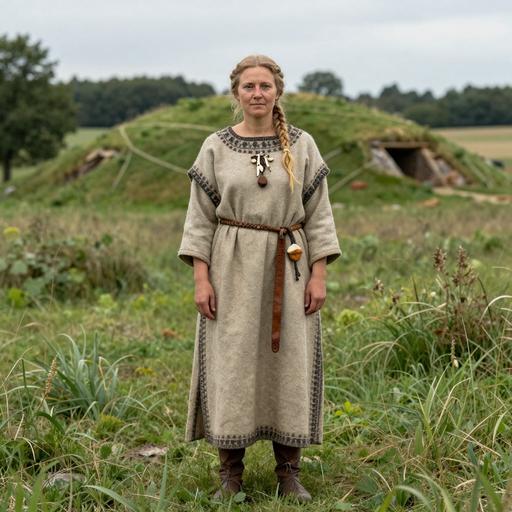
Portrait reconstruction of NEO580
Ancient Individual

A woman buried in Denmark in the Middle Neolithic era

NEO580
2868 BCE - 2490 BCE
Female
Corded Ware Culture of Middle Neolithic Denmark
Denmark
Scroll to begin
Chapter I

Identity

The biological and cultural markers that define this ancient individual

Sample ID

NEO580

Date Range

2868 BCE - 2490 BCE

Biological Sex

Female

mtDNA Haplogroup

Not available

Cultural Period

Corded Ware Culture of Middle Neolithic Denmark

Chapter II

Place

Where this individual was discovered

Country Denmark
Locality Klokkehøj (Funen region)
Coordinates 55.1080, 10.1110
Chapter III

Time

When this individual lived in the broader context of human history

NEO580 2868 BCE - 2490 BCE
Chapter IV

Story

The narrative of this ancient life

The Corded Ware Culture, also known as the Battle Axe Culture in regions like Denmark, represents a significant phase in European prehistory during the transition from the late Neolithic to the early Bronze Age, roughly spanning from 2900 to 2350 BCE. This era is characterized by a confluence of indigenous Neolithic traditions and Indo-European influences, which manifested distinct cultural attributes across Europe. In Denmark, which forms part of Scandinavia, the culture is understood mainly through its archaeological signatures such as burial practices, pottery, tool-making, and social structures.

Geographical and Temporal Context

Denmark, during the middle Neolithic, was a land characterized by a diverse landscape of forests, rivers, and coastal areas. The Corded Ware Culture extended through much of Northern Europe, from what is now the Netherlands, across Germany and into Scandinavia, including Denmark. The name \Corded Ware" derives from the distinctive pottery found throughout these regions, which was often decorated with cord-like impressions.

Cultural Characteristics

Pottery and Material Culture

A defining feature of the Corded Ware Culture is its unique pottery style. The ceramics typically exhibit beaker-shaped forms with a pronounced emphasis on decoration. Impressions were made using twisted cords, which were pressed into the wet clay, creating a signature decorative motif that has become emblematic of this culture.

Burial Practices

In Denmark, as in other parts of the Corded Ware cultural expanse, burial customs were significant indicators of societal values and beliefs. Individuals were often buried in single graves rather than communal burials that were more common in previous neolithic cultures. These graves were frequently oriented on a north-south axis, with bodies placed in a flexed position, often on their side. The presence of grave goods, such as stone battle axes, tools, and decorated pottery, suggests a society with a focus on status and the afterlife, with the axes in particular symbolizing both martial prowess and social status.

Settlement Patterns and Structures

Settlements from this period tend to be less preserved than burial sites but have been uncovered in some areas. The Corded Ware communities appear to have been semi-nomadic, likely practicing a mixed subsistence strategy based on pastoralism and agriculture. This combination allowed for the exploitation of diverse environmental resources, including animal husbandry and cereal farming, a hallmark of many contemporaneous Indo-European societies.

Social Structure and Indo-European Influence

The Corded Ware Culture represents a particular interest to archaeologists and historians for its potential connections to the spread of Indo-European languages across Europe. The culture’s social systems are inferred from burial practices, which populate a picture of stratified communities where some individuals held higher status, perhaps warrior elites or chieftains, reflecting a patriarchal and hierarchical society.

The presence of weaponry, such as the battle axes often found in male graves, underscores a societal structure where martial power and male dominance were likely emphasized. This aligns with the broader hypothesized socio-linguistic shifts brought about by Indo-European migrations, where warrior elites assumed pivotal roles in governance and social organization.

Technology and Economy

Technological advancements during this era in Denmark included the increased use of metal, evident from copper tools and ornaments found in various sites. However, stone tools like polished flint axes continued to be prevalent. The economy was based on a combination of agriculture and animal husbandry, with evidence pointing towards cattle, sheep, and goats as significant livestock components.

Religious and Cultural Continuities

Religious beliefs, while not explicitly documented, can be inferred through burial rites and ritual objects. Reverence for ancestors and the natural world likely played roles in their spiritual life. The use of burial mounds and megalithic structures suggests continued traditions of monumental commemorations of the dead, reflecting both continuity with earlier Neolithic practices and new confluences of Indo-European ideological elements.

Conclusion

The Corded Ware Culture of Middle Neolithic Denmark provides a fascinating glimpse into the complex web of cultural evolution involving Indo-European migratory influences and local Neolithic traditions. It showcases a transformative era in prehistoric Europe where new technologies, social structures, and artistic expressions took root, laying important cultural foundations for the subsequent Bronze Age civilizations. Through the lens of burial practices, material culture, and settlement patterns, we gain insights into the dynamic interactions and evolving identities of these early European societies."

Chapter V

Context

Other ancient individuals connected to this sample

Sources

References

Scientific publications and genetic data

Scientific Publication

Population genomics of post-glacial western Eurasia

Authors Allentoft ME, Sikora M, Refoyo-Martínez A
Abstract

Western Eurasia witnessed several large-scale human migrations during the Holocene1-5. Here, to investigate the cross-continental effects of these migrations, we shotgun-sequenced 317 genomes-mainly from the Mesolithic and Neolithic periods-from across northern and western Eurasia. These were imputed alongside published data to obtain diploid genotypes from more than 1,600 ancient humans. Our analyses revealed a 'great divide' genomic boundary extending from the Black Sea to the Baltic. Mesolithic hunter-gatherers were highly genetically differentiated east and west of this zone, and the effect of the neolithization was equally disparate. Large-scale ancestry shifts occurred in the west as farming was introduced, including near-total replacement of hunter-gatherers in many areas, whereas no substantial ancestry shifts happened east of the zone during the same period. Similarly, relatedness decreased in the west from the Neolithic transition onwards, whereas, east of the Urals, relatedness remained high until around 4,000 BP, consistent with the persistence of localized groups of hunter-gatherers. The boundary dissolved when Yamnaya-related ancestry spread across western Eurasia around 5,000 BP, resulting in a second major turnover that reached most parts of Europe within a 1,000-year span. The genetic origin and fate of the Yamnaya have remained elusive, but we show that hunter-gatherers from the Middle Don region contributed ancestry to them. Yamnaya groups later admixed with individuals associated with the Globular Amphora culture before expanding into Europe. Similar turnovers occurred in western Siberia, where we report new genomic data from a 'Neolithic steppe' cline spanning the Siberian forest steppe to Lake Baikal. These prehistoric migrations had profound and lasting effects on the genetic diversity of Eurasian populations.

Use code for 40% off Expires Feb 26