Menu
Store
Blog
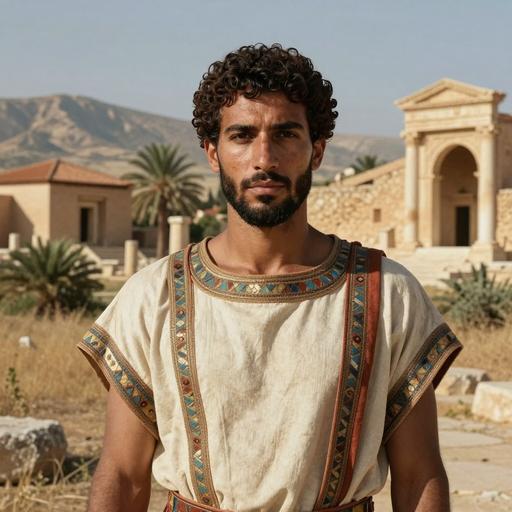
Portrait reconstruction of R10770
Ancient Individual

A man buried in Algeria in the Antiquity era

R10770
81 CE - 210 CE
Male
The Numido-Roman Berber Era
Algeria
Scroll to begin
Chapter I

Identity

The biological and cultural markers that define this ancient individual

Sample ID

R10770

Date Range

81 CE - 210 CE

Biological Sex

Male

mtDNA Haplogroup

Not available

Y-DNA Haplogroup

Not available

Cultural Period

The Numido-Roman Berber Era

Chapter II

Place

Where this individual was discovered

Country Algeria
Locality Sitifis. Necropole Orientale
Coordinates 36.1898, 5.4108
Chapter III

Time

When this individual lived in the broader context of human history

R10770 81 CE - 210 CE
Chapter IV

Story

The narrative of this ancient life

The Numido-Roman Berber era is a fascinating period in the history of North Africa, characterized by the interaction and blending of indigenous Berber culture with the political, social, and economic structures introduced by the Roman Empire. This era, primarily spanning from the end of the 3rd century BCE to the fall of the Western Roman Empire in the 5th century CE, was marked by a dynamic fusion of traditions and customs that significantly influenced the region's historical and cultural development.

The Numidian Kingdom

Before Roman involvement, the region we now know as Algeria was inhabited by Berber tribes, among which the Numidians were particularly prominent. The Numidian Kingdom emerged as a significant political entity in the 3rd century BCE under the leadership of King Massinissa. The kingdom initially allied with Rome during the Second Punic War against Carthage. Massinissa's reign established the foundation for future interaction with Rome, as he sought to model his administration on Roman governance, even adopting some aspects of Roman culture.

Roman Influence and Annexation

With the fall of Carthage in 146 BCE, Roman influence in North Africa increased. The Numidian kingdom maintained a level of autonomy but was increasingly drawn into the orbit of Roman politics. Following internal strife and the Jugurthine War, where Rome intervened to resolve a succession dispute, Rome annexed Numidia as a province by the 1st century BCE. This marked a major shift in the region, as Roman infrastructure, urban planning, and economic practices began to be implemented extensively.

Urbanization and Economy

One of the most notable contributions of the Romans to the Numido-Roman Berber culture was urbanization. Cities such as Timgad (Thamugadi), Djemila (Cuicul), and Tipasa flourished under Roman rule. These cities were built with typical Roman layouts – featuring forums, baths, theatres, and villas – and became centers of trade, culture, and politics.

The economy during this period was also transformed. Agriculture benefitted from Roman techniques and innovations, including the construction of roads and aqueducts that facilitated both trade and irrigation. North Africa became a critical supplier of wheat, olives, and other goods to the broader Roman Empire, integrating the region further into the imperial economy.

Cultural Synthesis

Cultural synthesis was a defining hallmark of this era. While Roman law, language (Latin), and customs were introduced, Berber traditions and languages persisted, creating a unique hybrid culture. Berbers adopted many Roman customs but retained their distinct local practices and identities. This blend of cultures is evident in artifacts, religious practices, and architectural styles that combine Roman forms with Berber motifs.

Religious life during this era also reflected cultural blending. Traditional Berber deities were worshiped alongside Roman gods, and the spread of Christianity in the region brought another layer of religious complexity. The Church gained significant influence, and regions like Hippo Regius (home to St. Augustine) became intellectual centers of early Christianity.

Legacy

The legacy of the Numido-Roman Berber era is enduring. The blending of Roman and Berber elements created a foundation for the unique cultural identity of North Africa that persisted even after the decline of Roman power in the region. The remnants of Roman cities and architecture continue to testify to this rich period of cultural fusion.

In sum, the Numido-Roman Berber era stands out as a time of great transformation and cultural integration. It represents a period where indigenous Berber society met and mixed with the advanced administrative and cultural mechanisms of the Roman Empire, producing a lasting impact on the historical trajectory of North Africa.

Chapter V

Genetics

The genetic ancestry of this ancient individual

Ancient Genetic Admixture

This analysis compares the DNA profile of R10770 with ancient reference populations, showing the genetic composition in terms of prehistoric ancestral groups.

Neolithic Farmers 58.8%
European Hunter-Gatherers 18.5%
Ancient Africans 15.9%
Western Steppe Pastoralists 6.8%

Modern Genetic Admixture

This analysis compares the DNA profile with present-day reference populations, showing what percentage of genetic makeup resembles modern populations from different regions.

Africa 67.8%
North African 56.6%
North African 50.7%
Egyptian 5.9%
Northern East African 8.7%
Ethiopian 8.6%
Congolese & Southern East African 2.4%
South East African 2.4%
Europe 28.9%
Southern European 28.9%
Iberian 18.4%
Sardinian 10.5%
Asia 3.3%
Arab, Egyptian & Levantine 3.3%
Arabian 3.3%

Closest Modern Populations

These are the modern populations showing the closest statistical alignment to A man buried in Algeria in the Antiquity era, ranked by genetic distance. Lower distance values indicate closer statistical similarity.

1
Moroccan North
3.2710
2
Tunisia
3.4250
3
Tunisian Berber Tamezret
3.8049
4
Tunisian Berber Zraoua
3.9740
5
Tunisian Berber Matmata
4.1310
6
Berber Tunisia Sen
4.2013
7
Tunisian
4.3581
8
Berber Tunisia Chen
4.6793
9
Algerian
5.2221
10
Libyan
5.6865
Chapter VI

Context

Other ancient individuals connected to this sample

Sources

References

Scientific publications and genetic data

G25 Coordinates

The G25 coordinates for sample R10770 can be used for detailed admixture analysis in our G25 Studio tool.

R10770,-0.02667892,0.14286902,-0.00053328,-0.06796944,0.0290647,-0.0346547,-0.01646862,0.0062002,0.06349336,0.03262218,0.00320656,-0.00011856,0.0105905,-0.012565,0.00580516,-0.00429816,0.00841642,-0.01512238,-0.02309748,0.00680438,-0.01024204,-0.01973364,0.01185872,-0.00502756,0.00260666
Analyze in G25 Studio
Use code for 40% off Expires Feb 26