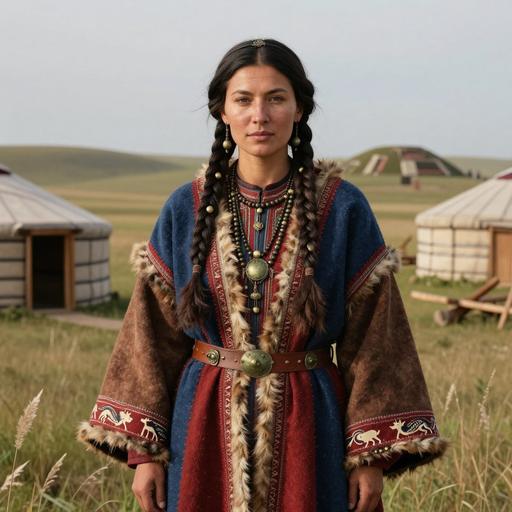
The Pazyryk Culture, part of the larger Scythian and Saka nomadic traditions, represents a fascinating era of Iron Age society in the Eurasian steppes, particularly around the Altai Mountains region, which includes parts of modern-day Kazakhstan. Berel, in Kazakhstan, is a significant archaeological site providing invaluable insights into this culture.
Geographical Context
The Berel site, located in the northeastern part of Kazakhstan, lies in the rugged landscapes of the Altai Mountains. This region is characterized by its steppe, forest, and mountainous environments, which provided a unique combination of resources and challenges. The Pazyryk People inhabited this area during the early Iron Age, roughly from the 6th to the 3rd century BCE.
Cultural Characteristics
1. Nomadic Lifestyle:
The Pazyryk Culture, like many of its Scythian counterparts, was primarily nomadic. They relied heavily on animal husbandry, particularly horses, which were central to their way of life – not only for transportation but also for warfare and trade.
2. Social Structure:
The social structure of the Pazyryk people was hierarchical, with evidence suggesting the existence of an elite class possibly comprising chieftains or warriors. This is inferred from the opulence of the burial mounds, known as kurgans, where the elite were interred with rich grave goods.
3. Burial Practices:
One of the most distinguishing features of the Pazyryk Culture is their burial practices. The kurgans uncovered at Berel and other sites often contain human and equine remains, buried with a plethora of grave goods. These goods include textiles, tools, jewelry, wooden objects, and remarkably well-preserved items due to the permafrost that acted as a natural preservative.
4. Art and Craftsmanship:
The Pazyryk people were skilled artisans. Their art often featured animal motifs, executed in what is now commonly known as the \Animal Style". This form of art depicted stylized animals and mythical creatures in dynamic poses, demonstrating the symbolic importance of animals in their culture.
5. Technology and Metallurgy:
Being an Iron Age culture, the Pazyryk were skilled metalworkers. They produced iron weapons and tools, as well as gold and bronze ornaments. The craftsmanship of these items indicates a high level of technical skill and artistic creativity.
Archaeological Discoveries
The Berel site has yielded numerous archaeological treasures, providing a window into the Pazyryk lifestyle:
Kurgans: The burial mounds at Berel are particularly famous. Excavations have uncovered tombs with well-preserved remains, including human bodies, horses, and an array of artifacts.
Textiles: Some of the most significant finds from Pazyryk sites are textiles, including carpets and clothing, which have provided insights into the weaving techniques and styles of the era.
Preserved Corpses: Due to the permafrost conditions, some human and horse mummies have been discovered in a remarkably preserved state, offering clues about their diet, health, and even tattoos.
Cultural Significance
The Pazyryk Culture is significant not only for its contributions to our understanding of Iron Age nomadic societies but also for its influence on later cultures. The art and crafts of the Pazyryk people reflect a cosmopolitan culture that engaged in long-distance trade and cultural exchanges across the Eurasian steppes.
Interactions and Influence
The Pazyryk Culture existed at a crossroads of civilizations. They interacted with numerous other cultures, including those to the east like the Xiongnu and to the west like the early Slavic and Persian cultures. These interactions facilitated the exchange of goods, technologies, and ideas.
Legacy
The Pazyryk people left behind a legacy that continues to intrigue historians, archaeologists, and the general public. Their artifacts provide a tangible connection to the past and offer insights into the life, beliefs, and art of the ancient nomadic peoples of the Eurasian steppes. Their cultural and artistic expressions continue to be a subject of study for understanding the broader tapestry of human history during the Iron Age.
In essence, the Pazyryk Culture of Berel, Kazakhstan, epitomizes the rich and dynamic history of the nomadic tribes that roamed the Eurasian steppes, leaving behind a legacy of art, craftsmanship, and insights into the human experience of their era."