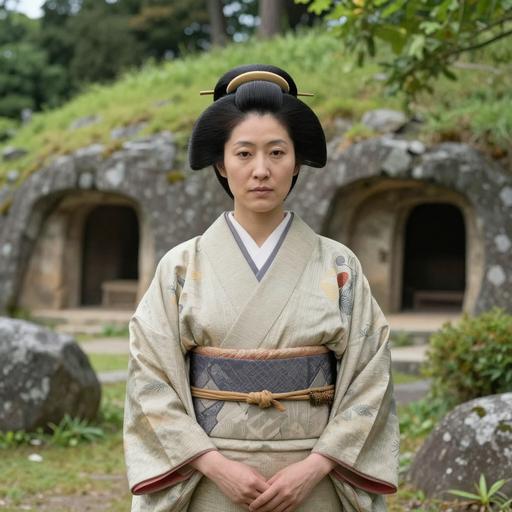
The Kofun period, lasting from approximately the mid-3rd century to the early 7th century, is a pivotal era in Japanese history, marking significant political, social, and cultural transformations. It is named after the large tumulus mounds, called \kofun," that were constructed as burial sites for the ruling elite during this time. The period witnessed the emergence of a more centralized state structure and the establishment of key cultural practices that would persist throughout Japanese history.
Political Structure and Society
Emergence of Powerful Clans:
- The Kofun period is characterized by the dominance of powerful regional clans known as "uji," each led by a chieftain. The Yamato clan eventually emerged as the most influential, coming to dominate much of the archipelago.
- These clans were integral to the formation of a more centralized authority, with the Yamato leaders leveraging alliances and military might to assert control over surrounding regions.
Centralization and State Formation:
- The consolidation of political power under the Yamato court laid the groundwork for a more unified Japanese state.
- Influences from the Korean Peninsula and China, including bureaucratic and administrative techniques, played a significant role in this centralization process.
Social Hierarchy:
- Society was hierarchically structured, with a clear division between the elite ruling class and commoners.
- The elite were distinguished by their political power, wealth, and access to prestigious goods obtained through trade and tribute.
Culture and Religion
Shinto Practices:
- Indigenous religious beliefs, which would later be codified as Shinto, were prevalent. These involved the worship of kami (spirits or gods) associated with natural phenomena, ancestors, and important clan deities.
- Ritual practices and ceremonies were important in both political and social contexts, serving as a means to legitimize the power of the ruling elite.
Burial Mounds (Kofun):
- The kofun themselves are key cultural artifacts from this period. These earthen mounds, often shaped like keyholes, served as tombs for the elite and symbolize the hierarchical nature of Kofun society.
- The tombs were accompanied by grave goods, including bronze mirrors, iron weapons, and clay haniwa figures, which provide insights into the material culture and beliefs of the time.
Art and Artifacts:
- Haniwa figures, made of terracotta, are among the most distinctive artifacts of this era. They served both decorative and ritual purposes, often being placed around the kofun.
- The period also saw the production of sophisticated metalwork and pottery, indicating advanced craftsmanship and trade links with neighboring cultures.
Economic and Technological Developments
Agriculture and Land Management:
- Advances in agricultural techniques led to increased productivity, which supported population growth and the development of larger settlements.
- Rice cultivation continued to be the backbone of the economy, with agricultural surplus allowing for the support of a warrior and artisan class.
Trade and External Relations:
- The Kofun period was marked by active trade and cultural exchanges with the Korean Peninsula and China. This led to the introduction of new technologies, such as ironworking and advanced pottery techniques.
- External influences also extended to military practices, architecture, and the adaptation of Chinese writing, which would lay the groundwork for the development of the Japanese script.
In conclusion, the Kofun period is critical to understanding the transition of Japan from fragmented tribal societies to a more unified state with a rich cultural identity. It set the stage for the subsequent Asuka period, during which Japan would further embrace continental influences and continue its transformation into a more sophisticated and centralized state. The legacy of the Kofun period is still visible today in Japan's cultural and historical landscape, particularly through its burial mounds and the enduring influence of early clan cultures."