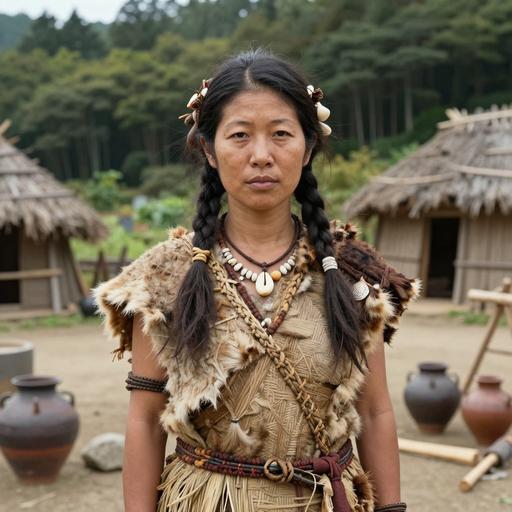
The Jomon period is a significant era in Japanese prehistory, spanning from approximately 14,000 BC to 300 BC. It is named after the distinctive \cord-marked" pottery produced during this time, and it represents one of the oldest known cultures of pottery-making in the world. The Jomon period is divided into several phases: Incipient, Initial, Early, Middle, Late, and Final, each characterized by advancements in technology, lifestyle, and social organization.
Incipient Jomon (c. 14,000–10,500 BC)
The Incipient Jomon period marks the transition from a hunter-gatherer society to more settled and complex communities. This era coincides with the end of the last Ice Age, which brought about changes in the climate, resulting in a richer and more diverse environment in Japan. The inhabitants, who had previously relied on hunting and gathering, began to exploit a broader range of resources, including fishing. The pottery of this era was simple and functional, used primarily for cooking and storage.
Initial Jomon (c. 10,500–7,000 BC)
During the Initial Jomon period, the population grew and began forming more permanent settlements, particularly along the coasts and river valleys. Communities depended much on marine resources, and some evidence suggests the beginnings of horticulture. The pottery evolved to become more decorative, with the characteristic cord-marked patterns, which were possibly created using ropes or sticks wrapped with cords.
Early Jomon (c. 7,000–5,200 BC)
The Early Jomon period is marked by the development of more complex societal structures. Settlements became larger, some consisting of pit dwellings arranged in a circular or horseshoe configuration. Pottery at this stage became increasingly ornate and varied, including deep bowls and cooking vessels. During this phase, there are indications of a semi-sedentary lifestyle, with evidence of forest management and cultivation of nuts and other native plants.
Middle Jomon (c. 5,200–3,500 BC)
This phase is often considered the peak of Jomon culture due to its widespread population distribution and the high level of artistic and technological achievement. The climate was warmer, supporting larger populations, who expanded into new areas. Pottery craftsmanship reached new heights with intricate designs and sophisticated techniques. There was also a flourishing of other forms of art, including elaborate lacquerwork, stone tools, and the creation of clay figurines known as dogū, believed to have spiritual or ritual significance.
Late Jomon (c. 3,500–2,500 BC)
During the Late Jomon period, environmental changes, notably cooling temperatures, prompted shifts in settlement patterns to more defensible and resource-rich areas. Pottery styles further diversified, with some regions developing unique local characteristics. The role of ritual and religion may have increased, as evidenced by the large quantities of dogū and other ritual artifacts discovered.
Final Jomon (c. 2,500–300 BC)
The Final Jomon period saw further adaptation to environmental changes, with people moving to smaller, more dispersed settlements. Social structure likely became more hierarchical, perhaps in response to more limited resources. The pottery styles continued evolving, and while it was less ornate than that of the Middle Jomon, it often featured new shapes and functions.
Culture and Society
The Jomon people are believed to have had a rich animistic belief system, viewing natural elements and animals as imbued with spiritual significance. This is reflected in the elaborate ceremonial objects and burial practices. The dogū figurines and masked clay figures suggest a sophisticated spiritual life possibly centered around fertility, healing, and protection.
Socially, the Jomon society was largely egalitarian but became increasingly complex through time, with variations in settlement sizes and burial goods indicating emerging social stratification. The communities were connected by trade networks that allowed the exchange of goods like obsidian, jade, and marine products.
Conclusion
The Jomon period is crucial in understanding prehistoric Japan's development, laying social, technological, and cultural foundations. Its legacy is evident in Japan's continued appreciation and reverence for traditional crafts and its deep connection with nature, aspects characteristic of the Jomon culture. The period's rich archaeological record offers insights into a society that was remarkably resilient and adaptive, embracing innovation while maintaining a harmonious relationship with the natural environment."