Menu
Currency
Main
Store
Blog

Loading Report

Preparing your ancestry journey

Connecting to ancient matches...

Preparing your report

Skip to main content
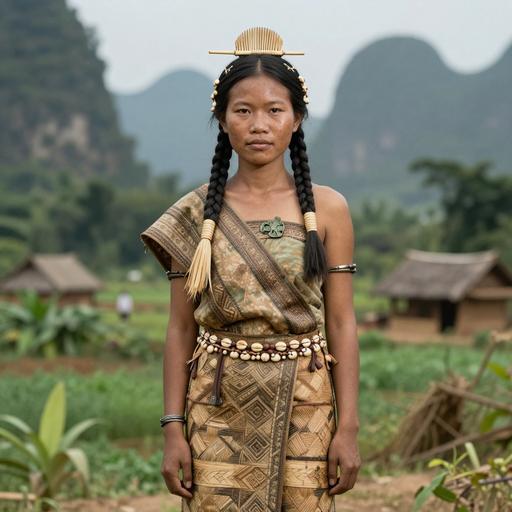
Portrait reconstruction of A woman buried in Laos in the Bronze Age era
Ancient Individual

A woman buried in Laos in the Bronze Age era

A woman buried in Laos during the Bronze Age Laos

A fragment of the ancient world, preserved across millennia in strands of DNA.

La727
459 BCE - 231 BCE
Female
Laos
Scroll to begin
Chapter I

Identity

The biological and cultural markers that define this ancient individual

Sample ID

La727

Date Range

459 BCE - 231 BCE

Cultural Period

Bronze Age Laos

Biological Sex

Female

mtDNA Haplogroup

N9a6

Y-DNA Haplogroup

N/A (Female)

Chapter II

Place

Where this individual was discovered

Country Laos
Locality Northeast Huapan. Tam Hang
Chapter III

Time

When this individual lived in the broader context of human history

La727 459 BCE - 231 BCE
Chapter IV

Story

The narrative of this ancient life

The Bronze Age in Laos is a fascinating period in Southeast Asian history that sheds light on the early development of civilizations within the region. During this era, which roughly spans from 1500 BCE to 500 BCE, significant cultural, technological, and social transformations took place. The study of this period provides insight into the early human settlements, the advent of metallurgy, and the intricate web of interactions across Southeast Asia.

Geography and Environment

Laos, a landlocked country in Southeast Asia, is characterized by its mountainous terrain, dense forests, and the Mekong River, which runs through its western boundary. This geographical setting significantly influenced the Bronze Age cultures in Laos, as it provided both challenges and opportunities for early communities. Fertile river valleys facilitated agriculture, while the jungles and mountains may have offered resources such as game, timber, and minerals. The Mekong River served as a crucial conduit for trade and cultural exchange, connecting Laos to distant regions.

Bronze Metallurgy

One of the defining characteristics of the Bronze Age is the development and use of bronze, an alloy of copper and tin. In Laos, as in other parts of Southeast Asia, this technological innovation marked a significant advancement. The inception of bronze metallurgy in the region is attributed to external influences and local ingenuity. Archaeological evidence suggests that the inhabitants of Laos were engaged in bronze production, although the specific sites and extent of this activity continue to be subjects of research.

Archaeological Discoveries

Key archaeological sites have provided critical evidence of Bronze Age activity in Laos. Sites such as Ban Chiang in neighboring Thailand have parallel cultures that likely influenced Laos, sharing technological and artistic developments. While specific Lao sites are lesser-known compared to Thailand and Vietnam, discoveries in Laos contribute to understanding regional networks of trade and communication.

Society and Culture

Bronze Age societies in Laos were likely organized in small, village-based communities, with a reliance on agriculture and supported by hunting and gathering. The social structure may have been relatively egalitarian, transitioning slowly towards more hierarchical systems as societies grew more complex.

The role of craftsmen was vital, particularly those skilled in metallurgy and pottery, as these crafts not only fulfilled practical needs but also played symbolic roles in society. Pottery from Bronze Age sites shows a variety of forms and decorations, indicating a rich cultural expression and possibly societal status markers.

Cultural Interactions

During the Bronze Age, Laos was part of a broader cultural and trade network across Southeast Asia. The diffusion of bronze technology itself suggests established trade routes and interactions with neighboring regions. This exchange brought goods, ideas, and possibly people, fostering a diverse cultural milieu.

Subsistence and Economy

Agriculture was the cornerstone of Bronze Age subsistence strategies. Rice, a staple crop, was likely cultivated along river valleys, contributing to the stability and growth of settlements. The domestication of animals supplemented agricultural production, with evidence suggesting the use of cattle and pigs.

Religion and Rituals

Religious beliefs and practices during this era are not well-documented, but it is plausible that animistic traditions predominated, as later historical practices suggest continuity of these beliefs. Artifacts such as ritual bronze items and burial goods imply a belief system that included an afterlife or the importance of spiritual worlds.

Conclusion

The Bronze Age in Laos represents a foundational period that shaped its historical trajectory. While much remains to be discovered, existing evidence highlights the dynamic interplay between technology, geography, and culture. Understanding this era aids in comprehending the longstanding cultural patterns that influence Southeast Asian civilizations to this day. As ongoing archaeological research continues to unearth new findings, our understanding of Bronze Age Laos will undoubtedly deepen, offering a more comprehensive picture of its past.

Context

Related Samples

This individual exists within a broader network of ancient samples. No ancient genome stands alone.

Sample ID Culture/Period Date Location Action
In661 Late Neolithic to Iron Age Indonesia 30 CE Sumatra. Northwest Aceh. Loyang Ujung Cave, Indonesia View
In662 Late Neolithic to Iron Age Indonesia 353 BCE Sumatra. Northwest Aceh. Loyang Ujung Cave, Indonesia View
La364 Late Neolithic to Bronze Age Laos 1125 BCE Northeast Huapan. Tam Pa Ping, Laos View
La368 The Hoabinhian Culture 6012 BCE Northern Bolikhamsay. Pha Faen, Laos View
La727 Bronze Age Laos 459 BCE Northeast Huapan. Tam Hang, Laos View
La898 Unknown Era in Laos 8000 BCE Northeast Huapan. Tam Hang, Laos View
Ma554 Historical Malaysia 1448 CE Northeast Borneo. Sabah. Supu Hujung4, Malaysia View
Ma555 Historical Malaysia 1505 CE Northeast Borneo. Sabah. Kinabatagan, Malaysia View
Ma911 Hoabinhian Culture, Malaysia 2463 BCE West Peninsular Kelantan. Gua Cha Cave, Malaysia View
Phl534 Red Slipped Pottery Culture, Philippines 84 CE Luzon. Northern Cagayan. Nagsabaran, Philippines View
Th519 Iron Age Thailand 236 CE Northern Mae Hong Son. Long Long Rak, Thailand View
Th521 Iron Age Thailand 215 CE Northern Mae Hong Son. Long Long Rak, Thailand View
Th530 Iron Age Thailand 238 CE Northern Mae Hong Son. Long Long Rak, Thailand View
Th531 Iron Age Thailand 259 CE Northern Mae Hong Son. Long Long Rak, Thailand View
Vt833 Late Neolithic Vietnam 2343 BCE Northern Thanh Hoa. Mai Da Dieu, Vietnam View
Vt880 Late Neolithic Vietnam 2500 BCE Northeast Quang Ninh. Hhon Hai Co Tien, Vietnam View
JHF05 Modern Malaysia 2000 CE West Peninsular Northern Perak, Malaysia View
JHM06 Modern Malaysia 2000 CE West Peninsular Northern Perak, Malaysia View
IK002 The Jomon Period in Japan 897 BCE Honshu. Central Aichi. Ikawazu, Japan View
Ma912 Late Neolithic Malaysia 744 BCE West Peninsular Kelantan. Gua Cha Cave, Malaysia View
Vt779 Bronze Age Dong Son Culture, Vietnam 386 BCE Northern Thanh Noa. Nui Nap, Vietnam View
Vt781 Bronze Age Dong Son Culture, Vietnam 389 BCE Northern Thanh Noa. Nui Nap, Vietnam View
Vt796 Bronze Age Dong Son Culture, Vietnam 350 BCE Northern Thanh Noa. Nui Nap, Vietnam View
Vt808 Bronze Age Dong Son Culture, Vietnam 391 BCE Northern Thanh Noa. Nui Nap, Vietnam View
Vt719 Historical Vietnam 1641 CE Northeast Quang Ninh. Hon Hai Co Tien, Vietnam View
Vt777 Late Neolithic Vietnam 399 BCE Northern Thanh Hoa. Mai Da Dieu, Vietnam View
Vt778 Late Neolithic Vietnam 800 BCE Northwest Lai Châu. Nam Tun, Vietnam View
Th519 236 CE Northern Mae Hong Son. Long Long Rak, Thailand View
IK002 897 BCE Honshu. Central Aichi. Ikawazu, Japan View
Ma912 744 BCE West Peninsular Kelantan. Gua Cha Cave, Malaysia View
Vt719 1641 CE Northeast Quang Ninh. Hon Hai Co Tien, Vietnam View
Vt777 399 BCE Northern Thanh Hoa. Mai Da Dieu, Vietnam View
Vt778 800 BCE Northwest Lai Châu. Nam Tun, Vietnam View
Vt779 386 BCE Northern Thanh Noa. Nui Nap, Vietnam View
Vt781 389 BCE Northern Thanh Noa. Nui Nap, Vietnam View
Vt796 350 BCE Northern Thanh Noa. Nui Nap, Vietnam View
Vt808 391 BCE Northern Thanh Noa. Nui Nap, Vietnam View
Sample ID Culture/Period Date Location Action
La727 Bronze Age Laos 459 BCE Northeast Huapan. Tam Hang, Laos View
Sources

References

Scientific publications and genetic data that inform this profile.

Scientific Publication

The prehistoric peopling of Southeast Asia

Authors McColl H, Racimo F, Vinner L, Demeter F, Gakuhari T et al.
Abstract

The human occupation history of Southeast Asia (SEA) remains heavily debated. Current evidence suggests that SEA was occupied by Hòabìnhian hunter-gatherers until ~4000 years ago, when farming economies developed and expanded, restricting foraging groups to remote habitats. Some argue that agricultural development was indigenous; others favor the "two-layer" hypothesis that posits a southward expansion of farmers giving rise to present-day Southeast Asian genetic diversity. By sequencing 26 ancient human genomes (25 from SEA, 1 Japanese Jōmon), we show that neither interpretation fits the complexity of Southeast Asian history: Both Hòabìnhian hunter-gatherers and East Asian farmers contributed to current Southeast Asian diversity, with further migrations affecting island SEA and Vietnam. Our results help resolve one of the long-standing controversies in Southeast Asian prehistory.

Use code for 25% off Expires Jul 13