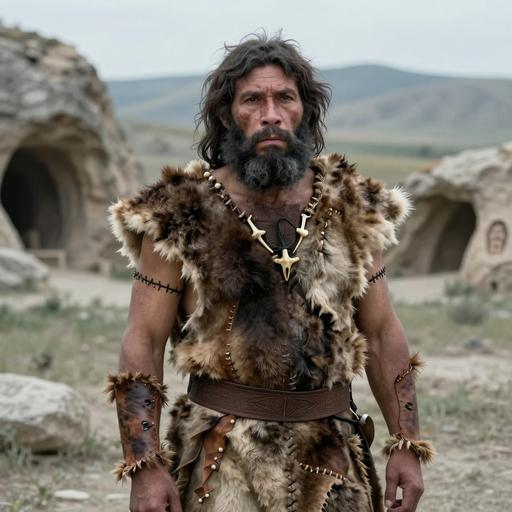
The Mezmaiskaya 2 Neanderthal represents the remains of a Neanderthal individual that was discovered in the Mezmaiskaya Cave, located in the northwestern Caucasus Mountains of Russia. This cave has provided substantial archaeological and paleoanthropological insights, offering a rich tapestry of Neanderthal life, environment, and cultural practices. The remains in Mezmaiskaya Cave date back to a period when Neanderthals coexisted and eventually overlapped with anatomically modern humans, making it highly significant for understanding the transition period in human evolution.
Era and Environment
Time Period:
The Mezmaiskaya 2 Neanderthal is dated to approximately 40,000 years ago, placing it in the late Middle Paleolithic to early Upper Paleolithic transition. This period is crucial as it marks the last chapters of Neanderthal existence in Europe and their eventual replacement by, or assimilation into, modern human populations.
Geographical Context:
The Caucasus region, where the Mezmaiskaya Cave is located, served as a crossroads between Europe and Asia. The rugged terrain and diverse ecosystems — ranging from mountains to forested valleys — provided a variety of resources but also posed significant challenges due to climatic fluctuations during the Pleistocene.
Cultural Aspects
Tool Use:
Neanderthals are renowned for their Mousterian stone tool technology, which involved the production of flake tools using the Levallois technique. These tools indicate a high degree of cognitive ability and adaptability to different environments. From Mezmaiskaya Cave, a variety of tools such as scrapers, points, and other bifacially modified implements have been unearthed, reflective of toolkits used for hunting and processing animal carcasses.
Subsistence and Diet:
Evidence suggests that Neanderthals in this region had a largely carnivorous diet, supplemented with plant materials. The fauna from Mezmaiskaya includes remains of large mammals such as bison, deer, and woolly rhinoceroses, indicating that these were hunted and processed within the cave. Stable isotope analysis of Neanderthal remains also supports the heavy reliance on meat.
Symbolic Thought and Behavior:
While traditionally viewed as less sophisticated than modern humans, evidence is gradually emerging that Neanderthals engaged in practices indicative of symbolic thought, such as the use of pigments and possibly body adornments. However, less direct evidence for symbolic behavior comes from Mezmaiskaya compared to other sites in Europe.
Physical Characteristics
Anatomy:
Remains from Mezmaiskaya Cave, including the Mezmaiskaya 2 Neanderthal, exhibit classic Neanderthal features: robust skeletal structures, short, stocky builds adapted to cold climates, and distinctive cranial features such as a protruding brow ridge and large nasal cavities.
Adaptations:
Neanderthals were well-adapted to the cold, possessing not just physical attributes that conserved heat but also cultural adaptations such as fire control and specialized clothing, possibly inferred from tool use suggestive of hide processing.
Social Aspects
Community Structure:
Though direct evidence from Mezmaiskaya is limited, Neanderthals were highly social, living in small, tight-knit groups. They relied on shared knowledge, social learning, and possibly a form of communicated planning, as evidenced by the subdivision of space within caves for different functions such as tool-making and butchery.
Interbreeding with Modern Humans:
The Mezmaiskaya 2 Neanderthal is from a time when interactions with emerging modern human populations might have occurred, leading to gene flow between the populations. Genetic studies imply that interbreeding events contributed to the presence of Neanderthal DNA in modern non-African human genomes.
Conclusion
The Mezmaiskaya 2 Neanderthal offers a glimpse into the life and times of a dwindling branch of the human family tree during a pivotal moment of transition and eventual convergence with modern humans. The evidence from Mezmaiskaya Cave underscores the adaptive nature, cultural practices, and social structures of Neanderthals, challenging earlier misconceptions and painting a more complex picture of these resilient and resourceful hominins.