Menu
Store
Blog
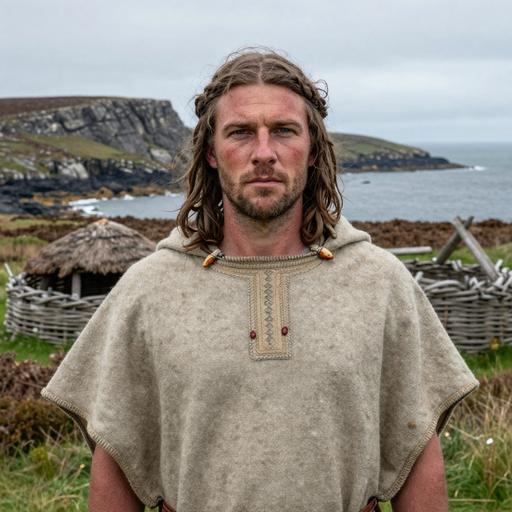
Portrait reconstruction of rath2
Ancient Individual

A man buried in Ireland in the Copper Age to Early Bronze Age era

rath2
2026 BCE - 1700 BCE
Male
Early Bronze Age Ireland
Ireland
Scroll to begin
Chapter I

Identity

The biological and cultural markers that define this ancient individual

Sample ID

rath2

Date Range

2026 BCE - 1700 BCE

Biological Sex

Male

mtDNA Haplogroup

U5b2a2

Y-DNA Haplogroup

R1b1a1b1a1a2c1a5c

Cultural Period

Early Bronze Age Ireland

Chapter II

Place

Where this individual was discovered

Country Ireland
Locality Rathlin Island. County Antrim
Coordinates 55.2921, -6.1917
Chapter III

Time

When this individual lived in the broader context of human history

rath2 2026 BCE - 1700 BCE
Chapter IV

Story

The narrative of this ancient life

The Early Bronze Age in Ireland, spanning approximately from 2500 to 1500 BCE, represents a pivotal era in the island's prehistoric development. This period was marked by substantial social, technological, and cultural transformations that laid the groundwork for future Celtic societies, although it predates Celtic influence.

Technological and Material Advances:

One of the principal characteristics of the Early Bronze Age in Ireland was the introduction and extensive use of metal, particularly bronze, which is an alloy typically consisting of copper and tin. This development marked a shift from the Stone Age reliance on flint and stone tools to more efficient and durable metal implements. The earliest phase of bronze working is often termed the Beaker culture, named after the distinctive pottery styles associated with it. These communities engaged in metallurgy, smelting copper from regions like Mount Gabriel in Cork and importing tin, likely from regions like Cornwall.

Settlements and Architecture:

During this era, the Irish landscape was dotted with small, often dispersed settlements. People primarily lived in circular wooden houses with wattle and daub walls and thatched roofs. These settlements were typically located near water sources, both for sustenance and transportation.

One of the most renowned architectural developments of the Early Bronze Age was the construction of extensive burial monuments. These included wedge tombs, stone circles, and cist graves, all of which played significant roles in ritual and community life. Wedge tombs, for instance, are primarily found in the western and northern parts of Ireland and are characterized by their narrowing shape toward the rear.

Social Organization and Culture:

The Early Bronze Age in Ireland saw the emergence of more stratified societies. The ability to produce bronze tools and ornaments led to increased social differentiation. Wealth and status became associated with the possession of metal goods, especially ornamental objects. Personal adornments included bracelets, lunulae (crescent-shaped neck ornaments), and other jewelry, often buried with high-status individuals.

Despite the lack of written records from this time, much can be inferred about religious and cultural life from the archaeological record. Megalithic art, especially the carvings found on tombs and stones, suggests a rich spiritual or religious life, possibly with a focus on ancestor worship or the veneration of natural elements like the sun and the moon.

Agriculture and Economy:

Subsistence practices during the Early Bronze Age involved a mix of agriculture, pastoralism, and hunting-gathering. Communities cultivated crops such as wheat and barley and raised livestock, including cattle, sheep, and pigs. The economy was largely based upon a combination of these agricultural practices, supplemented by hunting of wild animals and foraging for wild food resources.

Trade networks began to expand beyond local regions, facilitated by the demand for metal resources. Although less documented than in later periods, it's likely that maritime trade routes were established, given Ireland's expansive coastline and evidence of imported goods.

Legacy and Transition:

The Early Bronze Age set the stage for subsequent cultural developments in Ireland. As the period progressed, the techniques and ornamentation associated with metalworking became more complex and varied. The social changes initiated during this time, such as increased stratification and settlement hierarchy, helped form the foundations upon which Iron Age Celtic culture would later build.

Even though the Celtic influence is more closely tied to the late Bronze Age and Iron Age, the groundwork laid during this epoch was crucial. The Early Bronze Age in Ireland encapsulates a civilization in transition—a society evolving technologically, artistically, and socially against the backdrop of an ever-changing prehistoric landscape.

Chapter V

Genetics

The genetic ancestry of this ancient individual

Ancient Genetic Admixture

This analysis compares the DNA profile of rath2 with ancient reference populations, showing the genetic composition in terms of prehistoric ancestral groups.

Western Steppe Pastoralists 38.2%
European Hunter-Gatherers 34.6%
Neolithic Farmers 19.9%
Ancient Native Americans 2.9%
Ancient Africans 2.3%
Ancient Asians 2.0%

Modern Genetic Admixture

This analysis compares the DNA profile with present-day reference populations, showing what percentage of genetic makeup resembles modern populations from different regions.

Europe 90.3%
Northwestern European 61.1%
English 45.2%
Scandinavian 9.7%
Northwestern European 4.0%
Finnish 2.2%
Southern European 17.8%
Iberian 17.8%
Eastern European 11.4%
Asia 8.8%
Northern West Asian 7.5%
Caucasian 7.2%
Central Asian, Northern Indian & Pakistani 1.3%
Pakistan 1.3%
Africa 0.7%
West African 0.7%
Ghanaian, Liberian, Sierra Leonean 0.7%

Closest Modern Populations

These are the modern populations showing the closest statistical alignment to A man buried in Ireland in the Copper Age to Early Bronze Age era, ranked by genetic distance. Lower distance values indicate closer statistical similarity.

1
Orcadian
2.9730
2
Scottish
3.0833
3
Irish
3.3084
4
English
3.3584
5
Afrikaner
3.4150
6
Dutch
3.4166
7
Shetlandic
3.4770
8
English Cornwall
3.5534
9
Welsh
3.6126
10
French Brittany
3.6663
Chapter VI

Context

Other ancient individuals connected to this sample

Sources

References

Scientific publications and genetic data

Scientific Publication

Neolithic and Bronze Age migration to Ireland and establishment of the insular Atlantic genome

Authors Cassidy LM, Martiniano R, Murphy EM
Abstract

The Neolithic and Bronze Age transitions were profound cultural shifts catalyzed in parts of Europe by migrations, first of early farmers from the Near East and then Bronze Age herders from the Pontic Steppe. However, a decades-long, unresolved controversy is whether population change or cultural adoption occurred at the Atlantic edge, within the British Isles. We address this issue by using the first whole genome data from prehistoric Irish individuals. A Neolithic woman (3343-3020 cal BC) from a megalithic burial (10.3× coverage) possessed a genome of predominantly Near Eastern origin. She had some hunter-gatherer ancestry but belonged to a population of large effective size, suggesting a substantial influx of early farmers to the island. Three Bronze Age individuals from Rathlin Island (2026-1534 cal BC), including one high coverage (10.5×) genome, showed substantial Steppe genetic heritage indicating that the European population upheavals of the third millennium manifested all of the way from southern Siberia to the western ocean. This turnover invites the possibility of accompanying introduction of Indo-European, perhaps early Celtic, language. Irish Bronze Age haplotypic similarity is strongest within modern Irish, Scottish, and Welsh populations, and several important genetic variants that today show maximal or very high frequencies in Ireland appear at this horizon. These include those coding for lactase persistence, blue eye color, Y chromosome R1b haplotypes, and the hemochromatosis C282Y allele; to our knowledge, the first detection of a known Mendelian disease variant in prehistory. These findings together suggest the establishment of central attributes of the Irish genome 4,000 y ago.

G25 Coordinates

The G25 coordinates for sample rath2 can be used for detailed admixture analysis in our G25 Studio tool.

rath2,0.12238778,0.12053064,0.05732282,0.04329208,0.03366422,0.01402798,0.00256038,-0.00249848,0.00078722,-0.00405946,-0.0070893,0.0082087,-0.01239744,-0.0120067,0.02134784,-0.01270496,-0.01985272,-0.00043154,-0.00029784,-0.00369702,0.0076226,0.00054402,-0.00853074,0.0126083,-0.00522593
Analyze in G25 Studio
Use code for 40% off Expires Feb 26