Introduction
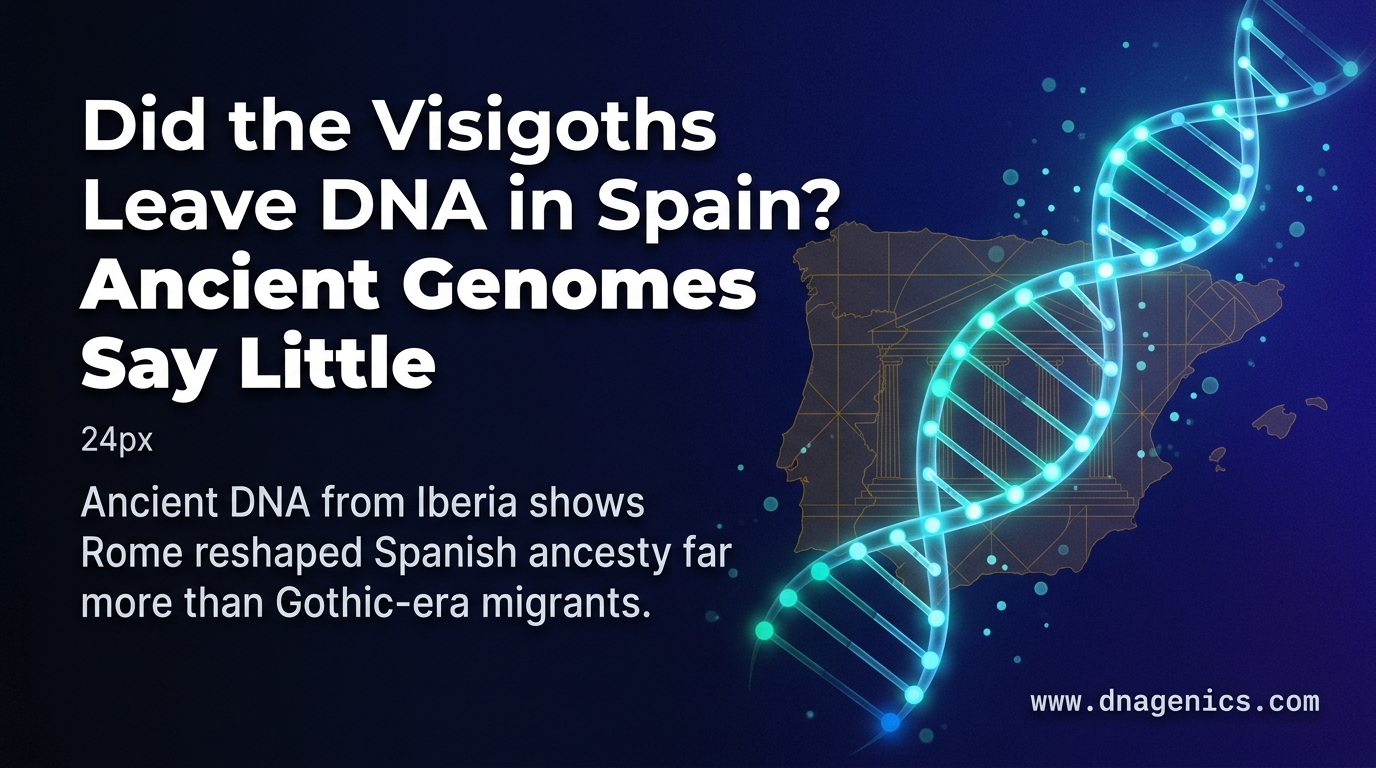
For centuries, the Visigoths occupied a special place in the Spanish imagination. Medieval rulers claimed Gothic descent, noble families prized the label, and the word godo took on meanings that ranged from aristocratic to dismissive, depending on where you were standing. That long cultural memory raises an obvious genetic question: did the Visigoths leave a strong mark on Spanish DNA?
A major ancient DNA study of Iberian genomes gives that question a nuanced answer. The short version is that the Visigoths did contribute to the genetic landscape of late antique Hispania, but their footprint was modest. The much larger transformation had already happened under Rome, when people from the eastern Mediterranean, North Africa, and other parts of the empire moved into the peninsula in significant numbers.
That distinction matters for anyone interested in DNA ancestry, migration history, and how populations change over time. Ancient DNA does not just help us identify who moved where, it also shows that cultural identity, language, and political power do not always track neatly with genetic ancestry.
Key Discoveries / Main Points
- Rome reshaped Hispania more than the Goths did, especially through migration from the eastern Mediterranean and North Africa during the Roman period.
- The Visigothic-era genetic signal is real but limited, with only a handful of individuals showing strongly elevated Central and Northern European ancestry.
- In the ancient sample, Pla de l'Horta near Girona stands out as the clearest Visigothic-period cemetery with migrant-linked ancestry patterns.
- The study used ancient DNA from 243 genomes across the Iberian Peninsula, and our analysis of 102 Iberian ancient genomes showed only six individuals with more than 40% Central and Northern European ancestry.
- The results fit historical estimates that the newcomers were a small minority compared with the much larger Hispano-Roman population.
What This Means for Your DNA
If you are tracing Spanish, Portuguese, or broader Iberian ancestry, this study is a useful reminder that ancestry is usually layered, not simple. A person living in Spain today may carry genetic signals from prehistoric Iberia, Roman-era mobility, later medieval movements, and many other episodes of population genetics. No single event defines the whole genetic story of the peninsula.
For people fascinated by the Visigoths, the result is especially important. The Gothic groups did not disappear without a trace, but their contribution was not large enough to overwrite the existing population. In practical terms, that means a modern DNA test is unlikely to reveal a neat, direct “Visigothic” marker. Instead, ancestry reports usually capture broader statistical similarity to reference populations, not a proven tribal identity.
That is where interpretation matters. A result showing affinity with Central and Northern European reference groups does not automatically mean “you descend from Visigoths.” It may reflect later movements, broader European ancestry, or deep shared components that predate the Gothic migrations altogether. Ancient DNA gives context, but it does not turn one percentage into a personal biography.
Historical and Archaeological Context
The historical backdrop is crucial. By the late Roman period, Hispania was already part of a highly connected empire. Soldiers, administrators, merchants, enslaved people, and families moved around the Mediterranean world, and the DNA record shows that movement clearly. People with ancestry linked to the eastern Mediterranean and North Africa appear in Roman Iberia long before the Visigoths became politically dominant.
The Visigoths entered Iberia in stages. Some arrived as Roman allies in the early fifth century, then the kingdom shifted south after later military defeats in Gaul. By the time the Visigothic political center was established in Toledo, the peninsula had already undergone major demographic change. Archaeology and history both support the idea that the Gothic elite ruled a much larger Hispano-Roman majority rather than replacing it.
That helps explain the cemetery evidence. At sites such as Pla de l'Horta near Girona, a small number of individuals show ancestry profiles strongly shifted toward Central and Northern Europe, while others remain primarily local Iberian. This is exactly what one might expect from a ruling minority, mixed families, and regional movement rather than a mass population replacement. The genetic record is consistent with limited migration, social mixing, and gradual integration over generations.
The Science Behind It
The study relied on ancient DNA from 243 genomes across 31 sites, spanning the first through eighth centuries. Researchers compared the genomes with reference groups and modeled ancestry using a four-source framework, including Iberian Iron Age ancestry, a Central and Northern European source, an eastern Mediterranean source, and a North African source. This kind of analysis is powerful because it can detect shifts in ancestry over time, even when written sources are silent or biased.
For additional context, a separate analysis of 102 ancient Iberian genomes used Global25 coordinates and non-negative least squares modeling. That approach is useful for visualizing broad ancestry patterns, but it also has limits. A single ancient genome can be noisy, especially if coverage is low, so moderate values must be interpreted carefully. In this case, only very elevated Central and Northern European ancestry values, especially in the right time period, were treated as meaningful evidence of migrant ancestry.
In Simple Terms: Ancient DNA works a bit like a historical map made from inherited genetic segments. Scientists compare old genomes with reference populations to see which ancient groups they most resemble, but the results show broad statistical patterns, not exact family identities.
One especially important point is that the so-called Central and Northern European component is not a Gothic label by itself. Some of that ancestry was already present in Iberia before the Visigoths arrived, and later medieval movement added more. So researchers have to combine genetics with archaeology and chronology to decide whether a signal is likely to reflect Gothic-era migration or something else.
Why It Matters
This study changes the way we think about the making of Spain. It shows that the genetic history of Iberia is not a simple story of one migrating people replacing another. Instead, it is a long sequence of contacts, imperial movement, regional settlements, and cultural transformations. In that sense, the Roman period was the major demographic turning point, while the Visigothic period added a smaller but detectable layer.
For the future of ancestry analysis, this is a good example of why ancient DNA is so valuable. It can correct long-standing myths, refine historical narratives, and show where identity was cultural, political, or elite rather than purely biological. As more ancient genomes become available, researchers will be able to map migration, marriage patterns, and local continuity in even finer detail across the Iberian Peninsula and beyond.
References / Further Reading
- Ancient genomes from the Iberian Peninsula spanning the first to eighth centuries, including Visigothic-period burials and Roman-era samples
- Historical chronology of Late Antiquity in Iberia, including the Visigothic kingdom and Roman provincial history
- Published ancient DNA work on Pla de l'Horta and related Visigothic-period cemeteries in northeastern Spain