Preparando el informe

Cargando la información y las referencias disponibles

Consultando el registro arqueológico...

Recopilando registros antiguos

Saltar al contenido principal
Aghitu Echoes: Late Hellenistic Armenia
Cultura destacada

Aghitu Echoes: Late Hellenistic Armenia

Three genomes from Aghitu illuminate a restless frontier between Hellenistic, Parthian, and local traditions

72 BCE - 60 CE
Aghitu, Armenia (Armenian Highlands)
Desplázate para empezar
Capítulo I

La historia

Comprender la cultura Aghitu Echoes: Late Hellenistic Armenia

Archaeogenetic and archaeological evidence from Aghitu, Armenia (72 BCE–60 CE) offers a preliminary glimpse into Late Hellenistic populations. Three mtDNA genomes (W, T2h, H) suggest maternal lineages common across Eurasia; Y-DNA remains undetermined due to limited male sampling.

Time Period

72 BCE – 60 CE (Late Hellenistic)

Region

Aghitu, Armenia (Armenian Highlands)

Common Y-DNA

Undetermined (no robust Y data; only 3 samples)

Common mtDNA

W (1), T2h (1), H (1)

Capítulo II

Cronología

Momentos clave de la historia de esta cultura

2500 BCE

Early Bronze cultural roots in the Highlands

Long-term settlement and trade networks in the Armenian Highlands provide deep cultural foundations later visible in Hellenistic-era sites like Aghitu.

Capítulo III

Origins & Emergence

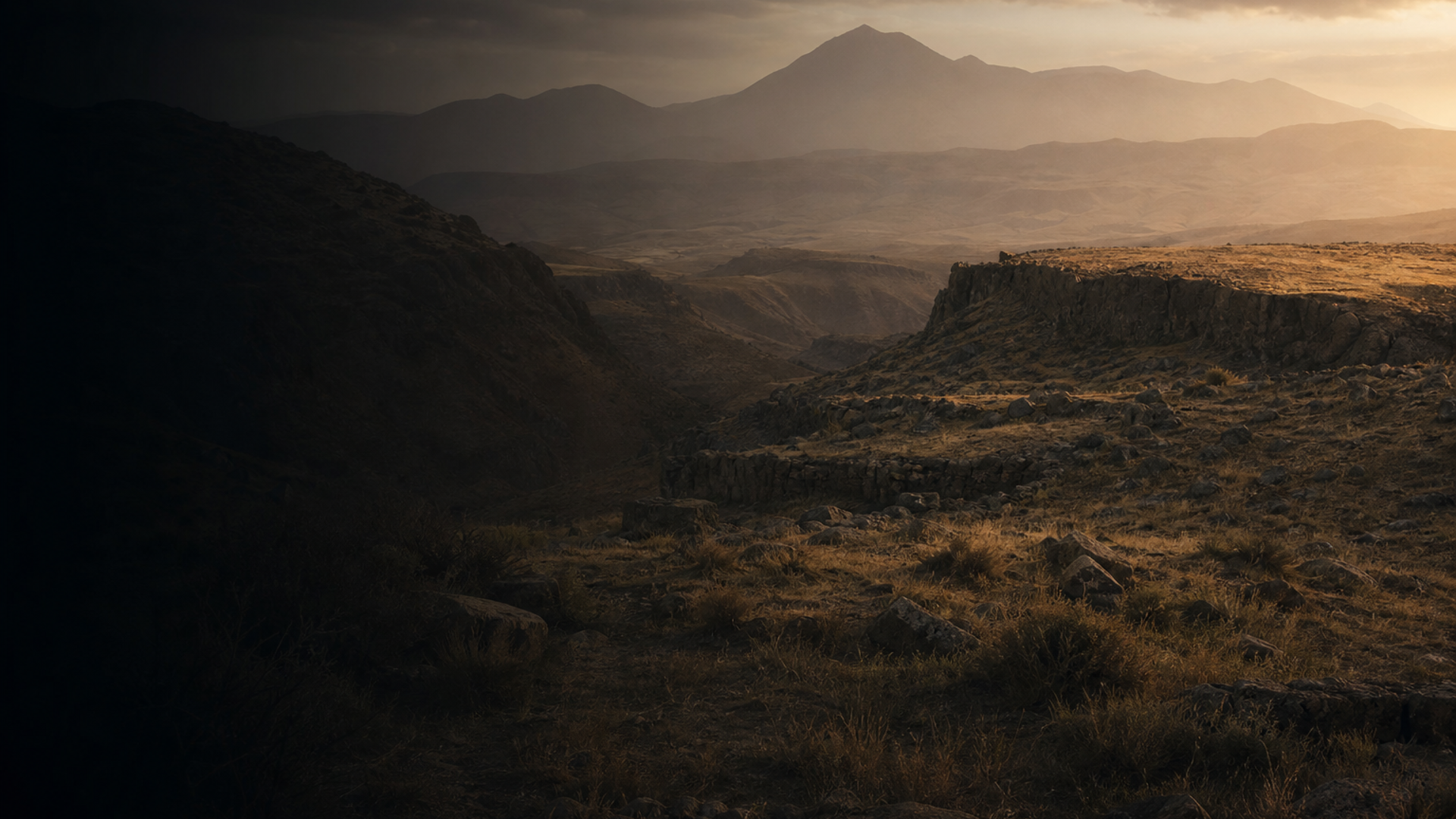
The Late Hellenistic period in the Armenian Highlands is a landscape of layered empires and shifting horizons. From the vantage of Aghitu, dated securely between 72 BCE and 60 CE, the archaeological record captures a borderland where Hellenistic artistic motifs, local traditions, and Parthian influences converge. Architectural fragments, pottery styles, and funerary customs at Aghitu hint at communities negotiating identity under regional powers rather than a single hegemonic culture.

Archaeological data indicates continuity with earlier Iron Age traditions alongside novel imports — glazed wares, imported amphora fragments, and stylistic hybridization in small finds. This mirrors historical accounts of Armenia as a crossroads: not simply conquered, but reshaped through trade, diplomacy, and migrations. Limited evidence suggests that some households at Aghitu practiced mixed subsistence strategies—agriculture supplemented by pastoral mobility—consistent with other Armenian Highlands settlements.

Genetic and material traces together suggest a population formed by local descent with episodic influxes of people and ideas. Yet, with only three genetic samples from Aghitu, any model of origins is preliminary. The archaeological record provides the stage; ancient DNA begins to illuminate the actors and the routes that brought them.

  • Aghitu samples dated 72 BCE–60 CE situate them in Late Hellenistic Armenia
  • Material culture shows a blend of local Iron Age traditions and Hellenistic/Parthian imports
  • Limited sampling means population-level origins remain provisional
Capítulo IV

Daily Life & Society

From shards of pottery to hearth remains, the lives at Aghitu emerge in fragments that together form an evocative picture. House foundations and domestic debris suggest family compounds focused on mixed farming — wheat, barley, and pulses — while animal bones point to sheep, goat, and cattle economies. Small-scale craft production, including spindle whorls and evidence of metalworking, speaks to household industry and trade connections.

Burial practices at Aghitu combine local rites with Hellenistic elements: inhumations accompanied by modest grave goods rather than the lavish tombs sometimes associated with elite Hellenistic contexts. This suggests a community where social differentiation existed but may have been less pronounced than in nearby urban centers.

Archaeological indicators of mobility — such as non-local ceramics and imported goods — imply seasonal or long-distance contacts, whether through trade, marriage ties, or itinerant artisans. These material traces are the cultural context into which the three recovered genomes were woven: individuals living in a world of connectivity and local resilience.

  • Mixed farming and pastoralism dominate subsistence strategies
  • Household craft and modest burial goods reflect local social organization
Capítulo V

Genetic Profile

Ancient DNA from Aghitu currently consists of three mitochondrial genomes, each yielding distinct maternal lineages: W (1), T2h (1), and H (1). These mtDNA haplogroups are broadly distributed across West Eurasia in antiquity and the present day. Haplogroup H is widespread in Europe and the Near East; W and T2 subclades are often associated with demographic movements across Eurasia, including steppe and Anatolian connections.

Importantly, no robust Y-chromosome signal is available from these three individuals, so paternal lineages remain undetermined. With a sample count of three (<10), any population-level interpretation must be treated as preliminary. The maternal diversity observed is consistent with a region acting as a conduit for people and maternal lineages rather than demonstrating sharp genetic discontinuity.

When combined with archaeological evidence, the genetic data tentatively support a model of local continuity punctuated by gene flow from neighboring regions. This pattern would align with the high mobility implied by material culture—trade, marriage, and small-scale migrations—seen across the Armenian Highlands during the Late Hellenistic era. Future sampling, especially male lineages and genome-wide data, is essential to test hypotheses about ancestry, admixture, and demographic change.

  • Three mtDNA haplogroups recovered: W, T2h, H (one each)
  • No definitive Y-DNA due to limited sample size; conclusions are preliminary
Capítulo VI

Legacy & Modern Connections

The echoes of Late Hellenistic Aghitu ripple into modern genetic and cultural landscapes. mtDNA lineages like H, W, and T2 persist in populations across the Caucasus, Anatolia, and Europe, indicating long-standing maternal continuities and connections. Archaeologically, the hybrid material culture at Aghitu is part of a broader Armenian story of adaptation, resilience, and cultural synthesis during periods of imperial flux.

Caution is essential: three mitochondrial genomes cannot map the full ancestry of a region. Nevertheless, these early genetic glimpses, paired with careful archaeological context, begin to connect ancient lives to present-day diversity. Future, larger-scale ancient DNA studies across Armenia will clarify the contribution of Late Hellenistic communities to the genetic tapestry of the modern Caucasus.

  • Maternal lineages at Aghitu echo patterns seen across the Caucasus and Near East
  • Current conclusions are tentative; broader sampling will refine links to modern populations
Con IA

Asistente de IA

Haz preguntas sobre la cultura Aghitu Echoes: Late Hellenistic Armenia

Asistente de IA por DNAGENICS

Desbloquear esta función
Pregunta sobre la cultura Aghitu Echoes: Late Hellenistic Armenia. El asistente con IA puede explicar hallazgos genéticos, contexto histórico, pruebas arqueológicas y conexiones modernas, con sus límites de interpretación.
Ejemplo de análisis con IA

La cultura Aghitu Echoes: Late Hellenistic Armenia representa un capítulo de la historia humana...

El análisis genético permite estudiar similitudes con poblaciones anteriores y posibles adaptaciones. Las muestras de ADN antiguo aportan información para investigar patrones migratorios y relaciones entre poblaciones, con límites que dependen del estudio y del contexto arqueológico.

Esta es una vista previa del análisis con IA. Accede al asistente completo para explorar información sobre:

  • Composición y similitud genética
  • Patrones migratorios y orígenes
  • Vida cotidiana y prácticas culturales
  • Contexto genético moderno

Explora más culturas antiguas

Descubre la historia de civilizaciones de distintas partes del mundo antiguo