Preparando el informe

Cargando la información y las referencias disponibles

Consultando el registro arqueológico...

Recopilando registros antiguos

Saltar al contenido principal
Alkhantepe: Late Chalcolithic Echoes
Cultura destacada

Alkhantepe: Late Chalcolithic Echoes

A single ancient genome from Uchtepe village illuminates Late Chalcolithic life in the Azerbaijan lowlands

3776 CE - 3651 BCE
Jalilabad district, Azerbaijan (Uchtepe / Alkhantepe)
Desplázate para empezar
Capítulo I

La historia

Comprender la cultura Alkhantepe: Late Chalcolithic Echoes

Archaeogenetic and archaeological evidence from Alkhantepe (Uchtepe, Jalilabad district, Azerbaijan), dated 3776–3651 BCE, links a single Late Chalcolithic individual to Y-haplogroup G1 and mtDNA K. Limited sample size makes conclusions preliminary but evocative of Caucasus coastal networks.

Time Period

3776–3651 BCE (Late Chalcolithic)

Region

Jalilabad district, Azerbaijan (Uchtepe / Alkhantepe)

Common Y-DNA

G1 (observed in 1 sample)

Common mtDNA

K (observed in 1 sample)

Capítulo II

Cronología

Momentos clave de la historia de esta cultura

3700 BCE

Alkhantepe individual deposited / sampled

A burial or human remain at Alkhantepe (Uchtepe, Jalilabad) dated 3776–3651 BCE yields the single ancient genome from this context, offering a preliminary genetic glimpse into Late Chalcolithic Azerbaijan.

Capítulo III

Origins & Emergence

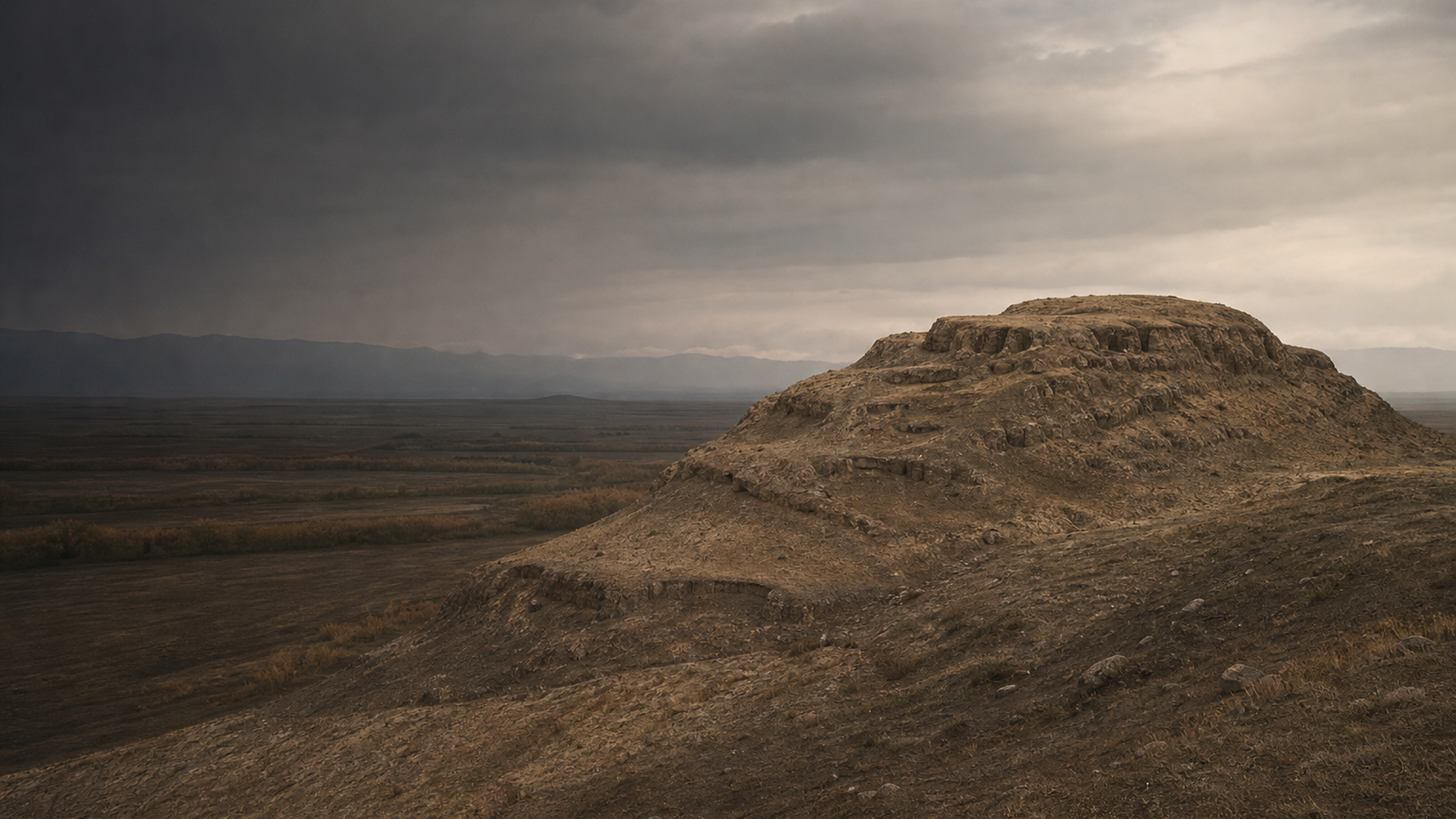
Alkhantepe, a Late Chalcolithic locus near Uchtepe village in Jalilabad district, sits in the lowland corridor of the South Caucasus where river plains meet semi-arid steppe. Archaeological data indicates human activity at the site around 3776–3651 BCE. The material traces from this era in Azerbaijan often reflect local adaptation to a mosaic landscape — seasonal herding, irrigated plots and participation in long-distance exchange across the Caucasus and into Mesopotamia.

Limited evidence suggests communities here experimented with new technologies of copper use and expanded craft specialization, while maintaining older ceramic traditions. The single ancient genome from Alkhantepe captures a human life lived at a frontier of ideas and goods: a point where coastal and inland routes threaded together.

Because only one genetic sample is available, any model of population origins must remain provisional. Nevertheless, the archaeological context aligns with broader Late Chalcolithic patterns across Azerbaijan: regional continuity from earlier Neolithic settlements combined with intermittent external contacts. This paints a picture of emergence by local communities adapting in a changing social and ecological landscape, rather than by abrupt replacement.

  • Located in Jalilabad district, Alkhantepe dates to c. 3776–3651 BCE
  • Local adaptation in lowland corridor with links to wider South Caucasus
  • Only one genome available—interpretations are tentative
Capítulo IV

Daily Life & Society

Archaeological evidence from Late Chalcolithic sites in the Azerbaijan lowlands suggests a life shaped by seasonal rhythms, craft specialization and exchange. At places like Alkhantepe, people likely combined small-scale agriculture on fertile floodplains with pastoral practices on nearby uplands. Pottery styles and toolkits found across the region indicate household-based production, with specialized items—stone and early metal tools—pointing to emerging craft specialists.

Settlement layouts across the lowlands often include clusters of dwellings, storage pits and middens, implying household economies oriented toward family groups and local exchange. Funerary behavior from contemporaneous sites in the region shows variability: some burials are simple, others accompanied by personal ornaments or food offerings, hinting at social differentiation. Trade or contact with neighboring zones brought exotic materials or stylistic influences, creating a cultural mosaic in which Alkhantepe participated.

Within this lived world, daily life would have been sensory and risky: seasonal flooding, the work of tending crops and herds, and the constant movement of goods and ideas along ancient routes. The single genetic sample from Alkhantepe offers a biological fragment of this wider tapestry, but cannot alone reconstruct the full complexity of social life.

  • Mixed economy: agriculture on floodplains plus pastoral mobility
  • Household production with emerging craft specialization and trade
Capítulo V

Genetic Profile

The Alkhantepe individual (Uchtepe village, Jalilabad district) yielded ancient DNA dated between 3776 and 3651 BCE. This single genome carries Y-chromosome haplogroup G1 and mitochondrial haplogroup K.

Haplogroup G1 is relatively rare today but has known concentrations in parts of the Caucasus and adjacent regions; its presence in a Late Chalcolithic lowland individual is compatible with long-standing paternal lineages in the South Caucasus. Mitochondrial haplogroup K is a West Eurasian maternal lineage that appears in Neolithic and later contexts across Europe and the Near East, often associated with agricultural expansions. Together, these markers suggest continuity with broader West Eurasian gene pools while also resonating with regional signatures.

Crucially, only one sample underpins these observations. With N=1, population-level claims (frequencies, migrations, sex-biased admixture) remain speculative. Archaeogenetic inference should therefore be framed as a single, informative data point: it confirms that haplogroups G1 (paternal) and K (maternal) were present in the Azerbaijan lowlands in the mid-4th millennium BCE, but cannot resolve how widespread these lineages were or the full demographic processes at play. Future sampling from Alkhantepe and neighboring sites will be essential to move from vivid conjecture to robust population models.

  • Y-haplogroup G1 observed — aligns with Caucasus-associated paternal lineages
  • mtDNA K observed — a West Eurasian maternal lineage common in Neolithic contexts
Capítulo VI

Legacy & Modern Connections

The single Alkhantepe genome offers a cinematic, if fragmentary, bridge between deep prehistory and modern genetic landscapes of the Caucasus. Contemporary populations in Azerbaijan and the wider South Caucasus retain a complex admixture of lineages shaped by millennia of mobility, but echoes of past paternal and maternal haplogroups persist in subtle ways.

Archaeologically, the Late Chalcolithic horizon in the lowlands contributes to cultural continuities visible in later Bronze Age communities: evolving metallurgy, settlement nucleation and intensified exchange networks. Genetically, one sample cannot map those continuities, but it does provide a temporal anchor — a biological timestamp that future ancient DNA from the region can compare against. As more genomes are added, researchers will be able to test whether the G1 and K signatures at Alkhantepe represent local continuity, incoming lineages, or a patchwork of both. For now, the legacy is one of possibility: a single voice in a chorus that awaits fuller harmonization.

  • Provides a genetic timestamp connecting Late Chalcolithic Azerbaijan to modern lineages
  • Highlights need for more samples to trace demographic continuity into later periods
Con IA

Asistente de IA

Haz preguntas sobre la cultura Alkhantepe: Late Chalcolithic Echoes

Asistente de IA por DNAGENICS

Desbloquear esta función
Pregunta sobre la cultura Alkhantepe: Late Chalcolithic Echoes. El asistente con IA puede explicar hallazgos genéticos, contexto histórico, pruebas arqueológicas y conexiones modernas, con sus límites de interpretación.
Ejemplo de análisis con IA

La cultura Alkhantepe: Late Chalcolithic Echoes representa un capítulo de la historia humana...

El análisis genético permite estudiar similitudes con poblaciones anteriores y posibles adaptaciones. Las muestras de ADN antiguo aportan información para investigar patrones migratorios y relaciones entre poblaciones, con límites que dependen del estudio y del contexto arqueológico.

Esta es una vista previa del análisis con IA. Accede al asistente completo para explorar información sobre:

  • Composición y similitud genética
  • Patrones migratorios y orígenes
  • Vida cotidiana y prácticas culturales
  • Contexto genético moderno

Explora más culturas antiguas

Descubre la historia de civilizaciones de distintas partes del mundo antiguo