Preparando el informe

Cargando la información y las referencias disponibles

Consultando el registro arqueológico...

Recopilando registros antiguos

Saltar al contenido principal
Beniamin of Shirak: A Hellenistic Echo
Cultura destacada

Beniamin of Shirak: A Hellenistic Echo

A single late-Hellenistic burial from Shirak Province that links archaeology and ancient DNA—preliminary but evocative.

44 CE - 61 BCE
Shirak Province, Armenia
Desplázate para empezar
Capítulo I

La historia

Comprender la cultura Beniamin of Shirak: A Hellenistic Echo

Archaeological remains from Beniamin (Shirak, Armenia) dated to 44–61 BCE offer a snapshot of life on the Armenian Plateau during the late Hellenistic era. Limited ancient DNA from one individual provides cautious hints of local continuity; conclusions remain preliminary due to the single sample.

Time Period

44–61 BCE

Region

Shirak Province, Armenia

Common Y-DNA

Not reported (single sample)

Common mtDNA

Not reported (single sample)

Capítulo II

Cronología

Momentos clave de la historia de esta cultura

50 BCE

Burial at Beniamin dated

A human burial from Beniamin, Shirak Province, is radiocarbon-dated to between 44 and 61 BCE; genetic sampling produced one ancient genome, providing a preliminary data point for regional population history.

Capítulo III

Origins & Emergence

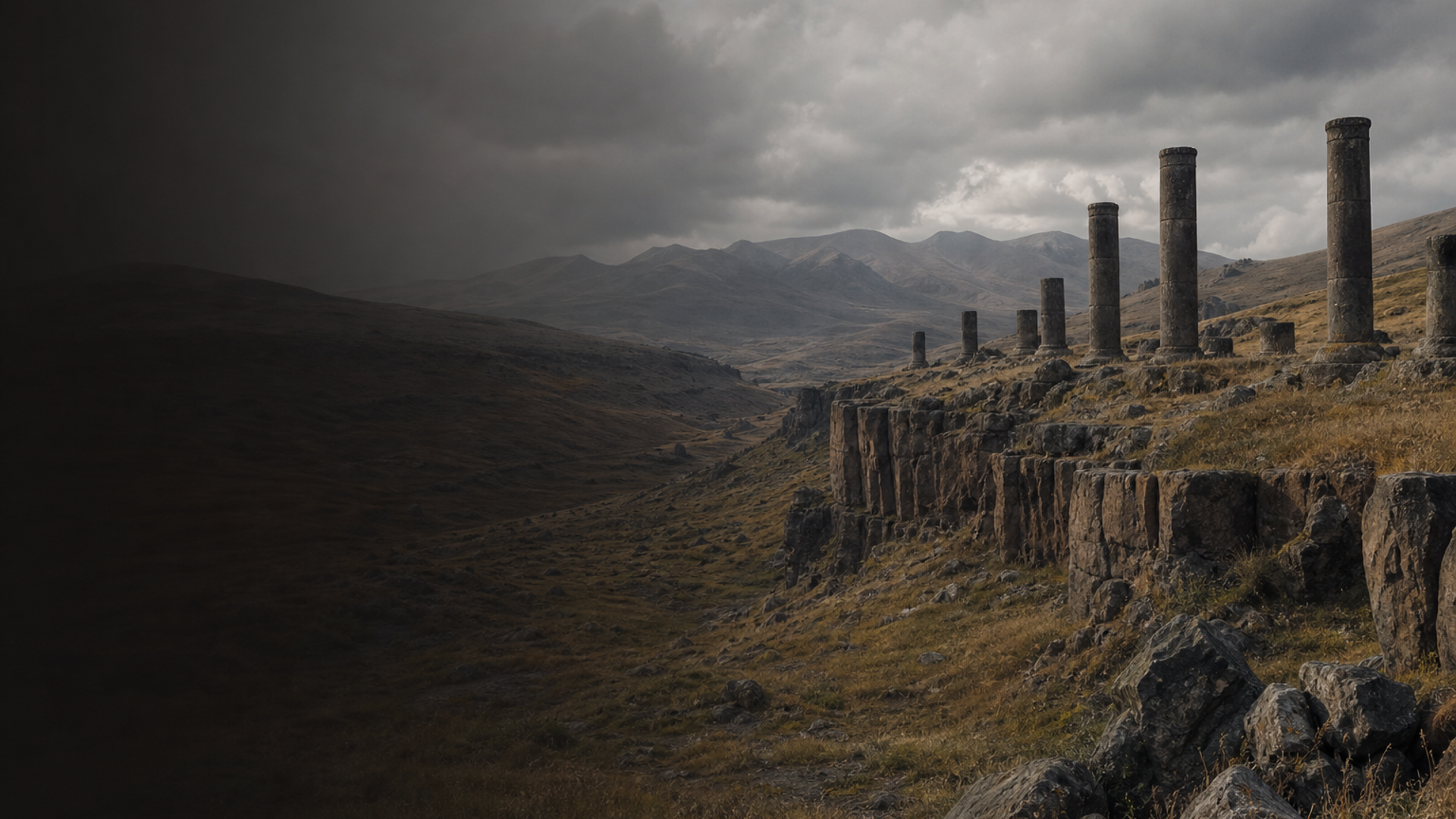
Beniamin sits on the high, wind-sculpted terraces of the Shirak plain, where human stories layer like silt. Archaeological data from the site—burial contexts and material fragments dated to 44–61 BCE—place this individual within the late Hellenistic transformations of the Armenian Plateau. This was an era of shifting political spheres following the fragmentation of Alexander’s eastern dominions and the rise of local Armenian polities.

Limited evidence suggests that inhabitants of the region maintained long-established lifeways even as external influences arrived by trade and diplomacy. At Beniamin, grave construction and any associated artifacts (where preserved) reflect local funerary customs known across the plateau; however, preservation is uneven and artifact assemblages are sparse. The single radiocarbon-calibrated date anchors the burial to a narrow window, but it cannot on its own reveal the broader demographic or cultural dynamics.

Archaeologically, the site points toward local continuity with adaptive interactions at regional crossroads. Genetically, with only one sampled individual, any narrative of migration, admixture, or replacement remains hypothetical and must be framed as provisional. Further excavation and additional ancient DNA sampling across Shirak and neighboring districts are necessary to move from evocative possibility to robust historical reconstruction.

  • Burial dated by calibrated radiocarbon to 44–61 BCE
  • Located in Beniamin, Shirak Province on the Armenian Plateau
  • Current evidence suggests local continuity; larger sample needed
Capítulo IV

Daily Life & Society

The human presence at Beniamin would have been shaped by highland rhythms—seasonal herding, cereal cultivation in sheltered hollows, and exchange along routes that threaded the Armenian uplands. Archaeological traces from comparable sites in the region indicate small agrarian communities organized around kin networks, with material culture that blends indigenous traditions and Hellenistic motifs.

Though preservation limits direct statements about tools, textiles, or diet at Beniamin specifically, osteological remains and burial treatment can hint at social identity: the way a body was interred, accompanying grave goods (if any), and skeletal markers of workload all encode daily experience. Funerary practice often acted as a public script, signaling social roles, gendered labor, and ties to ancestral land. In this cinematic landscape—wind, basalt, and barley—residents balanced subsistence strategies with long-distance contacts that brought new goods and ideas.

Because we currently rely on one sampled burial, reconstructions of community structure and socioeconomic patterns at Beniamin remain cautious. Excavation expansion and multi-disciplinary analyses (isotopes, zooarchaeology, microbotany) would richly illuminate household economies, mobility, and diet.

  • Highland agrarian-herding lifeways likely dominant
  • Burial practices offer the clearest social signal at present
Capítulo V

Genetic Profile

The genetic evidence from Armenia_Beniamin is extremely limited: the dataset comprises a single individual dated to 44–61 BCE. As such, any population-level inference must be treated as provisional. The available report does not list common Y-chromosome or mitochondrial haplogroups for this burial, and no population-wide frequencies can be derived from one genome.

Despite these limits, ancient DNA—even from a lone individual—serves as a directional pointer. In broader studies of the Armenian Plateau, ancient genomes often reveal deep regional continuity since the Bronze Age as well as episodic inputs linked to mobility across West Asia and the Caucasus. If future sequencing from Beniamin and neighboring sites confirms patterns similar to regional datasets, this would strengthen arguments for local genetic persistence through the Hellenistic era.

Key caveats: with n=1, signals of admixture, continuity, or demographic change are highly uncertain. Researchers should prioritize expanding the sample count, reporting haplogroups and coverage metrics transparently, and integrating isotopic mobility data. Only then can archaeological context and genetic data be woven together into a robust narrative about population history on the Shirak plain.

  • Single ancient genome—insufficient for population-level conclusions
  • No common Y/mtDNA haplogroups reported; results are preliminary
Capítulo VI

Legacy & Modern Connections

Beniamin is a whisper from a familiar landscape: the people who lived and died here inhabit the genetic and cultural palimpsest of modern Armenia. Archaeology links mortuary practices and material traces to long-term traditions on the plateau, while ancient DNA has the potential to trace biological continuities and past movements. For now, the legacy of this site is twofold—tangible cultural inheritance and a clear scientific prompt.

The single genetic sample gestures toward possibilities rather than conclusions. If subsequent sampling reveals continuity with earlier Bronze or Iron Age populations of the Armenian Plateau, it will reinforce narratives of local persistence. Alternatively, evidence of admixture could illuminate how Hellenistic-era connections reshaped regional genetic landscapes. In either scenario, Beniamin highlights how a focused combination of archaeology and genomics can transform a solitary burial into a keystone for understanding human resilience and exchange in antiquity.

  • Site underscores potential continuity on the Armenian Plateau
  • Additional DNA sampling could connect ancient lifeways to modern populations
Con IA

Asistente de IA

Haz preguntas sobre la cultura Beniamin of Shirak: A Hellenistic Echo

Asistente de IA por DNAGENICS

Desbloquear esta función
Pregunta sobre la cultura Beniamin of Shirak: A Hellenistic Echo. El asistente con IA puede explicar hallazgos genéticos, contexto histórico, pruebas arqueológicas y conexiones modernas, con sus límites de interpretación.
Ejemplo de análisis con IA

La cultura Beniamin of Shirak: A Hellenistic Echo representa un capítulo de la historia humana...

El análisis genético permite estudiar similitudes con poblaciones anteriores y posibles adaptaciones. Las muestras de ADN antiguo aportan información para investigar patrones migratorios y relaciones entre poblaciones, con límites que dependen del estudio y del contexto arqueológico.

Esta es una vista previa del análisis con IA. Accede al asistente completo para explorar información sobre:

  • Composición y similitud genética
  • Patrones migratorios y orígenes
  • Vida cotidiana y prácticas culturales
  • Contexto genético moderno

Explora más culturas antiguas

Descubre la historia de civilizaciones de distintas partes del mundo antiguo