Preparando el informe

Cargando la información y las referencias disponibles

Consultando el registro arqueológico...

Recopilando registros antiguos

Saltar al contenido principal
Cenxun Cave: Sui–Tang Era Mothers of Guangxi
Cultura destacada

Cenxun Cave: Sui–Tang Era Mothers of Guangxi

Three mitochondrial genomes from Cenxun Cave (440–658 CE) illuminate local maternal lineages in southern China

440 CE - 658 CE
Guangxi, southern China (Cenxun Cave, Pingguo County)
Desplázate para empezar
Capítulo I

La historia

Comprender la cultura Cenxun Cave: Sui–Tang Era Mothers of Guangxi

Ancient DNA from three individuals in Cenxun Cave (Baise, Guangxi) dated 440–658 CE reveals predominantly mtDNA haplogroup M, suggesting maternal links to regional East and Southeast Asian populations. Conclusions are preliminary due to the small sample size.

Time Period

440–658 CE

Region

Guangxi, southern China (Cenxun Cave, Pingguo County)

Common Y-DNA

Not reported / undetermined (no reliable Y data)

Common mtDNA

M (2 samples), M10 (1 sample)

Capítulo II

Cronología

Momentos clave de la historia de esta cultura

440 CE

Earliest dated individual at Cenxun Cave

Radiocarbon and archaeological context place one individual at Cenxun Cave around 440 CE, within the late Northern/Southern dynasties period.

581 CE

Sui Dynasty unifies China

The Sui (581 CE) reunified much of China, increasing administrative and infrastructural links that affected southern regions like Guangxi.

618 CE

Beginning of Tang Dynasty

The Tang dynasty (beginning 618 CE) ushered in expanded trade and mobility; the latest Cenxun individual dates shortly after this transition (up to 658 CE).

Capítulo III

Origins & Emergence

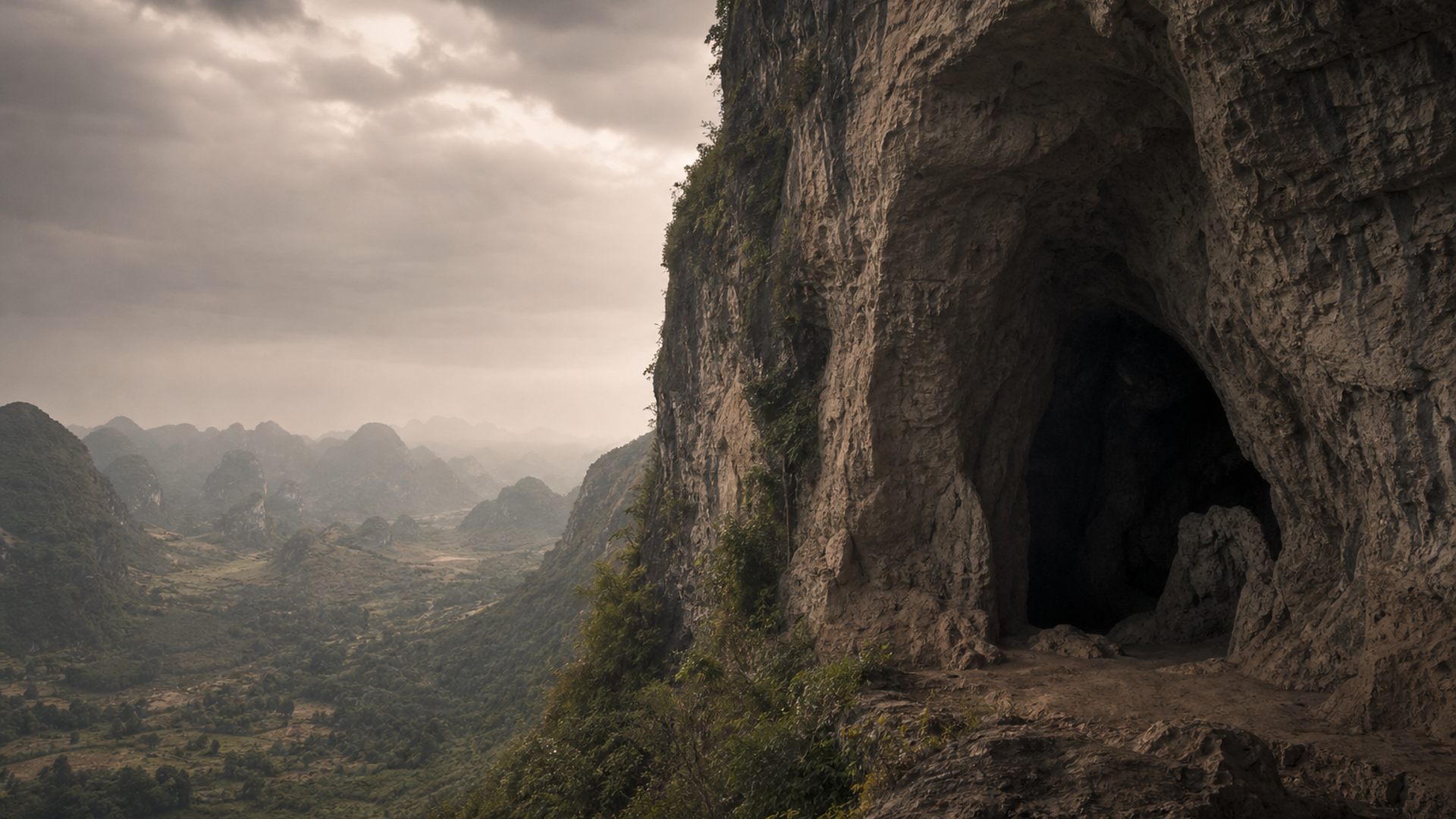
Cenxun Cave sits in Taiping Town, Pingguo County, within Baise City in Guangxi — a landscape of karst cliffs and river valleys that has funneled human movement between inland China and the southern coast for millennia. The dated interval for the recovered remains (440–658 CE) spans the late Northern and Southern period through the Sui unification (581 CE) and into the early Tang dynasty (after 618 CE). Archaeological data indicates continuity of local occupation in Guangxi across these political transitions, but the human story is best read at the level of people rather than court names: these centuries saw intensified mobility, trade, and cultural exchange along river corridors.

Limited evidence from Cenxun Cave (three sequenced individuals) suggests maternal lineages belonging to mtDNA haplogroup M, a deep-rooted clade widespread across East and Southeast Asia. While the mitochondrial signal attests to regional maternal ancestry, the few samples cannot resolve finer-scale migrations or the complex interactions between indigenous southern groups and migrants from northern China. In short: the remains speak to a local groundedness in southern China during the Sui–Tang transition, but any broader narrative about population replacement or major influxes would be premature given the small sample size.

  • Samples dated 440–658 CE bridge late Northern/Southern periods, Sui, and early Tang eras
  • Site: Cenxun Cave, Taiping Town, Pingguo County, Baise City, Guangxi
  • mtDNA evidence points to haplogroup M — common in East and Southeast Asia
Capítulo IV

Daily Life & Society

The archaeological context of Cenxun Cave implies human presence in a karst environment where caves could be used for shelter, ritual activity, or burial practices. During the 5th–7th centuries CE, communities in southern China engaged in mixed subsistence strategies: wet-rice agriculture in river plains, upland foraging, and localized craft production. Trade routes were active along rivers and mountain passes, bringing goods and ideas into Guangxi from both the interior and maritime networks.

Material traces from contemporaneous sites in Guangxi and nearby provinces suggest diverse lifeways — from village farming to regional exchange hubs — but direct association of artifacts to the three genetic samples is limited. Osteological remains can sometimes preserve information on diet and mobility; where such analyses are available, they often show a reliance on C3 and C4 plants and local protein sources. Cemetery placement and burial treatments at cave sites can reflect social identity, though specific funerary details at Cenxun Cave remain sparsely reported.

Overall, the human landscape was one of local rootedness shaped by wider economic and cultural currents: families tied to the land, yet participating in the ebb and flow of Sui–Tang era mobility.

  • Karst cave context suggests use for burial or habitation in a riverine landscape
  • Regional economy likely mixed agriculture and localized exchange during Sui–Tang transitions
Capítulo V

Genetic Profile

Three individuals from Cenxun Cave yielded mitochondrial genomes dominated by haplogroup M (two samples) with one assigned more specifically to M10. Haplogroup M is a broad maternal lineage with deep roots across southern and eastern Asia; its presence here is consistent with long-term regional continuity in southern China and nearby areas. M10 is a subclade observed in East Asian populations and has been reported in both coastal and inland contexts in modern and ancient datasets.

No robust Y-chromosome results are reported for these individuals, so paternal affiliations remain undetermined. The small sample count (n=3) places an important caveat on interpretation: with fewer than ten samples, patterns may reflect family-level relationships or chance sampling rather than population-wide trends. Ancient mitochondrial DNA is especially informative about maternal ancestry and cannot by itself describe population structure, admixture proportions, or sex-biased migration.

Genetic continuity with present-day southern Chinese and Southeast Asian maternal lineages is plausible, but testing such hypotheses requires larger sample sizes, genome-wide data, and comparative analyses with coeval sites across Guangxi and the broader Sui–Tang world. For now, the Cenxun mitochondria offer a tantalizing glimpse into local maternal heritage during a period of political change.

  • mtDNA: two samples M, one M10 — consistent with regional East/Southeast Asian maternal lineages
  • Sample size (n=3) is small; interpretations are preliminary and may reflect family-level patterns
Capítulo VI

Legacy & Modern Connections

The Cenxun Cave individuals connect the deep time of Guangxi’s landscapes to living populations through maternal lineages that persist in East and Southeast Asia. These mitochondrial signals suggest threads of continuity in local maternal ancestry across the Sui–Tang transition — a period of political upheaval but also everyday resilience.

Cautious comparison with modern populations may reveal affinities, but such links demand careful genome-wide analysis and broader archaeological sampling. The current dataset is a starting point: expanding both the number of ancient genomes from Guangxi and the kinds of genetic markers studied will let researchers trace routes of ancestry, marriage networks, and mobility that shaped the region we see today.

  • mtDNA affinities hint at long-term maternal continuity in southern China
  • Broader sampling and genome-wide data are needed to connect ancient individuals to modern populations
Con IA

Asistente de IA

Haz preguntas sobre la cultura Cenxun Cave: Sui–Tang Era Mothers of Guangxi

Asistente de IA por DNAGENICS

Desbloquear esta función
Pregunta sobre la cultura Cenxun Cave: Sui–Tang Era Mothers of Guangxi. El asistente con IA puede explicar hallazgos genéticos, contexto histórico, pruebas arqueológicas y conexiones modernas, con sus límites de interpretación.
Ejemplo de análisis con IA

La cultura Cenxun Cave: Sui–Tang Era Mothers of Guangxi representa un capítulo de la historia humana...

El análisis genético permite estudiar similitudes con poblaciones anteriores y posibles adaptaciones. Las muestras de ADN antiguo aportan información para investigar patrones migratorios y relaciones entre poblaciones, con límites que dependen del estudio y del contexto arqueológico.

Esta es una vista previa del análisis con IA. Accede al asistente completo para explorar información sobre:

  • Composición y similitud genética
  • Patrones migratorios y orígenes
  • Vida cotidiana y prácticas culturales
  • Contexto genético moderno

Explora más culturas antiguas

Descubre la historia de civilizaciones de distintas partes del mundo antiguo