Preparando el informe

Cargando la información y las referencias disponibles

Consultando el registro arqueológico...

Recopilando registros antiguos

Saltar al contenido principal
Echoes of Chalcolithic Portugal
Cultura destacada

Echoes of Chalcolithic Portugal

Human stories from megaliths and caves brought into focus by ancient DNA.

3352 CE - 2153 BCE
Portugal (Estremadura, Lisbon, Évora)
Desplázate para empezar
Capítulo I

La historia

Comprender la cultura Echoes of Chalcolithic Portugal

Portugal_C (3352–2153 BCE): 18 Chalcolithic individuals from Portuguese sites link megalithic tombs and ritual enclosures to a genetic mixture of local hunter-gatherer and Neolithic farmer ancestries, with limited evidence for incoming Steppe-related male lineages.

Time Period

3352–2153 BCE

Region

Portugal (Estremadura, Lisbon, Évora)

Common Y-DNA

I (majority), G (low)

Common mtDNA

U, J, K, H (including H1)

Capítulo II

Cronología

Momentos clave de la historia de esta cultura

2500 BCE

Perdigões and regional ritual intensity

Perdigões' ditched enclosure and nearby tombs were active focal points for ritual and deposition, reflecting heightened social coordination across southwestern Iberia.

Capítulo III

Origins & Emergence

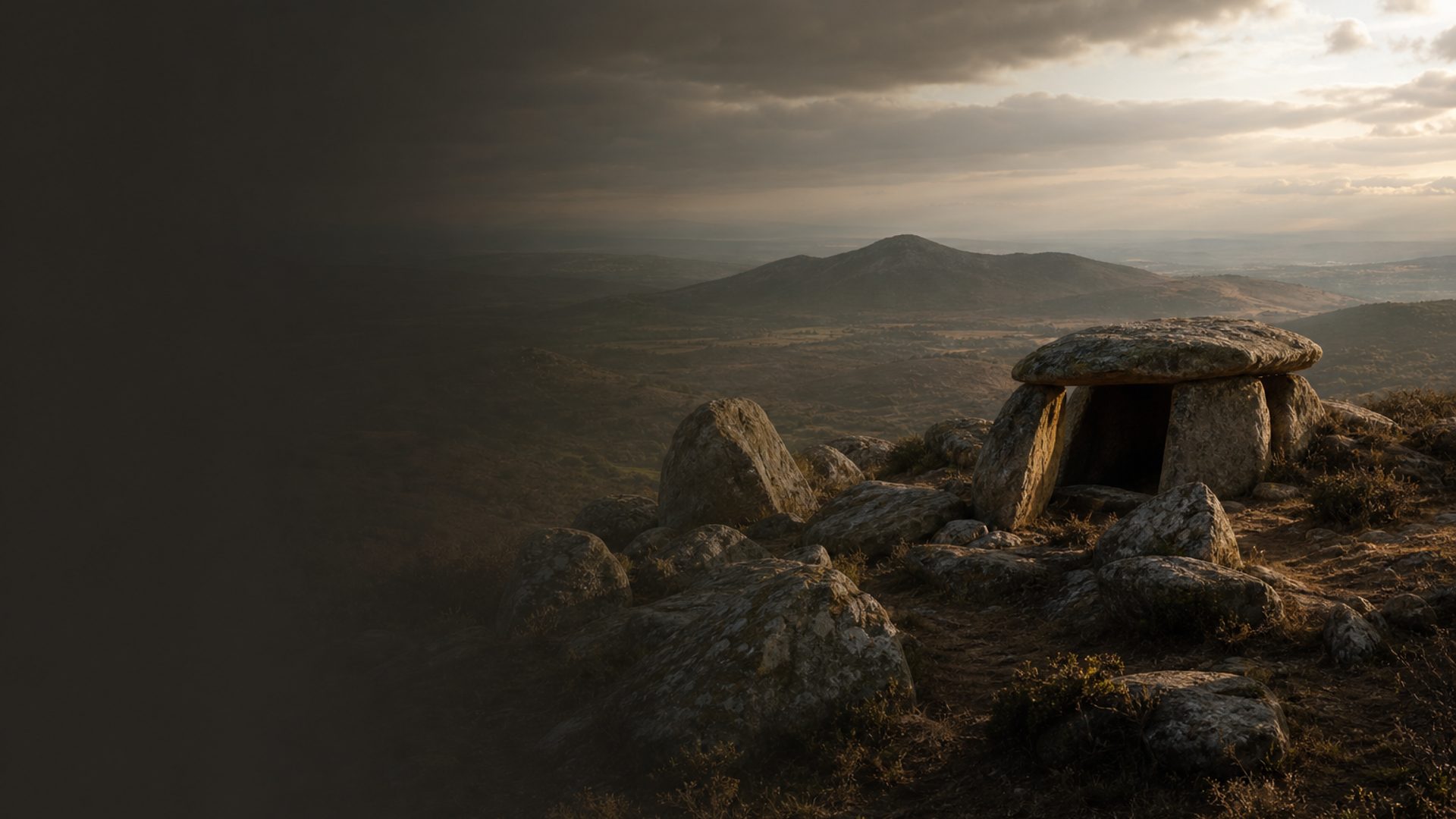
The Portugal_C assemblage sits squarely within the Chalcolithic — a cinematic threshold when copper tools, monumental tombs and large ritual enclosures reshaped Iberia's landscapes. Archaeological data indicates activity at key sites included in this set: the megalithic tholos of Paimogo I (Lourinhã), the subterranean gallery of Almonda (Galeria da Cisterna), the ritual ditched enclosure of Perdigões (Reguengos de Monsaraz), and cave burials at Monte Canelas and Cova das Lapas. These places, dated between 3352 and 2153 BCE, reflect a network of funerary and ritual practice rather than a single, uniform culture.

Material culture — pottery styles, monumental mortuary architecture, and evidence for long-distance exchange — points to local development built on earlier Neolithic traditions. Limited evidence suggests regional continuity of population rather than wholesale population replacement: the persistence of certain maternal lineages and the dominance of a Y-DNA profile consistent with earlier European lineages hint at deep local roots. At the same time, archaeological indicators of new social complexity — forced/organized labor to build tombs, curated grave offerings, and signs of increased inequality — mark the Chalcolithic as a period of social transformation in western Iberia.

  • Sites include Perdigões, Paimogo I, Almonda, Monte Canelas, Cova das Lapas
  • Dates span 3352–2153 BCE, Chalcolithic Portugal context
  • Archaeology shows local continuity with new social complexity
Capítulo IV

Daily Life & Society

Daily life in Chalcolithic Portugal can be glimpsed through bones, pottery, and the very layout of monuments. Settlements associated with this era show mixed farming economies — cereals and domesticated animals — supplemented by marine and river resources along the Atlantic coast. Caves and tholoi were focal points for collective burial and ritual, where communities deposited selected individuals and curated grave goods, an expression of shared memory and emerging social hierarchies.

Archaeobotanical and faunal remains from nearby contemporaneous sites indicate seasonal mobility between coastal and inland zones. Craft specialization appears in copper working and high-quality ceramics, while the scale of some constructions (for example, the Perdigões enclosure) implies coordinated labor and leadership structures. Osteological evidence from Iberian Chalcolithic populations often shows varied diets and workload markers, suggesting differentiated roles by age and sex. Nonetheless, many aspects of daily life remain partially obscured: preservation biases and uneven excavation histories mean our picture is fragmentary and must be read in tandem with genetic signals.

  • Mixed farming economy with coastal-inland resource use
  • Monuments and collective burials reflect emerging social hierarchy
Capítulo V

Genetic Profile

Eighteen individuals compose the Portugal_C genetic sample — a modest but informative window into Chalcolithic demography. Y-chromosome data are dominated by haplogroup I (9 individuals) with a single G. The prevalence of I echoes patterns seen in other Iberian ancient populations, where I lineages (often I2 in other datasets) are associated with long-term European ancestry and suggest substantial local male continuity. The presence of G — commonly linked to early Neolithic farmer expansions elsewhere in Europe — in one individual points to lingering farmer-associated paternal ancestry but is too rare here to indicate a major incoming male migration.

Mitochondrial diversity includes U (4), J (3), K (3), H (3) and a single H1. U maternal lineages are frequently connected to earlier hunter-gatherer ancestry, while J, K and H are common among Neolithic and Chalcolithic farming populations. Together, these maternal markers suggest admixture between indigenous Mesolithic-descended groups and farmer-descended communities. Notably, the absence or low frequency of Steppe-associated Y haplogroups (e.g., R1b) in this set suggests limited male-mediated Steppe influx into these sampled locales during 3352–2153 BCE; however, this conclusion is preliminary because patterns can vary across regions and cemetery-based sampling can bias results. With 18 samples, broad trends are discernible, but sub-haplogroup resolution and low-count categories (G = 1, H1 = 1) require cautious interpretation.

  • Y-DNA dominated by I (9); single G suggests limited incoming farmer-related males
  • mtDNA mix (U, J, K, H) indicates admixture of hunter-gatherer and farmer maternal lineages
Capítulo VI

Legacy & Modern Connections

The genetic echoes of Portugal_C contribute to a longer narrative of Iberian population history: deep local roots punctuated by interactions with Neolithic farmer descendants and, later, more distant influences. Modern populations of Portugal carry fragments of this layered ancestry, but millennia of additional migrations (Bronze Age movements, historical-era exchanges) have reworked genetic landscapes. Archaeogenetic links between Chalcolithic remains and living populations are therefore indirect and complex.

Archaeologically, the monumental landscapes and ritual practices of the Chalcolithic shaped regional identities seen in later periods. For heritage and museum audiences, combining the tangible drama of tholoi and enclosures with DNA results creates an evocative narrative of continuity, contact and transformation — always tempered by the scientific need to acknowledge sample limits and regional variation.

  • Contributes to Portugal's layered ancestry; modern links are indirect
  • Monuments and DNA together reveal continuity and episodic contact
Con IA

Asistente de IA

Haz preguntas sobre la cultura Echoes of Chalcolithic Portugal

Asistente de IA por DNAGENICS

Desbloquear esta función
Pregunta sobre la cultura Echoes of Chalcolithic Portugal. El asistente con IA puede explicar hallazgos genéticos, contexto histórico, pruebas arqueológicas y conexiones modernas, con sus límites de interpretación.

Ejemplo de análisis con IA

La cultura Echoes of Chalcolithic Portugal representa un capítulo de la historia humana...

El análisis genético permite estudiar similitudes con poblaciones anteriores y posibles adaptaciones. Las muestras de ADN antiguo aportan información para investigar patrones migratorios y relaciones entre poblaciones, con límites que dependen del estudio y del contexto arqueológico.

Esta es una vista previa del análisis con IA. Accede al asistente completo para explorar información sobre:

  • Composición y similitud genética
  • Patrones migratorios y orígenes
  • Vida cotidiana y prácticas culturales
  • Contexto genético moderno

Explora más culturas antiguas

Descubre la historia de civilizaciones de distintas partes del mundo antiguo