Preparando el informe

Cargando la información y las referencias disponibles

Consultando el registro arqueológico...

Recopilando registros antiguos

Saltar al contenido principal
Echoes of Modern Kyrgyzstan
Cultura destacada

Echoes of Modern Kyrgyzstan

A concise archaeological and genetic snapshot of Kyrgyzstan in 2000 CE

2000 CE
Kyrgyzstan
Desplázate para empezar
Capítulo I

La historia

Comprender la cultura Echoes of Modern Kyrgyzstan

A scientific portrait of present-day Kyrgyzstan (2000 CE) based on 16 samples from Bishkek and nearby locales. This entry situates modern Kyrgyz populations within long-standing East–West admixture on the Central Asian stage, while stressing limited coverage and preliminary conclusions.

Time Period

2000 CE (modern)

Region

Kyrgyzstan

Common Y-DNA

Not reported / dataset incomplete

Common mtDNA

Not reported / dataset incomplete

Capítulo II

Cronología

Momentos clave de la historia de esta cultura

2500 BCE

Expansion of mobile pastoralism

Spread of mobile herding across the Central Asian steppe established long-range exchange networks that later influenced genetic admixture patterns.

Capítulo III

Origins & Emergence

The Kyrgyz people of 2000 CE are the product of millennia of movement across mountain ranges and steppe corridors. Archaeological data indicates persistent patterns of mobile pastoralism and long-distance exchange across the Tian Shan and surrounding ranges. Over centuries, Turkic-language expansions, Silk Road commerce, and interactions with neighboring Iranian- and Mongolic-speaking groups layered cultural and biological influences.

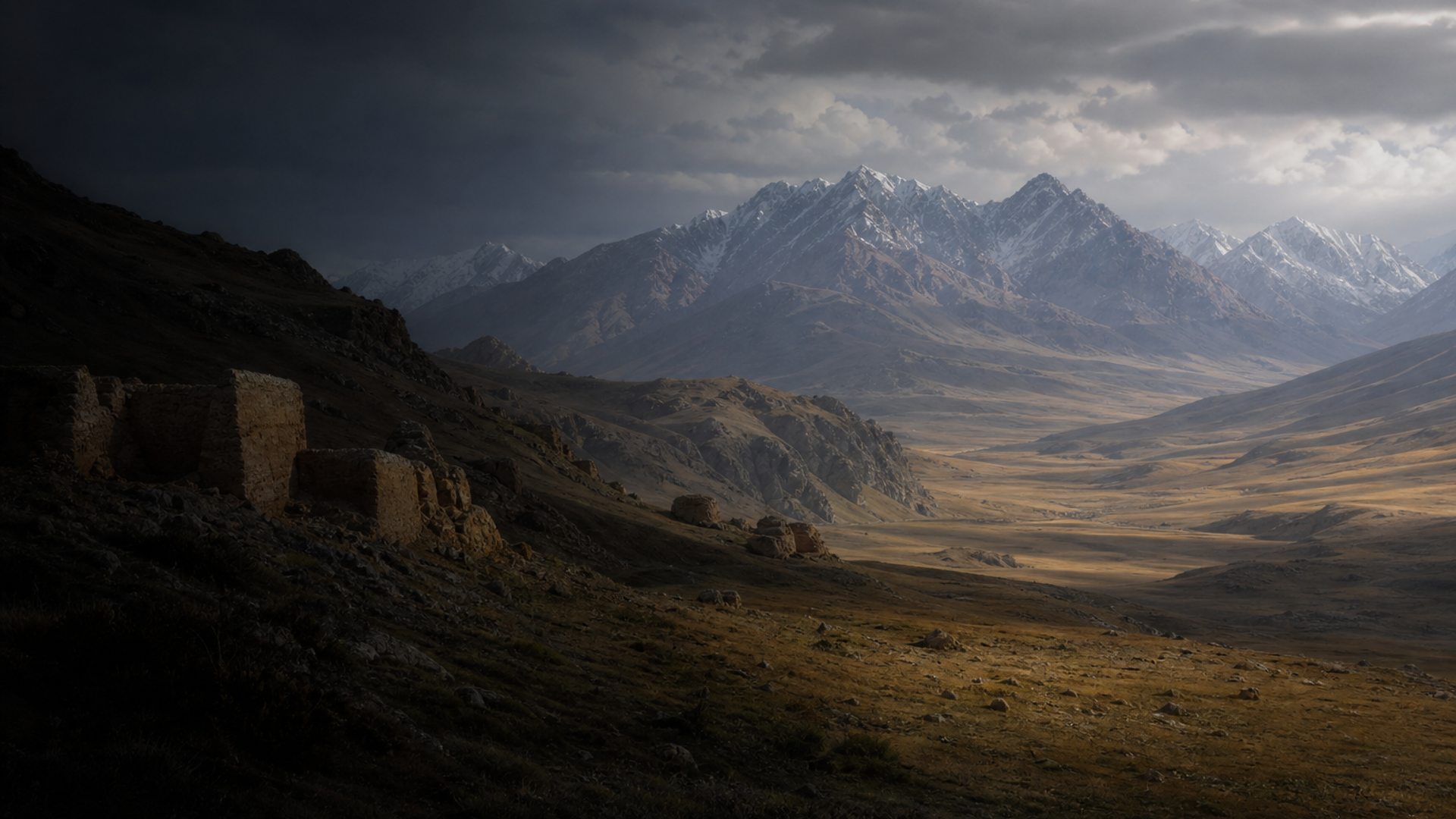
In cinematic terms: a landscape of high pastures and river-cut valleys where caravans, herders and armies passed under the same sky. Material culture echoes—nomadic felt, horse gear, caravan wares—speak to social networks that shaped identity. For the modern era, however, archaeological evidence is often complemented, and sometimes overshadowed, by historical records and ethnography, because many relevant traces are recent and ephemeral.

Genetically, these origins are best described as composite. Limited genome-wide studies of Central Asian populations point to admixture between eastern Eurasian and western Eurasian ancestries; archaeological continuity of pastoral economies provides a plausible social mechanism for sustained contact. Yet the specific dataset for this entry (16 samples, mostly from Bishkek) offers a localized, preliminary window rather than a full portrait of Kyrgyz origins.

Because modern national identities were also shaped by 20th-century processes—Soviet resettlement, urbanization, and administrative borders—archaeology must be read alongside historical demography when interpreting the emergence of contemporary Kyrgyz society.

  • Modern Kyrgyz identity formed from deep steppe and mountain contacts
  • Archaeology shows continuity of pastoral and exchange economies
  • Genetic data suggest layered East–West admixture; local dataset is preliminary
Capítulo IV

Daily Life & Society

Daily life in Kyrgyzstan around 2000 CE is a tapestry of urban and pastoral practices. Archaeological traces for this recent period are sparse relative to deeper time, but ethnographic and material studies—alongside modern excavations at settlement edges and cemeteries—reveal hybrid livelihoods: urban commerce in Bishkek, seasonal transhumant herding in mountain pastures, and the persistence of craft traditions.

Homes alternate between Soviet-era apartment blocks and traditional yurt use in rural highlands; marketplaces continue ancient patterns of exchange that once linked Silk Road caravans. Funerary customs and household assemblages vary regionally, reflecting kinship ties, religious influence, and socioeconomic change. Archaeological deposits from late-20th-century contexts often contain industrial materials that complicate preservation but also document rapid cultural transitions.

For museum and ancestry platforms, these daily-life signals matter because they shape patterns of mating, migration, and social structure that leave genetic signatures. Urbanization concentrates diverse ancestries, while pastoral mobility mixes lineages across valleys and ranges. However, because most archaeological sampling for the modern era is limited and focused near population centers like Bishkek, claims about nationwide social patterns should be made cautiously.

  • Urban-rural mosaic: Bishkek contrasts with highland transhumance
  • Material culture reflects both ancient exchange networks and 20th-century change
Capítulo V

Genetic Profile

This dataset comprises 16 samples collected in Kyrgyzstan (notably Bishkek and nearby locales) dated to 2000 CE. The recording provided lacks specific Y-chromosome and mitochondrial haplogroup assignments, so genomic interpretation must rely on broader regional patterns and cautious inference.

Broadly, genetic studies across Central Asia document a composite ancestry in modern Kyrgyz populations: substantial mixtures of eastern Eurasian and western Eurasian components, shaped by repeated migrations, Silk Road exchange, and local demographic processes. Archaeological context—pastoral networks, caravan routes, and mountain refugia—offers plausible mechanisms for sustained gene flow between populations from eastern Siberia/Mongolia and west Eurasia.

Important caveats: the sample set is modest and geographically concentrated. With only 16 individuals and incomplete Y/mtDNA reporting, any conclusions about haplogroup distributions or fine-scale population structure are preliminary. Where genome-wide data exist for the region, they often show sex-biased admixture patterns (for example, differing paternal vs maternal contributions), but such patterns cannot be confirmed here without targeted analyses.

Future directions include expanding geographic sampling (rural highlands, multiple provinces), integrating uniparental markers (Y and mtDNA), and comparing modern genomes to ancient DNA from Bronze-to-Medieval Central Asia to trace temporal changes in ancestry.

  • Dataset: 16 samples (Bishkek-centered), limited geographic coverage
  • Regional genetic signal: admixture of East and West Eurasian ancestries; local conclusions are preliminary
Capítulo VI

Legacy & Modern Connections

Modern Kyrgyz identity carries deep echoes of steppe mobility and Silk Road exchange. Archaeological landscapes—mountain pastures, caravan stops, and settlement ruins—testify to long-term connectivity that helped shape the genetic tapestry visible today. For individuals exploring ancestry, the modern Kyrgyz genetic landscape underscores how recent movements (urbanization, Soviet-era policies) and ancient contacts both leave measurable traces.

For researchers and the public, the datasets available here are a starting point: they highlight the value of combining archaeology, history, and genetics to tell human stories. But they also remind us that modest sample sizes and uneven geographic coverage limit resolution. A fuller understanding will come from denser sampling across Kyrgyzstan's varied landscapes and from tying modern genetic data to well-dated archaeological and historical contexts.

  • Contemporary Kyrgyz genetics reflect millennia of East–West contact
  • Expanded sampling and contextual archaeology are needed to refine ancestry narratives
Con IA

Asistente de IA

Haz preguntas sobre la cultura Echoes of Modern Kyrgyzstan

Asistente de IA por DNAGENICS

Desbloquear esta función
Pregunta sobre la cultura Echoes of Modern Kyrgyzstan. El asistente con IA puede explicar hallazgos genéticos, contexto histórico, pruebas arqueológicas y conexiones modernas, con sus límites de interpretación.
Ejemplo de análisis con IA

La cultura Echoes of Modern Kyrgyzstan representa un capítulo de la historia humana...

El análisis genético permite estudiar similitudes con poblaciones anteriores y posibles adaptaciones. Las muestras de ADN antiguo aportan información para investigar patrones migratorios y relaciones entre poblaciones, con límites que dependen del estudio y del contexto arqueológico.

Esta es una vista previa del análisis con IA. Accede al asistente completo para explorar información sobre:

  • Composición y similitud genética
  • Patrones migratorios y orígenes
  • Vida cotidiana y prácticas culturales
  • Contexto genético moderno

Explora más culturas antiguas

Descubre la historia de civilizaciones de distintas partes del mundo antiguo