Preparando el informe

Cargando la información y las referencias disponibles

Consultando el registro arqueológico...

Recopilando registros antiguos

Saltar al contenido principal
Évora Early Bronze Age Echoes
Cultura destacada

Évora Early Bronze Age Echoes

Three ancient genomes from Évora offer a tentative window into Portugal's Early Bronze Age

2200 CE - 1700 BCE
Portugal (Évora)
Desplázate para empezar
Capítulo I

La historia

Comprender la cultura Évora Early Bronze Age Echoes

Ancient DNA from three individuals (Évora — São Manços, Monte da Cabida 3) dated 2200–1700 BCE reveals limited but intriguing genetic ties in Early Bronze Age Portugal. Archaeology and genetics together suggest continuity and incoming influences; conclusions remain preliminary.

Time Period

2200–1700 BCE

Region

Portugal (Évora)

Common Y-DNA

R (1/3)

Common mtDNA

H, J, U (each 1/3)

Capítulo II

Cronología

Momentos clave de la historia de esta cultura

2200 BCE

Early Bronze Age signatures in Évora

Archaeological and genetic traces appear in Évora (São Manços, Monte da Cabida 3), marking local Early Bronze Age activity between 2200–1700 BCE.

Capítulo III

Origins & Emergence

The Early Bronze Age horizon in southern Portugal is a period of shifting networks and enduring landscapes. Archaeological data indicates activity in the Évora region between roughly 2200 and 1700 BCE, represented here by three samples recovered from São Manços, Monte da Cabida 3. Material culture across Iberia during this time shows greater regionalization after the Late Chalcolithic — pottery styles, metalwork and burial practices evolve in ways that suggest both local continuity and new external contacts.

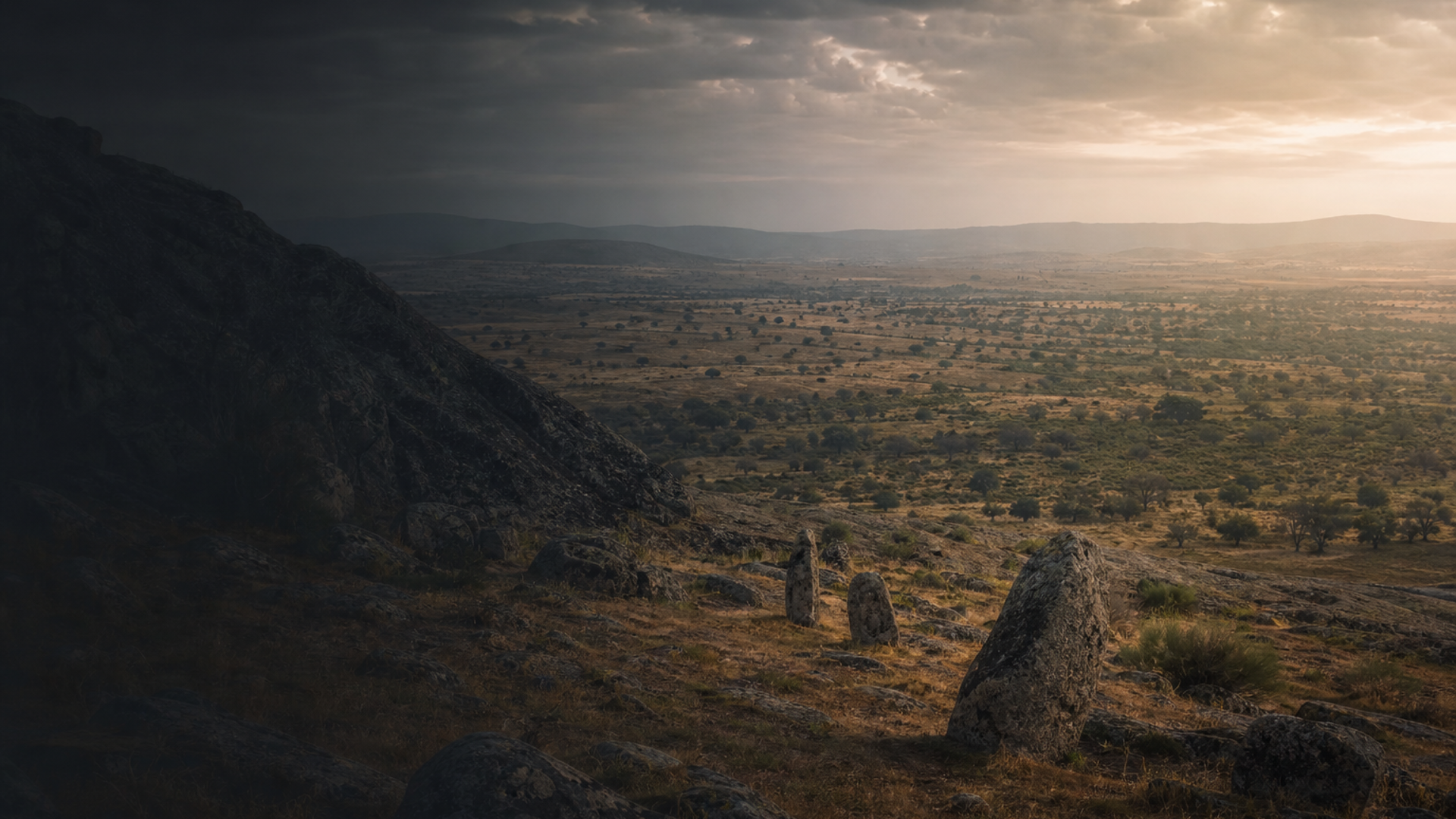
These Évora individuals should be read as part of that mosaic: limited skeletal and contextual data place them within funerary or settlement-related contexts near Monte da Cabida, a site that sits in the long human palimpsest of the Alentejo plain. Archaeological data indicates reuse of monumental places and a continued relationship with earlier megalithic traditions in the region, even as bronze metallurgy spreads.

Limited evidence suggests that the local social landscapes were dynamic — long-lived settlements, occasional long-distance exchange, and the appearance of novel objects. Because the dataset for Portugal_EBA here is small (n = 3), broader demographic models remain provisional. Still, these genomes anchor archaeological impressions to specific people and places in Évora’s deep past.

  • Early Bronze Age in Évora dated to 2200–1700 BCE
  • Samples from São Manços, Monte da Cabida 3
  • Evidence suggests local continuity with new external influences
Capítulo IV

Daily Life & Society

Archaeological traces in southern Portugal evoke a landscape of open fields, seasonal movement, and community focal points. Settlement archaeology in the Alentejo shows small nucleated habitations and farmsteads alongside reused ritual monuments; archaeobotanical remains suggest mixed agriculture with cereals and pulses, while faunal assemblages point to sheep, goat and cattle herding as economic mainstays.

At Monte da Cabida and nearby loci, funerary deposits and domestic debris indicate lives lived close to the land and to long-term ancestral markers. Grave goods, often modest, are consistent with societies where status was expressed through control of livestock, access to metal, and stewarding ritual places. The material culture seen across the region — pottery typologies, metal fragments, and stone architecture — implies local craft traditions complemented by exchange networks that brought exotic raw materials and ideas.

Importantly, the human stories inferred from artifacts are illuminated, not replaced, by DNA. The three genome samples provide personal glimpses: individuals who were part of these everyday economies, connected to their landscapes and to broader currents of change. Given the small sample size, interpretations of social structure or mobility should be treated as preliminary.

  • Mixed agriculture and pastoralism dominated subsistence
  • Communities reused ritual and funerary monuments while adopting new material forms
Capítulo V

Genetic Profile

Genetic data from the Portugal_EBA set comprises three individuals dated between 2200 and 1700 BCE, recovered from Évora (São Manços, Monte da Cabida 3). Among these, Y-chromosome results show a single individual carrying haplogroup R. Mitochondrial haplogroups are H, J and U — one example each — reflecting maternal lineages commonly observed across Neolithic and Bronze Age Europe.

Taken together, this limited snapshot hints at a genetic tapestry where local maternal lineages persisted (H, J, U are widespread in prehistoric Europe) while paternal lineages including R overlap with broader west Eurasian patterns. Haplogroup R (without finer subclade resolution here) is frequent in Bronze Age Europe and can be associated in some regions with steppe-related ancestries, but with only one Y sample the data cannot confirm sizeable incoming male-mediated gene flow into Évora.

Genome-wide affinities (where available) should be interpreted cautiously: with n = 3, statistical power is very low. Preliminary signals may indicate continuity from Late Chalcolithic populations alongside admixture episodes shared across Iberia during the Early Bronze Age. Future sampling and higher resolution analyses (more genomes, Y-SNP resolution, and autosomal ancestry modeling) are required to test hypotheses of migration, kinship, and social structure.

Limited sample count makes these conclusions provisional; nevertheless, these genomes are valuable anchors tying archaeological contexts at Monte da Cabida to the broader demographic currents of Bronze Age Europe.

  • Y-DNA: R (1/3) — suggests overlap with wider Bronze Age paternal lineages
  • mtDNA: H, J, U (each 1/3) — maternal lineages consistent with regional continuity
Capítulo VI

Legacy & Modern Connections

The echoes of Early Bronze Age Évora persist in the modern landscape: continuity of settlement in the Alentejo, lingering place-names, and the survival of cultural memory encoded in monuments. Genetic threads from this period — though sampled sparingly here — contribute to the deep ancestry of Iberian populations. Maternal lineages like H, J and U remain common in modern Iberia, and paternal haplogroup R is widespread across contemporary Western Europe.
Connecting ancient genomes to living people is a long and careful process: these three individuals provide snapshots that, when combined with larger regional datasets, help reconstruct patterns of continuity and change. The preliminary nature of the Portugal_EBA dataset should be emphasized. Additional archaeological excavation and targeted ancient DNA sampling across Portugal will sharpen the picture of how Early Bronze Age communities contributed to the genetic and cultural fabric of later populations.

  • Maternal haplogroups mirror lineages still common in Iberia today
  • Current conclusions are provisional; more samples needed to clarify continuity
Con IA

Asistente de IA

Haz preguntas sobre la cultura Évora Early Bronze Age Echoes

Asistente de IA por DNAGENICS

Desbloquear esta función
Pregunta sobre la cultura Évora Early Bronze Age Echoes. El asistente con IA puede explicar hallazgos genéticos, contexto histórico, pruebas arqueológicas y conexiones modernas, con sus límites de interpretación.
Ejemplo de análisis con IA

La cultura Évora Early Bronze Age Echoes representa un capítulo de la historia humana...

El análisis genético permite estudiar similitudes con poblaciones anteriores y posibles adaptaciones. Las muestras de ADN antiguo aportan información para investigar patrones migratorios y relaciones entre poblaciones, con límites que dependen del estudio y del contexto arqueológico.

Esta es una vista previa del análisis con IA. Accede al asistente completo para explorar información sobre:

  • Composición y similitud genética
  • Patrones migratorios y orígenes
  • Vida cotidiana y prácticas culturales
  • Contexto genético moderno

Explora más culturas antiguas

Descubre la historia de civilizaciones de distintas partes del mundo antiguo




