Preparando el informe

Cargando la información y las referencias disponibles

Consultando el registro arqueológico...

Recopilando registros antiguos

Saltar al contenido principal
Himera: Voices of Archaic Sicily
Cultura destacada

Himera: Voices of Archaic Sicily

Genomic and archaeological glimpses into a Sicilian Greek city-state (500–400 BCE)

500 CE - 400 BCE
Himera, Termini Imerese, Palermo (Sicily, Italy)
Desplázate para empezar
Capítulo I

La historia

Comprender la cultura Himera: Voices of Archaic Sicily

Archaeogenetic and archaeological evidence from Himera (Termini Imerese, Sicily) offers a glimpse into a multicultural Archaic Greek community. Four genomes (500–400 BCE) show Y haplogroup G and diverse maternal lineages (U, T2, H, T), suggesting local and eastern Mediterranean connections. Conclusions remain preliminary.

Time Period

500–400 BCE

Region

Himera, Termini Imerese, Palermo (Sicily, Italy)

Common Y-DNA

G (1)

Common mtDNA

U, T2, H, T

Capítulo II

Cronología

Momentos clave de la historia de esta cultura

648 BCE

Founding in the Archaic Period

Himera emerges as a Greek colony on Sicily's northern coast, integrating settlers and local populations into a coastal polis (brief, archaeological and historical evidence).

480 BCE

Battle of Himera

A major conflict between Himera (Greek allies) and Carthaginian forces leaves archaeological traces of destruction and reconstruction at the site.

1800 CE

Modern Excavations Begin

Archaeological interest and systematic excavations around Termini Imerese uncover necropoleis and material culture that frame later aDNA sampling.

Capítulo III

Origins & Emergence

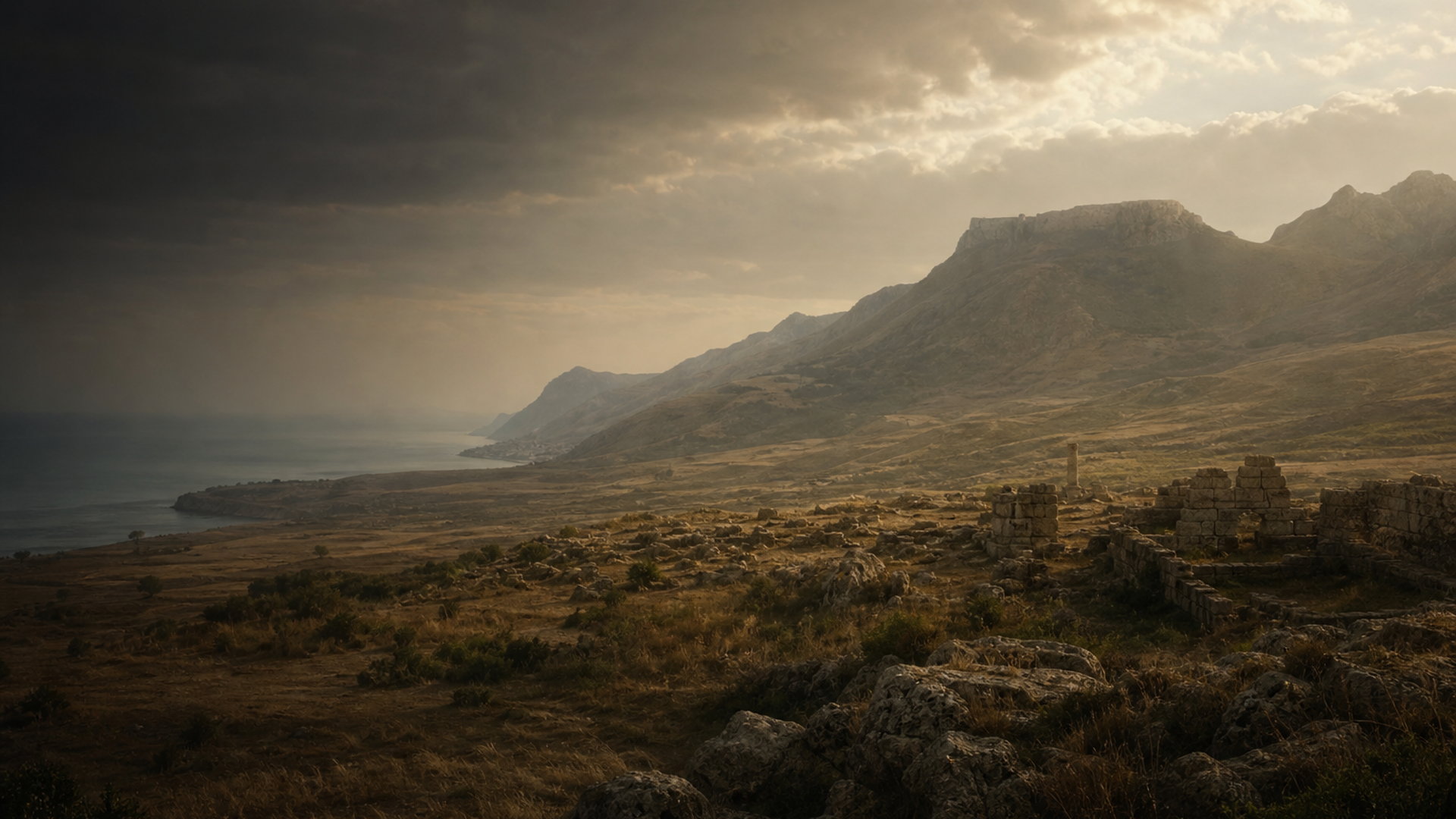
Himera sits on the northern coast of Sicily like a shard of Greek light thrown into the western Mediterranean. Founded during the era of Greek colonization in the 7th–6th centuries BCE, Himera became an important Archaic polis and commercial hub linking mainland Greece with indigenous Sicilian groups and maritime networks across the central Mediterranean. Archaeological layers at Himera and its necropoleis around Termini Imerese (Palermo province) reveal Hellenic urban planning, sanctuaries, and imported pottery alongside locally produced ceramics, indicating cultural entanglement rather than stark separation.

Historical events — most dramatically the battle of 480 BCE when Himera clashed with Carthaginian forces — are reflected in destruction layers and shifts in material culture. Archaeological data indicates phases of rebuilding and continuity into the 5th century BCE. Bioarchaeological remains recovered from funerary contexts provide direct human evidence for the people who lived here.

Limited genetic sampling (four individuals) offers tantalizing but tentative signals: the presence of Y haplogroup G and a diversity of maternal haplogroups points to individuals with varied geographic ancestries, consistent with a frontier port city where settlers, merchants, and locals mingled. Archaeological context supports a picture of emergence through mobility, trade, and cultural interaction, but the small sample size means broader demographic patterns remain uncertain.

  • Founded during the Greek colonization of Sicily; major Archaic polis.
  • Archaeology shows imported Greek goods alongside local Sicilian traditions.
  • Material and genetic evidence point to multicultural interactions, but data are limited.
Capítulo IV

Daily Life & Society

Daily life in Himera would have been a tapestry of salt air, market voices, ritual processions, and craft production. Excavations around Termini Imerese have revealed domestic architecture, pottery kilns, and workshops indicating local industry in pottery and metalwork. Food remains and amphorae point to a diet enriched by local cereals, olives, fish, and imported wine and oil; trade ceramics and goods from mainland Greece and the wider Mediterranean testify to active maritime commerce.

Burial practices at nearby necropoleis show variation: inhumations with grave goods alongside simpler burials reflect social differentiation. Funerary assemblages — weapons, pottery, personal ornaments — suggest roles tied to status, gender, and perhaps mercantile networks. Inscriptions and architectural fragments hint at civic institutions familiar from other Archaic Greek poleis, though locally inflected by contact with Sicel and Phoenician neighbors.

Archaeological evidence indicates a community shaped by mobility: craftsmen and sailors, colonists and indigenous families shared landscape and economy. This social complexity creates the context in which genetic diversity observed in ancient DNA can be understood as part of everyday life in an interconnected Mediterranean world.

  • Economy based on maritime trade, crafts (pottery, metal), and local agriculture.
  • Funerary diversity indicates social differentiation and cross-cultural interaction.
Capítulo V

Genetic Profile

Ancient DNA from four individuals attributed to Himera (500–400 BCE) provides a preliminary genetic window into this Archaic Greek community. The Y-chromosome data show haplogroup G in one male sample. Haplogroup G is broadly distributed in the Near East, Caucasus, and parts of Europe, and in Mediterranean contexts can reflect Neolithic farmer ancestries and later population movements; its presence here is compatible with eastern or island Greek connections but is not diagnostic on its own.

Mitochondrial diversity among the four individuals includes haplogroups U, T2, H, and T. These maternal lineages are widespread across Europe and the Near East in the Bronze Age and Iron Age periods, and their presence at Himera aligns with a mixed maternal ancestry: some lineages associated with long-standing European populations (e.g., U, H) and others common in broader Mediterranean networks (T2, T).

Important caveats: with only four genomes, interpretations are preliminary. Archaeological context suggests a port with regular inbound mobility, so the observed genetic heterogeneity may reflect transient individuals (merchants, sailors) as well as local families. Robust conclusions about population continuity, admixture proportions, or kinship patterns require larger sample sizes and comparative datasets from contemporaneous Sicilian, Greek, and Punic sites. Nevertheless, these early genetic results complement the archaeological picture of Himera as a crossroads of peoples and genes in the Archaic Mediterranean.

  • Y-DNA: G observed (1 male); suggestive of eastern/Mediterranean connections.
  • mtDNA: U, T2, H, T indicate diverse maternal ancestries; sample size is small.
Capítulo VI

Legacy & Modern Connections

Himera's ruins and the human remains recovered there are threads tying modern Sicily to its layered past. Archaeological remains preserve the material culture of a city at the edge of Greek colonization, while ancient DNA begins to trace the biological echoes of trade, migration, and local continuity. For contemporary populations of Sicily and southern Italy, genetic studies show deep Mediterranean admixture over millennia; the Himera samples hint at the specific currents — Greek, local Sicilian, and wider eastern Mediterranean — that contributed to this mosaic.

Caution must temper enthusiasm: four samples cannot map the full demographic story. Yet when combined with pottery, architecture, and historical records (such as accounts of the 480 BCE conflict with Carthage), these genomes enrich a cinematic yet evidence-based narrative of human lives in an Archaic port. Future, larger-scale aDNA sampling across Sicilian sites will clarify how typical the Himera profiles were and how those ancient threads connect to present-day genetic landscapes.

  • Ancient DNA complements archaeology to reveal Sicily's multicultural past.
  • Current conclusions are provisional; larger datasets are needed for firm links to modern populations.
Con IA

Asistente de IA

Haz preguntas sobre la cultura Himera: Voices of Archaic Sicily

Asistente de IA por DNAGENICS

Desbloquear esta función
Pregunta sobre la cultura Himera: Voices of Archaic Sicily. El asistente con IA puede explicar hallazgos genéticos, contexto histórico, pruebas arqueológicas y conexiones modernas, con sus límites de interpretación.

Ejemplo de análisis con IA

La cultura Himera: Voices of Archaic Sicily representa un capítulo de la historia humana...

El análisis genético permite estudiar similitudes con poblaciones anteriores y posibles adaptaciones. Las muestras de ADN antiguo aportan información para investigar patrones migratorios y relaciones entre poblaciones, con límites que dependen del estudio y del contexto arqueológico.

Esta es una vista previa del análisis con IA. Accede al asistente completo para explorar información sobre:

  • Composición y similitud genética
  • Patrones migratorios y orígenes
  • Vida cotidiana y prácticas culturales
  • Contexto genético moderno

Explora más culturas antiguas

Descubre la historia de civilizaciones de distintas partes del mundo antiguo