Preparando el informe

Cargando la información y las referencias disponibles

Consultando el registro arqueológico...

Recopilando registros antiguos

Saltar al contenido principal
Iron Shadows of England
Cultura destacada

Iron Shadows of England

A genomic and archaeological portrait of Middle–Late Iron Age England (715 BCE–100 CE)

715 BCE - 100 CE
England (United Kingdom)
Desplázate para empezar
Capítulo I

La historia

Comprender la cultura Iron Shadows of England

Archaeological remains from 10 English sites (715 BCE–100 CE) are paired with 74 ancient genomes to reveal population continuity with Western European R-lineages and diverse maternal ancestries. Limited evidence suggests regional mobility and continental cultural links.

Time Period

715 BCE–100 CE

Region

England (United Kingdom)

Common Y-DNA

R (29), I (3), F (2), G (1)

Common mtDNA

H (18), J (10), U (9), T (9), K (5)

Capítulo II

Cronología

Momentos clave de la historia de esta cultura

43 CE

Roman invasion transforms landscapes

The Roman conquest beginning in 43 CE initiates administrative, economic and demographic transformations that overlay Iron Age social networks and leave variable genetic and archaeological signatures across England.

Capítulo III

Origins & Emergence

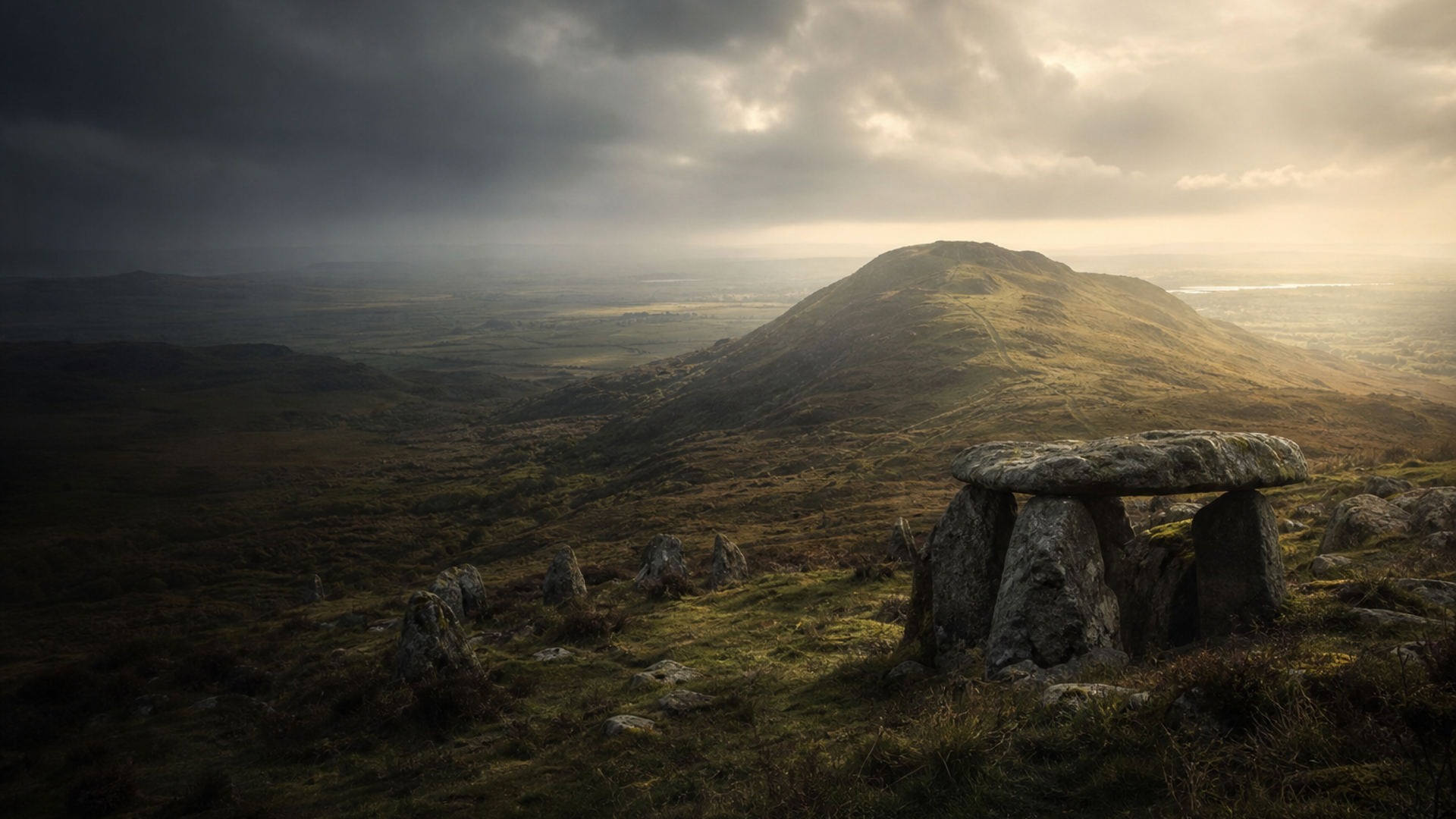
The Middle to Late Iron Age in England emerges across a tapestry of hillforts, coastal settlements and funerary landscapes between 715 BCE and 100 CE. Material culture — La Tène-style metalwork, oppida-like enclosures, and richly furnished burials — speaks of intensified regional hierarchy and increased long-distance contacts with continental Europe. Archaeological data indicates that many of the sampled contexts are associated with small burial mounds, roadside cemeteries and settlement phases on prominent hills: Winnall Down (Hampshire), Ham Hill (Somerset), and Dalton Parlours (West Yorkshire) among others.

Genomic data from 74 individuals sampled across ten sites support a picture of substantial continuity with earlier British populations, but also complexity introduced by mobility. The predominance of Y-haplogroup R (29/35 male-assigned Y cases) aligns with Western European R lineages known from the late Bronze and Iron Ages, suggesting persistence of paternal ancestries in many communities. At the same time, material signs of continental exchange and occasional eastern or southern mitochondrial lineages hint at mobility, marriage networks, and small-scale migration. Limited evidence suggests regional variation in uptake of La Tène styles and status displays; archaeological interpretation remains cautious where context is disturbed or sample sizes are small for any single site.

Key archaeological sites cited in these samples include Winnall Down (Hampshire), Worlebury (Somerset), Over (Cambridgeshire), Tregunnel (Newquay, Cornwall), Fairford Saxon Way (Gloucestershire), East Kent Access Road (Kent), Wattle Syke and Dalton Parlours (West Yorkshire), Thame (Oxfordshire), and Ham Hill (Somerset).

  • Emergence across hillforts, coastal settlements, and barrow cemeteries
  • Material links to continental La Tène traditions coexist with local practices
  • 74 genomes suggest broad continuity with punctuated mobility
Capítulo IV

Daily Life & Society

Daily life in Middle–Late Iron Age England unfolded amid pastoral landscapes, clustered farmsteads and increasingly fortified settlements. Archaeobotanical and zooarchaeological assemblages from contemporary sites show mixed farming, with cereals, cattle and sheep central to subsistence, while craft specialization — ironworking, smithing and the production of decorated metalwork — marked social differentiation. Archaeological data indicates that long-distance trade brought exotic goods and ideas: continental brooches, wine imports and metalwork suggest elite consumption tied to wider networks.

Burial practices visible in the sampled contexts vary from crouched inhumations to more elaborate graves with metal offerings. Such variability implies regional traditions and shifting social identities rather than a single uniform culture. Craft workshops identified near settlements and roadside distributions of artifacts like weaponry and personal ornaments point to both local production and itinerant artisans. Coastal sites (e.g., Tregunnel, Newquay) capture maritime links: fish, shellfish, and traded goods appear alongside local ceramics.

Archaeological evidence alone cannot resolve individual life histories; integrating DNA reveals kinship patterns within cemeteries and possible exogamy. Yet preservation biases and uneven excavation histories mean reconstructions of daily life remain probabilistic, and interpretations should be treated as models that will refine as new data appear.

  • Mixed farming and craft specialization shaped local economies
  • Burial variability and imported goods reflect social complexity
Capítulo V

Genetic Profile

The combined ancient DNA dataset (74 individuals) provides a nuanced genetic portrait of Middle–Late Iron Age England. Y-chromosome results show a strong representation of haplogroup R (29 of the Y-assigned males), with smaller numbers of I (3), F (2) and G (1). This dominance of R is consistent with continuity of Western European paternal lineages through the later Bronze Age into the Iron Age, though specific subclade resolution varies by sample and is not uniformly available for all individuals. mtDNA diversity is broader: haplogroups H (18), J (10), U (9), T (9) and K (5) together indicate a mosaic of maternal ancestries reflecting deep local roots and episodic inputs from neighboring regions.

Genetic affinities place most individuals within the range of broadly northwest European Iron Age populations, but there are measurable regional differences across sites. Coastal and southeast contexts (e.g., East Kent Access Road, Tregunnel) show slightly elevated signals consistent with continental interaction, whereas inland hillfort samples trend toward local ancestry profiles. Kinship analyses within some cemeteries reveal family clusters, suggesting small kin-based burial groups; limited sample sizes at individual sites mean these patterns are often preliminary.

Uncertainty must be acknowledged: sampling bias by site and preservation, incomplete geographic coverage of Iron Age England, and varying genome coverage limit fine-grained demographic reconstructions. Nevertheless, the genetic data corroborate archaeological evidence for both continuity and selective mobility during 715 BCE–100 CE.

  • Predominant Y haplogroup R supports paternal continuity with Western Europe
  • Diverse maternal mtDNA (H, J, U, T, K) indicates mixed maternal ancestries
Capítulo VI

Legacy & Modern Connections

The biological and cultural legacies of Middle–Late Iron Age England persist in both landscape and genome. Many modern populations in Britain carry descendants of the same broad lineages evident in these samples — particularly Western European R-lineages — though later migrations (Roman, Anglo-Saxon, Viking, Norman) layered additional ancestry. Archaeological continuities in place names, settlement focal points and earthworks testify to the enduring imprint of Iron Age social organization.

Genetically, the dataset helps anchor models of ancestry used in modern population studies: it provides pre-Roman baselines against which subsequent demographic events can be compared. However, caution is necessary when connecting ancient individuals directly to modern identities; gene flow across two millennia and cultural change mean that continuity is complex, not identical. Limited geographic sampling in some regions also means local histories remain incompletely resolved. Future targeted sampling and higher-resolution genomic data will refine how these Iron Age people contributed to the genetic tapestry of later Britain.

  • Provides a pre-Roman genomic baseline for British ancestry studies
  • Continuity exists alongside later, transformative migrations and cultural change
Con IA

Asistente de IA

Haz preguntas sobre la cultura Iron Shadows of England

Asistente de IA por DNAGENICS

Desbloquear esta función
Pregunta sobre la cultura Iron Shadows of England. El asistente con IA puede explicar hallazgos genéticos, contexto histórico, pruebas arqueológicas y conexiones modernas, con sus límites de interpretación.
Ejemplo de análisis con IA

La cultura Iron Shadows of England representa un capítulo de la historia humana...

El análisis genético permite estudiar similitudes con poblaciones anteriores y posibles adaptaciones. Las muestras de ADN antiguo aportan información para investigar patrones migratorios y relaciones entre poblaciones, con límites que dependen del estudio y del contexto arqueológico.

Esta es una vista previa del análisis con IA. Accede al asistente completo para explorar información sobre:

  • Composición y similitud genética
  • Patrones migratorios y orígenes
  • Vida cotidiana y prácticas culturales
  • Contexto genético moderno

Explora más culturas antiguas

Descubre la historia de civilizaciones de distintas partes del mundo antiguo