Preparando el informe

Cargando la información y las referencias disponibles

Consultando el registro arqueológico...

Recopilando registros antiguos

Saltar al contenido principal
Island of Winds: Early Modern Faroes
Cultura destacada

Island of Winds: Early Modern Faroes

Church burials and DNA reveal a compact, maritime community in the Faroe Islands (1500–1700 CE)

1500 CE - 1700 CE
Faroe Islands
Desplázate para empezar
Capítulo I

La historia

Comprender la cultura Island of Winds: Early Modern Faroes

Archaeological and ancient DNA data from Church2 in the Faroe Islands (1500–1700 CE) reveal a compact Early Modern community dominated by Western European maternal lineages and a majority R paternal signal. Findings suggest continuity with North Atlantic networks but require broader sampling.

Time Period

1500–1700 CE

Region

Faroe Islands

Common Y-DNA

R (majority, 12), I1 (1)

Common mtDNA

H (majority, 12), J, H17, U, H5

Capítulo II

Cronología

Momentos clave de la historia de esta cultura

1500 CE

Church2 burials begin (documented era)

Church2 cemetery provides primary archaeological and genetic material dated to the Early Modern Faroes (1500–1700 CE).

Capítulo III

Origins & Emergence

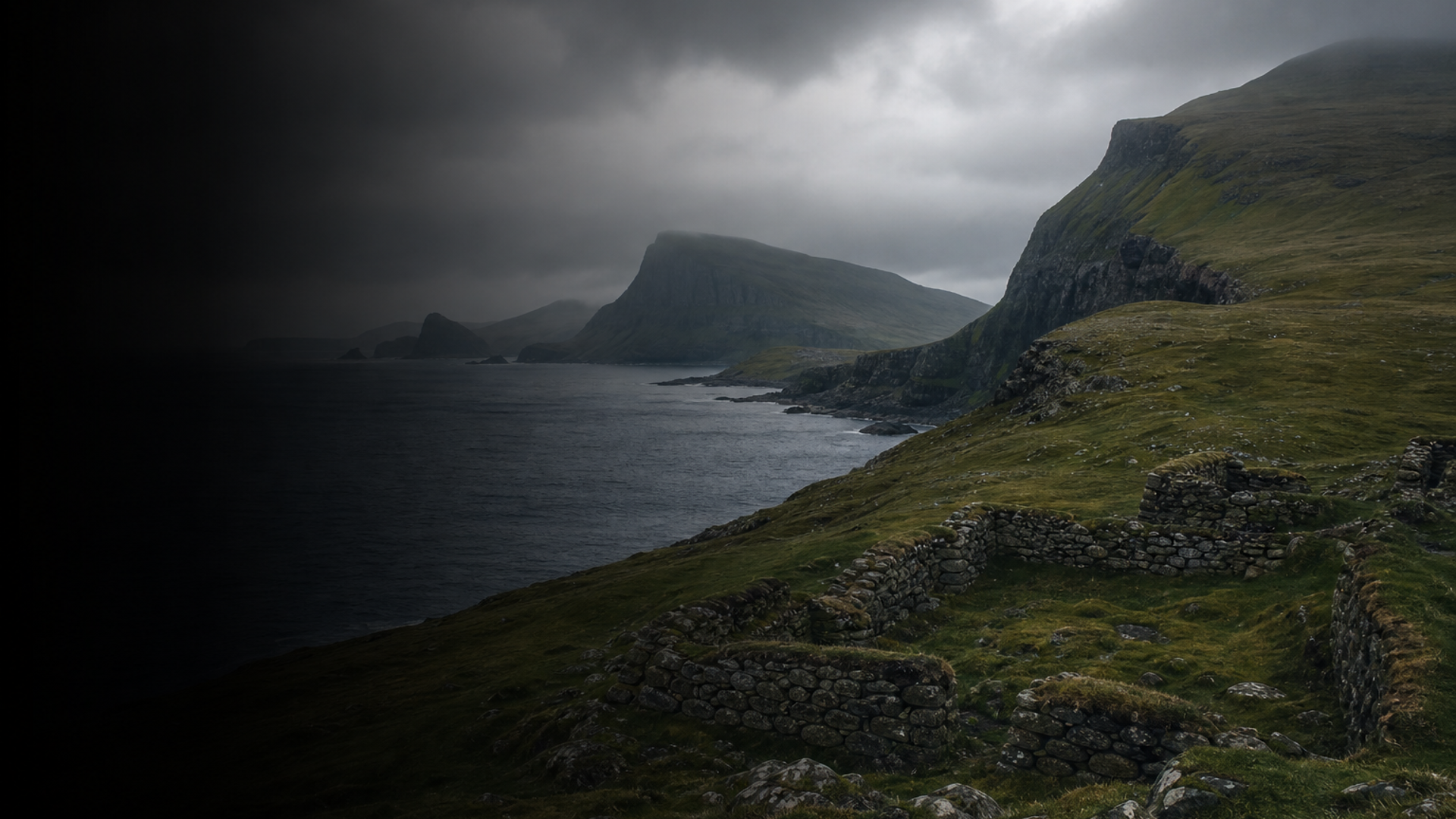
The Early Modern Faroes (1500–1700 CE) unfold against a landscape of wind-swept grass and stone—an archipelago long shaped by seafaring horizons. Archaeological data from Church2 (Faroes) places burials and associated material culture in the domestic and ecclesiastical heart of island life. While Norse settlement of the Faroes began many centuries earlier (c. 9th–10th centuries CE), the 16th–17th century record at Church2 reflects a community negotiating continuity and change: sustaining pastoral and maritime economies, using churchyard burial practices, and maintaining connections across the North Atlantic.

Material remains and burial contexts suggest a settled, small-population society where local traditions layered over centuries of contact. Historical documents from the North Atlantic hint at fishing, sheep husbandry, and periodic links to Norway, Scotland, and Iceland; the archaeological footprint at Church2 echoes those networks. Limited evidence means we must be cautious about precise migration events, but the combined archaeological and genetic picture suggests the Early Modern Faroes were at once insular and interconnected—an island culture whose everyday life bore traces of broader Atlantic currents.

  • Church2 provides primary burial context for 1500–1700 CE Faroes
  • Archaeological data indicates continuity with earlier Norse settlement patterns
  • Island isolation coupled with Atlantic contacts shaped emergence
Capítulo IV

Daily Life & Society

Life on the Early Modern Faroes was organized around sea, sheep, and stone. Archaeological indicators—settlement traces, churchyard burials, and recovered artefacts—paint a scene of modest households oriented to coastal resources. Fish and small-boat technologies were central to subsistence; sheep grazing shaped the inland landscape. Church2 sits at the center of ritual life, where interments reflect community structure and perhaps family plots that persisted through generations.

Social organization likely combined kin groups and parish ties. Graves at Church2 imply established burial rites associated with Christian practice, but variation in graves and associated objects hints at social differences—age, sex, and perhaps status within a small population. Craft activities, repair of boats and tools, and seasonal travel for trade or kin-visiting would have punctuated the year. Archaeological data indicates resilience: islanders adapted material culture and economic strategies to the North Atlantic environment while maintaining cultural links across sea routes.

  • Subsistence centered on fishing and sheep husbandry
  • Churchyard burials suggest enduring parish and kin structures
Capítulo V

Genetic Profile

Sixteen individuals sampled from Church2 (Faroes) provide an Early Modern snapshot linking bones to biological lineages. Y-chromosome data show a clear majority labeled as R (12 individuals) with a single I1; a small number of male lineages are not assigned to named categories in the provided counts. Mitochondrial DNA is dominated by haplogroup H (12 individuals), with additional maternal types J, H17, U, and H5 represented.

The prevalence of mtDNA H suggests continuity with widespread Western European maternal lineages common across the North Atlantic; the paternal R majority is consistent with broader Western European and Atlantic signals observed in many historical-period populations, though the dataset does not specify subclades (e.g., R1b) so direct assignment to particular migratory events is not possible here. The single I1 instance aligns with a known Scandinavian-associated paternal lineage but is rare in this sample.

Genetic patterns hint at a community shaped by admixture across Atlantic networks—maternal continuity paired with a predominantly R paternal signal—yet these inferences remain provisional. With 16 samples the dataset is informative for local structure but modest in size: broader geographic and temporal sampling, and subclade resolution, would strengthen interpretations about migration, kinship, and sex-biased mobility.

  • Majority Y-DNA R (12) with one I1 — suggests Western Atlantic/pan-European paternal signals
  • mtDNA dominated by H (12) — indicates strong Western European maternal continuity
Capítulo VI

Legacy & Modern Connections

The genetic and archaeological imprint of the Early Modern Faroes continues to echo in the present. The dominance of mitochondrial H and a majority R paternal signal at Church2 resonates with broader patterns seen in North Atlantic populations, suggesting continuity of maternal lineages and persistent links to wider European gene pools. Local cultural practices—church-centered burial, maritime livelihoods, and small kin-based communities—helped conserve genetic signals over generations.

However, these results should be read with caution: 16 samples offer a meaningful but limited window into population history. Future ancient DNA work with finer Y-chromosome subclade resolution and wider sampling across islands, cemeteries, and time periods will clarify how Early Modern Faroese communities contributed to the genetic landscape of the modern Faroe Islands. For now, Church2 provides a cinematic glimpse of island lives shaped by sea and stone, and a tangible genetic thread connecting Early Modern islanders to the broader North Atlantic story.

  • Findings suggest maternal continuity and Atlantic connectivity into the present
  • Broader sampling and subclade resolution are needed to confirm long-term patterns
Con IA

Asistente de IA

Haz preguntas sobre la cultura Island of Winds: Early Modern Faroes

Asistente de IA por DNAGENICS

Desbloquear esta función
Pregunta sobre la cultura Island of Winds: Early Modern Faroes. El asistente con IA puede explicar hallazgos genéticos, contexto histórico, pruebas arqueológicas y conexiones modernas, con sus límites de interpretación.
Ejemplo de análisis con IA

La cultura Island of Winds: Early Modern Faroes representa un capítulo de la historia humana...

El análisis genético permite estudiar similitudes con poblaciones anteriores y posibles adaptaciones. Las muestras de ADN antiguo aportan información para investigar patrones migratorios y relaciones entre poblaciones, con límites que dependen del estudio y del contexto arqueológico.

Esta es una vista previa del análisis con IA. Accede al asistente completo para explorar información sobre:

  • Composición y similitud genética
  • Patrones migratorios y orígenes
  • Vida cotidiana y prácticas culturales
  • Contexto genético moderno

Explora más culturas antiguas

Descubre la historia de civilizaciones de distintas partes del mundo antiguo