Preparando el informe

Cargando la información y las referencias disponibles

Consultando el registro arqueológico...

Recopilando registros antiguos

Saltar al contenido principal
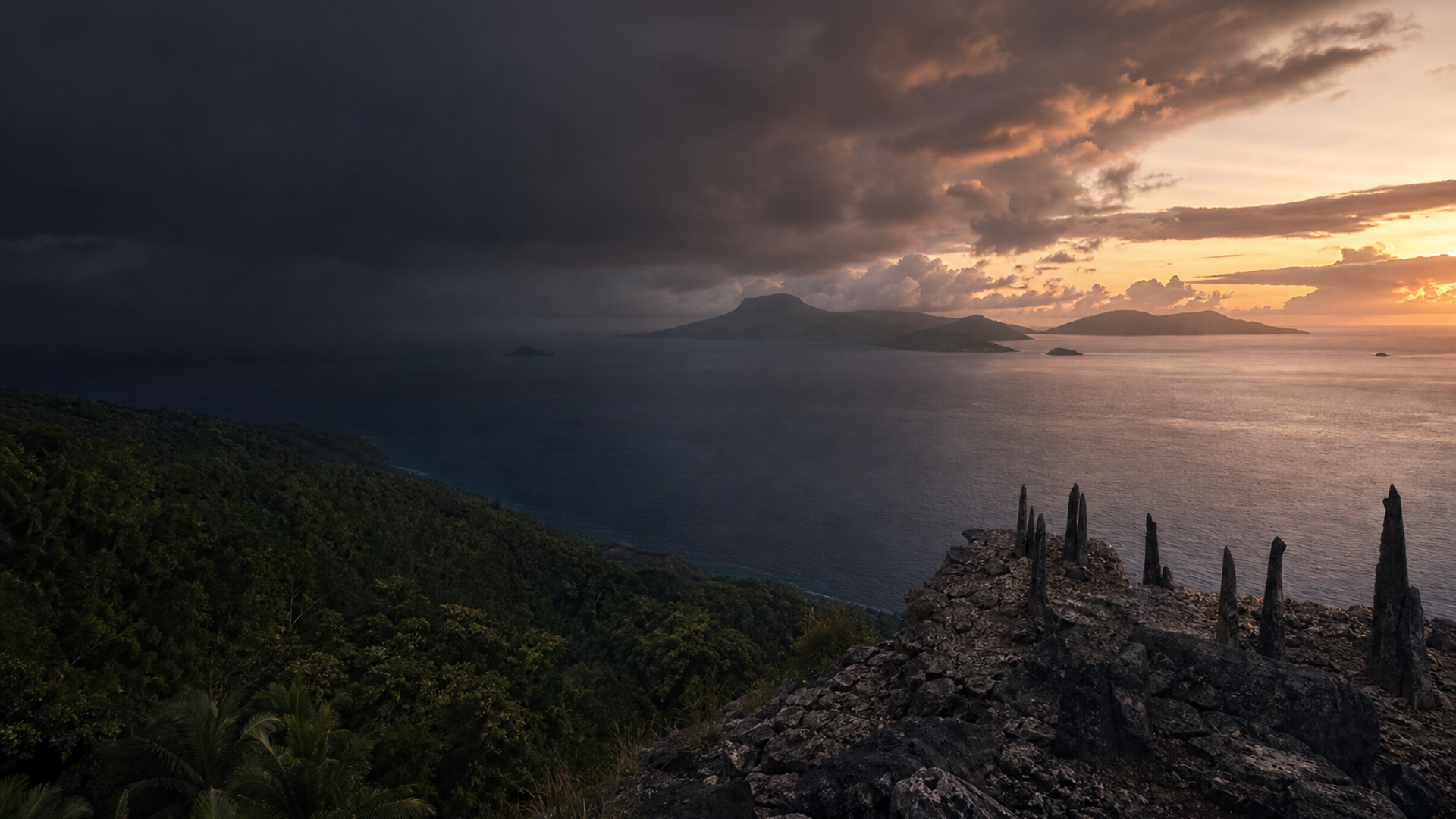
Islands at Dusk: Vanuatu 400 Years Ago
Cultura destacada

Islands at Dusk: Vanuatu 400 Years Ago

A snapshot of life in Vanuatu between 1450–1650 CE, where archaeology and DNA illuminate island stories

1450 CE - 1650 CE
Vanuatu (Retoka, Efate, Mangaasi)
Desplázate para empezar
Capítulo I

La historia

Comprender la cultura Islands at Dusk: Vanuatu 400 Years Ago

Archaeological and ancient DNA data from Retoka, Efate and Mangaasi (1450–1650 CE) reveal a small, mixed island population. Y-DNA C dominates paternal lineages while mtDNA shows both Papuan-associated and Austronesian maternal signatures. Small sample sizes make conclusions preliminary.

Time Period

1450–1650 CE

Region

Vanuatu (Retoka, Efate, Mangaasi)

Common Y-DNA

C (2 of 4 samples)

Common mtDNA

P2 (2), Q1 (1), B (1)

Capítulo II

Cronología

Momentos clave de la historia de esta cultura

2500 BCE

Lapita expansion across Remote Oceania

Early Lapita voyagers spread across islands; their pottery and seafaring set foundations for later Pacific societies.

Capítulo III

Origins & Emergence

Vanuatu in the decades around 1450–1650 CE sits in the long human story of Remote Oceania. Archaeological data indicates communities continued coastal and reef-focused lifeways established millennia earlier during the Lapita era, but by this late pre-contact interval local ceramic and tool traditions had matured into distinct island expressions. Excavations and surface collections at Retoka, Efate, and Mangaasi show occupation layers and material culture that reflect sustained settlement, exchange networks, and intensive gardening economies.

Genetically, the small set of ancient samples from these sites suggests continuity with broader Melanesian and Austronesian currents. The presence of Y-DNA haplogroup C in multiple individuals points to paternal ancestry that is common in parts of Near Oceania; meanwhile mtDNA lineages include both Papuan-associated types (P2, Q1) and an Austronesian-associated lineage (B). These patterns are consistent with archaeological models of sustained local adaptation and recurrent interaction across islands.

Limited evidence suggests regional variability: some communities show stronger Papuan-rooted maternal profiles while others carry clearer Austronesian mitochondrial signals. Because the dataset for this precise 1450–1650 CE window is small (four samples), the emerging picture should be treated as provisional. Further sampling across more sites and time slices is needed to resolve the timing and intensity of island-level demographic changes.

  • Occupations at Retoka, Efate, and Mangaasi date to 1450–1650 CE
  • Material culture indicates local traditions shaped by long-distance voyaging
  • Small sample size (n=4) means origin narratives are preliminary
Capítulo IV

Daily Life & Society

Imagine a shoreline where canoes creak at dawn and gardens slope up from the reef. Archaeological evidence from late-pre-contact Vanuatu points to mixed subsistence strategies: intensive horticulture (taro, yams, breadfruit), reef and open-ocean fishing, and the management of domesticates and forest resources. Settlement traces at Efate and nearby islands suggest hamlets and family compounds organized around coastal access and productive gardens.

Craft traditions—carved wood, shell ornamentation, and locally produced ceramics—reflect both continuity and localized innovation. Exchange of high-value goods, such as obsidian or shell, maintained inter-island links; oral histories recorded at European contact hint at ranked social leadership and ritual specialists, though archaeological data on social hierarchy in this window remain nuanced and site-specific.

Daily life was anchored by mobility: canoe technology enabled travel, trade, and social alliance across the archipelago. Environmental management, including arboriculture and agroforestry, shaped resilient island economies. However, because archaeological sampling from this 1450–1650 CE interval is limited, many aspects of household organization and social complexity remain incompletely documented.

  • Gardening and fishing formed the economic backbone
  • Crafts and exchange tied islands across Vanuatu
Capítulo V

Genetic Profile

Ancient DNA from four individuals excavated at Retoka, Efate, and Mangaasi offers a brief but evocative genetic window into Vanuatu around 1450–1650 CE. Two of the four male-line profiles carry Y-DNA haplogroup C, a lineage found across parts of Near Oceania and often associated with long-standing Melanesian paternal ancestry. On the maternal side, mtDNA results show two individuals with haplogroup P2, one with Q1, and one with B. This mixture aligns with a broader regional pattern where Papuan-associated maternal lineages (P, Q) and Austronesian-linked maternal lineages (notably B sub-lineages) co-occur in island populations.

Interpreting these findings requires caution. The small sample count (n=4) means that frequencies here are not robust population estimates. Nevertheless, the pattern—paternal C alongside both Papuan and Austronesian maternal types—echoes models of sex-biased admixture seen elsewhere in Oceania, where Austronesian-speaking voyagers and resident Papuan-descended communities interacted over centuries. Archaeogenetic data, integrated with archaeological contexts at Retoka and Efate, suggest ongoing exchange and genetic blending rather than a single replacement event.

Future sequencing of larger samples, especially spanning earlier and later centuries and more islands, will clarify whether these four individuals reflect local norms or idiosyncratic lineages. For now, the genetic evidence paints a picture of connected island communities with layered ancestries.

  • Y-DNA: C in 2 of 4 samples, indicating Melanesian-linked paternal ancestry
  • mtDNA: P2 (2), Q1 (1), B (1) — a mix of Papuan-associated and Austronesian maternal lineages
Capítulo VI

Legacy & Modern Connections

The genetic and archaeological signal from 1450–1650 CE links directly to living Ni-Vanuatu communities. Modern populations of Vanuatu carry complex ancestries formed over millennia of voyaging, local development, and social ties between islands. The coexistence of Papuan-associated and Austronesian-associated maternal lineages, paired with paternal signals like Y-DNA C, underscores a legacy of layered ancestry.

Because the ancient dataset is small, we emphasize continuity in broad strokes rather than precise demographic claims. What emerges is a resilient island world: dynamic maritime networks, persistent local traditions, and human stories encoded both in soil and in genomes. Each new ancient genome from Vanuatu will sharpen our understanding of migration, marriage patterns, and the ways islanders shaped their genetic and cultural landscapes.

  • Modern Ni-Vanuatu likely descend from mixed Papuan and Austronesian ancestries
  • Small ancient sample sizes mean links to present-day groups are suggestive, not definitive
Con IA

Asistente de IA

Haz preguntas sobre la cultura Islands at Dusk: Vanuatu 400 Years Ago

Asistente de IA por DNAGENICS

Desbloquear esta función
Pregunta sobre la cultura Islands at Dusk: Vanuatu 400 Years Ago. El asistente con IA puede explicar hallazgos genéticos, contexto histórico, pruebas arqueológicas y conexiones modernas, con sus límites de interpretación.
Ejemplo de análisis con IA

La cultura Islands at Dusk: Vanuatu 400 Years Ago representa un capítulo de la historia humana...

El análisis genético permite estudiar similitudes con poblaciones anteriores y posibles adaptaciones. Las muestras de ADN antiguo aportan información para investigar patrones migratorios y relaciones entre poblaciones, con límites que dependen del estudio y del contexto arqueológico.

Esta es una vista previa del análisis con IA. Accede al asistente completo para explorar información sobre:

  • Composición y similitud genética
  • Patrones migratorios y orígenes
  • Vida cotidiana y prácticas culturales
  • Contexto genético moderno

Explora más culturas antiguas

Descubre la historia de civilizaciones de distintas partes del mundo antiguo