Preparando el informe

Cargando la información y las referencias disponibles

Consultando el registro arqueológico...

Recopilando registros antiguos

Saltar al contenido principal
Katelai Iron Age: Swat Valley Echoes
Cultura destacada

Katelai Iron Age: Swat Valley Echoes

An Iron Age community in Swat (1203–800 BCE) where archaeology and DNA reveal layered ancestries.

1203 CE - 800 BCE
Swat Valley, Pakistan
Desplázate para empezar
Capítulo I

La historia

Comprender la cultura Katelai Iron Age: Swat Valley Echoes

Archaeological excavations at Katelai in Swat Valley (1203–800 BCE) reveal an Iron Age community whose material culture and uniparental DNA (n=32) record mixtures of South Asian and west Eurasian lineages. Genetic patterns suggest complex local ancestry and regional connections.

Time Period

1203–800 BCE

Region

Swat Valley, Pakistan

Common Y-DNA

R (6), J (4), L (3), I (2), H (2)

Common mtDNA

M (5), U (4), HV (4), U7b (2), H (2)

Capítulo II

Cronología

Momentos clave de la historia de esta cultura

1203 BCE

Katelai Iron Age Horizon

Archaeological horizon at Katelai dated to c.1203 BCE marks local adoption of iron technology and a mixed material culture in Swat Valley.

Capítulo III

Origins & Emergence

The Katelai Iron Age horizon in the Swat Valley emerges from a landscape already shaped by millennia of farming, craft, and long-distance exchange. Archaeological data from Katelai (Swat Valley, Pakistan) dated between 1203 and 800 BCE indicate a community negotiating local traditions and incoming influences: iron technology appears alongside pottery forms and settlement patterns that echo both highland and lowland practices.

Limited evidence suggests Katelai functioned as a regional node — a place of seasonal aggregation, craft production, and exchange along the Himalayan foothills. Material traces show a pragmatic, adaptive society rather than a sudden, intrusive replacement: houses, toolkits, and metalworking debris point to in situ innovation layered over older ceramic and lithic traditions.

Genetic data from 32 individuals provide a complementary window: uniparental markers reveal a mixture of south Asian maternal lineages and a spectrum of paternal haplogroups including west Eurasian and South Asian types. This genetic mosaic is consistent with archaeological signs of connectivity to both the Gangetic plains and the broader west Eurasian world.

Caveat: while 32 samples give meaningful patterns, local variability and temporally fine-grained shifts may be masked. Archaeological contexts are sometimes fragmentary, so conclusions about origin processes remain cautiously framed.

  • Dates: 1203–800 BCE in Katelai, Swat Valley
  • Iron technology alongside local craft traditions
  • Genetic evidence indicates mixed south Asian and west Eurasian ancestry
Capítulo IV

Daily Life & Society

The human scale at Katelai can be sketched from household debris, artefact scatters, and landscape traces. Archaeological indicators point to compact settlements leveraging valley agriculture and upland resources: fields on terraced slopes, storage pits, and hearths suggest routine farming, seasonal herding, and household metallurgy. Iron knives, chisels, and fragments of smelting debris indicate that working iron became part of daily craft and economic life.

Ceramic assemblages — utilitarian wares for cooking and storage — show continuities with earlier Swat Valley traditions, while some forms and decorative motifs hint at exchange with neighboring regions. Burials and funerary offerings at nearby sites in the Swat region reveal diverse practices; at Katelai specifically, preservation is variable, so inferences must be cautious. Social life likely combined kin-based households with wider networks of exchange that linked valleys and passes.

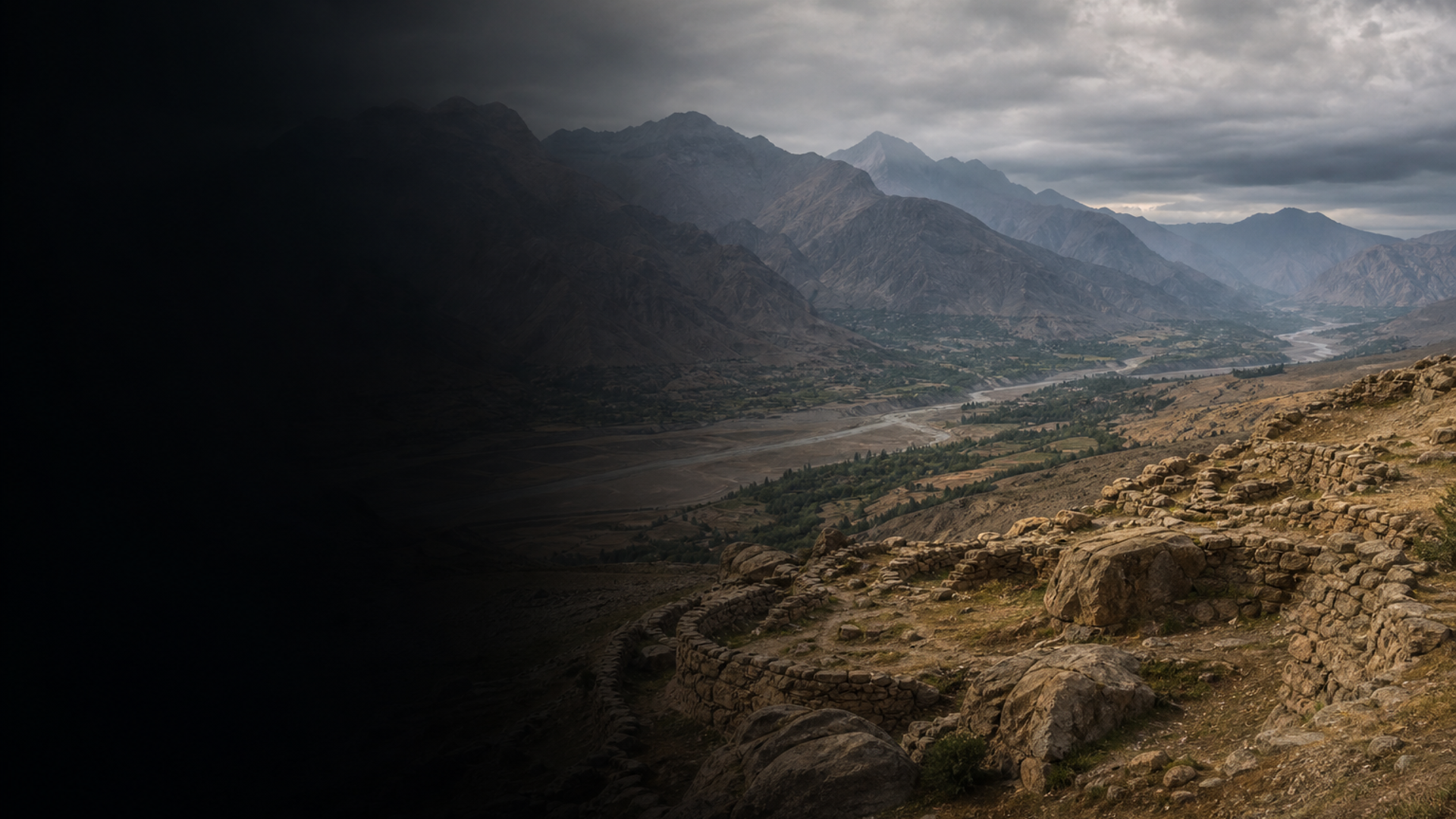
Cinematic image: a dawn in the Swat Valley, smoke from small forges rising above low stone houses as shepherds move flocks and traders prepare for mountain routes. This everyday scene reflects lives negotiated between local subsistence and broader connections evident in both artefacts and genes.

  • Household metallurgy and iron tools present
  • Agriculture combined with seasonal mobility and exchange
Capítulo V

Genetic Profile

The Katelai sample set (n = 32) offers an unusually detailed uniparental snapshot for an Iron Age community in northwest South Asia. Paternal lineages show a plurality of haplogroups: R (6 individuals) — often associated with wider west Eurasian/steppe distributions — is the largest single category, followed by J (4), L (3), I (2), and H (2). Maternal lineages are dominated by haplogroup M (5), common across South Asia, with substantial representation of U (4), HV (4), and smaller counts of U7b (2) and H (2).

Interpretation: this pattern indicates admixture between local South Asian maternal backgrounds and a mix of local and incoming paternal lineages. The presence of R and J on the Y-chromosome suggests male-mediated gene flow from west Eurasian or northwest South Asian sources; L and H reflect indigenous South Asian paternal components. Maternal M and U lineages indicate continuity of South Asian maternal ancestry, consistent with models in which incoming groups integrate with local female populations.

Caveats and context: uniparental markers capture only a fraction of ancestry and can be shaped by social processes (e.g., patrilocality, founder events). Although 32 samples provide a robust signal for broad patterns, claims about precise migration routes or timing would require autosomal data, more temporally resolved sampling, and direct archaeological association. Still, the combined archaeological and genetic picture points to a community shaped by layered ancestries and sustained regional connections.

  • Plural paternal profile: R and J alongside South Asian L, I, H
  • Maternal lineages dominated by South Asian M and western U/H variants
Capítulo VI

Legacy & Modern Connections

Echoes of Katelai live on in the genetic diversity of northwest Pakistan and the cultural palimpsest of the Swat Valley. Many of the uniparental haplogroups seen at Katelai — including Y-R and mtDNA M and U sublineages — persist in modern populations of the region, suggesting partial continuity of ancestry. Archaeological continuities in craft, settlement geometry, and landscape use also suggest long-term adaptation to the valley's environment.

At the same time, Katelai represents a waypoint in larger movements: subsequent centuries brought new political formations, trade networks, and cultural influences that layered atop local traditions. For modern-day residents and researchers alike, integrating DNA with the archaeological record humanizes long-term histories — revealing how mobility, marriage, and daily labor formed the genetic and cultural threads of the present.

Limited evidence cautions against simple narratives of direct descent; instead, Katelai highlights regional continuity mingled with episodes of connection and change.

  • Genetic continuity with modern northwest Pakistani lineages
  • Cultural persistence combined with later regional transformations
Con IA

Asistente de IA

Haz preguntas sobre la cultura Katelai Iron Age: Swat Valley Echoes

Asistente de IA por DNAGENICS

Desbloquear esta función
Pregunta sobre la cultura Katelai Iron Age: Swat Valley Echoes. El asistente con IA puede explicar hallazgos genéticos, contexto histórico, pruebas arqueológicas y conexiones modernas, con sus límites de interpretación.
Ejemplo de análisis con IA

La cultura Katelai Iron Age: Swat Valley Echoes representa un capítulo de la historia humana...

El análisis genético permite estudiar similitudes con poblaciones anteriores y posibles adaptaciones. Las muestras de ADN antiguo aportan información para investigar patrones migratorios y relaciones entre poblaciones, con límites que dependen del estudio y del contexto arqueológico.

Esta es una vista previa del análisis con IA. Accede al asistente completo para explorar información sobre:

  • Composición y similitud genética
  • Patrones migratorios y orígenes
  • Vida cotidiana y prácticas culturales
  • Contexto genético moderno

Explora más culturas antiguas

Descubre la historia de civilizaciones de distintas partes del mundo antiguo