Saltar al contenido principal
Cultura destacada

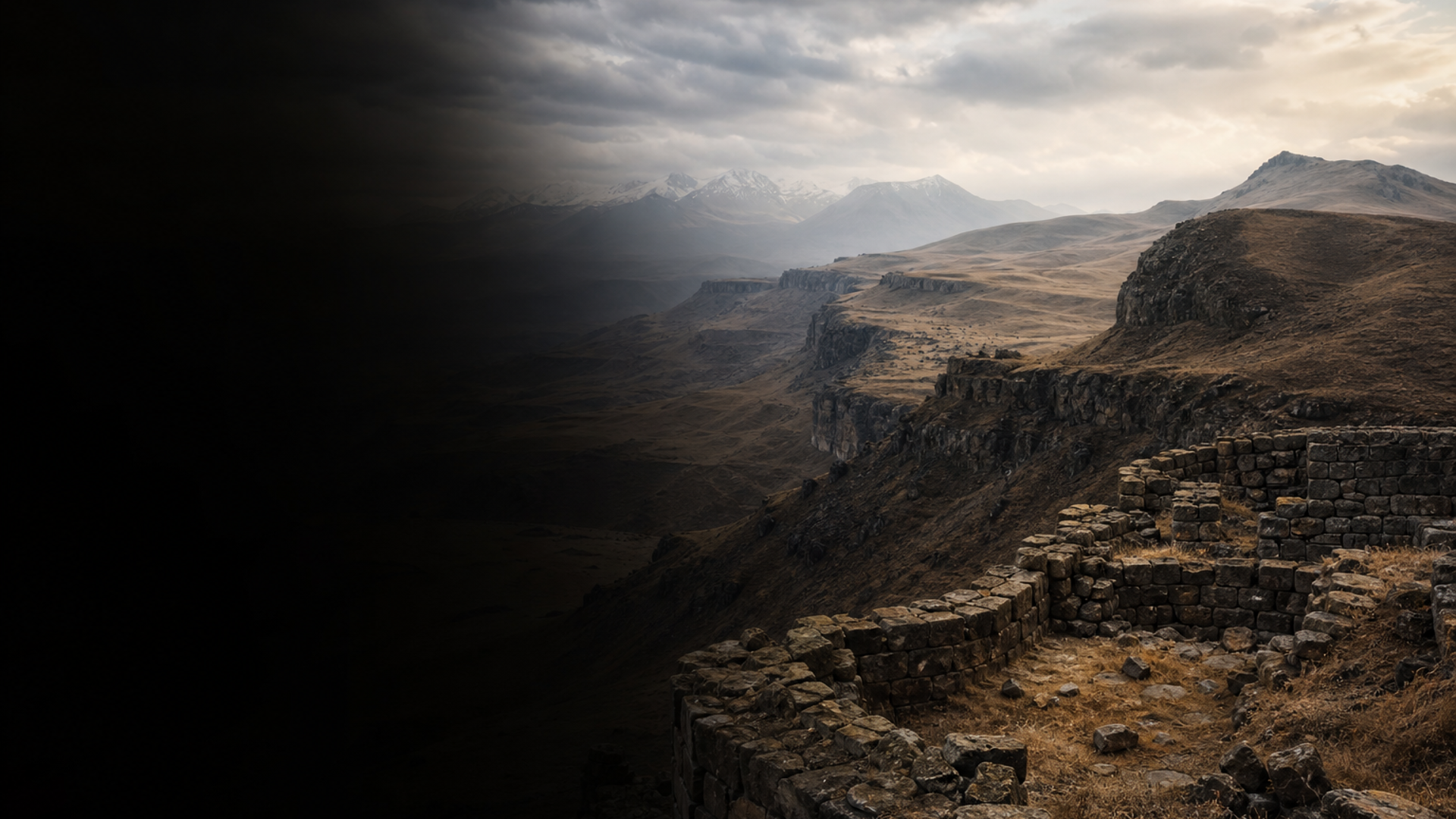
Late Bronze Armenia: Highland Echoes

Archaeology and DNA illuminate communities across Armenian highlands, 1439–805 BCE

1439 CE - 805 BCE
Armenian Highlands (modern Armenia)

La historia

Archaeological remains from Lori Berd to Karashamb, paired with 47 ancient genomes, reveal a Late Bronze Age Armenian tapestry of local continuity and regional connections across the Caucasus.

Time Period

1439–805 BCE

Region

Armenian Highlands (modern Armenia)

Common Y-DNA

I, R, J (each observed)

Common mtDNA

U (8), T (5), K (4), J (4), N (3)

Cronología

1439 BCE

Earliest sampled burials in dataset

The oldest radiocarbon-calibrated samples in the Armenia_LBA set date to c. 1439 BCE from cemetery contexts in the highlands.

1200 BCE

Regional exchange and material links

Archaeological horizons show intensified exchange of metals and ceramics across the South Caucasus and Anatolia, reflected in grave goods and settlement finds.

805 BCE

Latest sampled individuals

The most recent genomes in this collection date to c. 805 BCE, closing the sampled Late Bronze Age window for this dataset.

Origins & Emergence

The Armenia_LBA assemblage represents communities of the Armenian Highlands during the later Bronze Age (archaeological dates for sampled burials span 1439–805 BCE). Excavations and surveys at cemetery sites such as Karashamb, Tekhut, Lori Berd, Nerkin Getashen, and Noratus reveal funerary architectures and grave goods that link local traditions to wider Late Bronze Age networks across the South Caucasus and the Near East.

Archaeological data indicate continuity of highland pastoral and mixed-farming lifeways, with local metallurgy and imported objects testifying to long-distance contacts. Limited evidence suggests households organized around kin groups and seasonal herding patterns adapted to mountain valleys. Material culture shows both enduring local styles and elements that parallel neighboring Anatolian and Caucasian assemblages, consistent with exchange rather than wholesale population replacement.

Genetic sampling across these named sites begins to anchor those archaeological inferences in biological terms: the genomes sampled at cemetery contexts provide a snapshot of ancestry, mobility, and biological kinship in a geographically compact but culturally connected landscape. While the archive of material culture demonstrates links across regions, ancient DNA allows us to ask whether those links also involved gene flow, shared maternal lines, or the movement of individuals.

  • Samples come from multiple cemetery sites across Armenia (Karashamb, Lori Berd, Noratus, etc.)
  • Material culture shows both local continuity and regional connections
  • DNA provides a complementary window into mobility and kinship

Daily Life & Society

Life in Late Bronze Age Armenian communities unfolded in mountain valleys, riverine terraces, and fortified hilltops. Archaeological deposits from cemeteries and nearby settlements preserve pottery, tools, metalwork fragments, and evidence for livestock management that suggest mixed farming, sheep and cattle herding, and specialized craft production. Fortified sites and burial mounds imply concerns with protection, status, and control of pastures and routes.

Grave assemblages vary from modest offerings to richer burials, indicating social differentiation and possibly household-based status. Funerary rites recorded at sites such as Tekhut and Karashamb frequently include ceramic vessels, bronze items, and occasionally imported objects—a cinematic tableau of flames, smoke, and ritual gestures that bound families to the landscape. Osteological data, where preserved, point to a physically demanding life: repetitive strains, healed injuries, and dietary signals consistent with cereals, legumes, and pastoral products.

Archaeology suggests networks of exchange linking Armenian highlands to the broader Late Bronze Age world—trade in metal, the movement of craft styles, and the circulation of ideas. Genetic evidence (see below) helps test whether these networks also carried people and biological lineages, and whether kin groups were buried together at cemetery locales.

  • Mixed farming, herding, and local metallurgy characterize economy
  • Burial variability indicates social differentiation and ritual complexity

Genetic Profile

A set of 47 ancient genomes from Armenian Late Bronze Age contexts provides a regional genetic snapshot between 1439 and 805 BCE. Among assigned Y-chromosome calls in this dataset, haplogroups I, R, and J are observed as single instances each; most male haplogroups are either unassigned or low-frequency in the published sampling. Maternal lineages are more informative in this assemblage: mtDNA includes U (8 individuals, ~17%), T (5, ~11%), K (4, ~8.5%), J (4, ~8.5%), and N (3, ~6.4%), with other haplogroups at lower counts.

These maternal frequencies reflect strong representation of West Eurasian lineages common across the Near East and Caucasus. Archaeological and genetic concordance suggests substantial local continuity of maternal ancestry in the highlands, while the presence of diverse mtDNA types indicates connections to neighboring regions. The limited number of distinct Y-haplogroups called may reflect preservation or sampling bias; therefore conclusions about male-line continuity or replacement should be cautious.

Population-genetic analyses place Armenia_LBA genomes within the broader mosaic of Late Bronze Age Caucasus and Near Eastern populations: they show affinities to other South Caucasus groups with varying degrees of shared ancestry from local Neolithic farmers, Bronze Age highland communities, and intermittent inputs related to steppe-associated ancestries. Formal admixture modeling is needed to quantify proportions; current data indicate a landscape of continuity with episodic gene flow rather than abrupt population turnover.

  • Dataset includes 47 genomes from multiple Armenian cemetery sites
  • mtDNA shows predominant West Eurasian lineages (U, T, K, J, N)

Legacy & Modern Connections

The genetic and archaeological tapestry of Armenia_LBA contributes to the deep history of the Armenian Highlands as a crossroads of cultures. Archaeological continuity in funerary and material practices, paired with mitochondrial continuity in the genetic record, suggests that modern populations in the region retain threads of ancestry stretching back to the Late Bronze Age. However, the complex history of the Caucasus—marked by later Iron Age transformations, historical migrations, and medieval movements—means that modern genetic landscapes are palimpsests of many layers.

Ancient DNA from these 47 individuals helps anchor narratives of continuity and contact: it demonstrates local persistence of maternal lineages and hints at regional genetic exchange. Future sampling across more sites, time slices, and autosomal analyses will refine how these Bronze Age communities contributed to the genetic heritage of subsequent populations in Armenia and the wider Caucasus.

  • Evidence supports maternal-line continuity into later periods
  • Further sampling and modeling are needed to clarify long-term contributions

Asistente de IA

Asistente de IA por DNAGENICS

Desbloquear esta función
Pregunta sobre la cultura Late Bronze Armenia: Highland Echoes. El asistente con IA puede explicar hallazgos genéticos, contexto histórico, pruebas arqueológicas y conexiones modernas, con sus límites de interpretación.
Ejemplo de análisis con IA

La cultura Late Bronze Armenia: Highland Echoes representa un capítulo de la historia humana...

El análisis genético permite estudiar similitudes con poblaciones anteriores y posibles adaptaciones. Las muestras de ADN antiguo aportan información para investigar patrones migratorios y relaciones entre poblaciones, con límites que dependen del estudio y del contexto arqueológico.

Esta es una vista previa del análisis con IA. Accede al asistente completo para explorar información sobre:

  • Composición y similitud genética
  • Patrones migratorios y orígenes
  • Vida cotidiana y prácticas culturales
  • Contexto genético moderno