Preparando el informe

Cargando la información y las referencias disponibles

Consultando el registro arqueológico...

Recopilando registros antiguos

Saltar al contenido principal
Loebanr Iron Age: Swat's Mountain Horizon
Cultura destacada

Loebanr Iron Age: Swat's Mountain Horizon

A genetic and archaeological portrait of the Loebanr Iron Age, Swat Valley (1107–790 BCE)

1107 CE - 790 BCE
Swat Valley, Pakistan
Desplázate para empezar
Capítulo I

La historia

Comprender la cultura Loebanr Iron Age: Swat's Mountain Horizon

Archaeological and genetic evidence from 38 individuals at Loebanr (Swat Valley, Pakistan) illuminates a diverse Iron Age community (1107–790 BCE). Material culture and mixed Y‑DNA/mtDNA lineages reveal regional continuity and long‑distance connections across South and Central Asia.

Time Period

1107–790 BCE

Region

Swat Valley, Pakistan

Common Y-DNA

L (9), R (4), Q (3), J (2), C (1)

Common mtDNA

T (5), M5a (4), U (4), M (4), W (4)

Capítulo II

Cronología

Momentos clave de la historia de esta cultura

1000 BCE

Loebanr Iron Age occupation

Archaeological layers at Loebanr indicate active settlement, ironworking, and funerary activity within the broader Iron Age horizon of Swat Valley.

Capítulo III

Origins & Emergence

Born in a mountain corridor

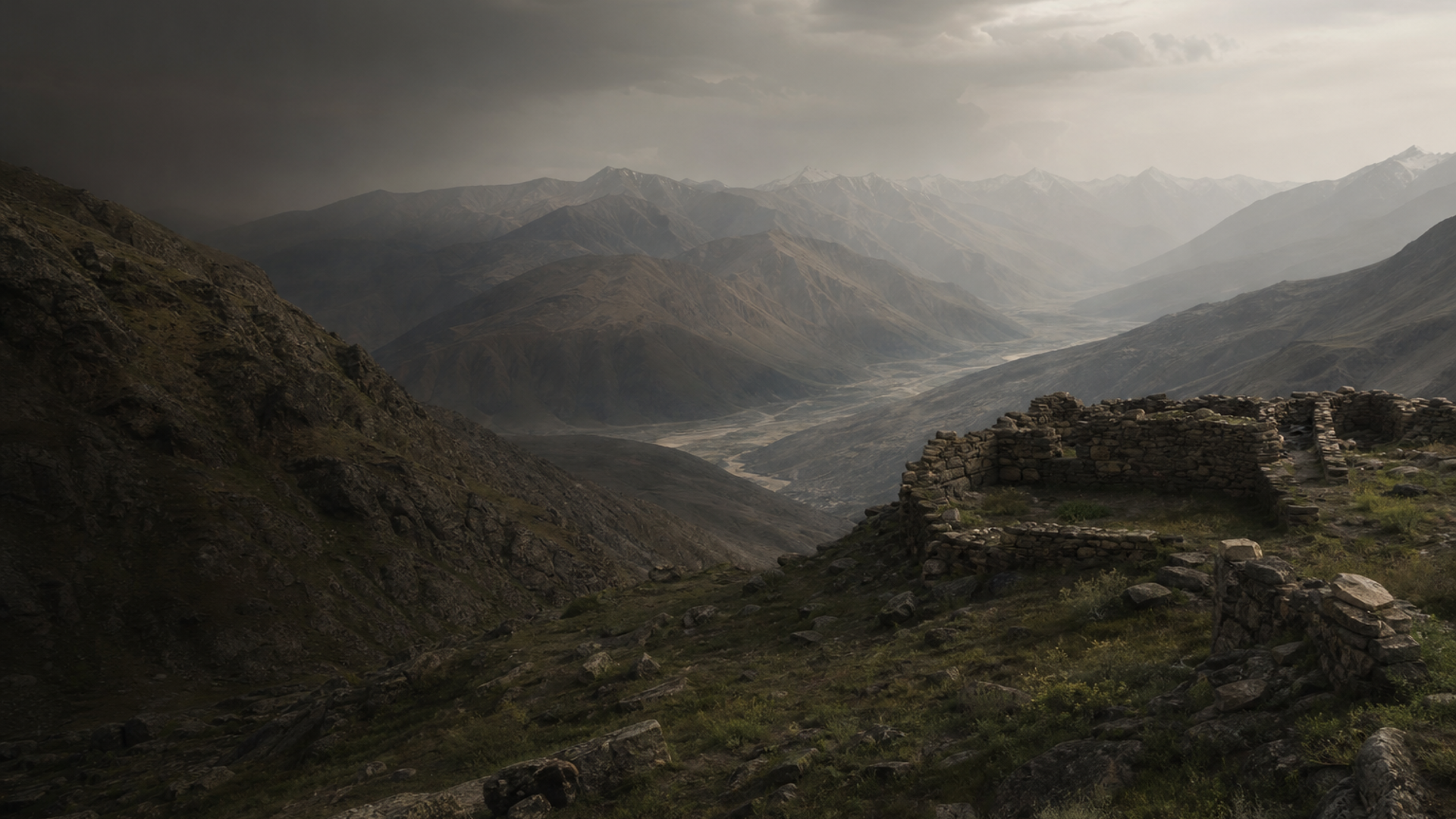
The Loebanr Iron Age emerges in the high valleys of northern Pakistan between roughly 1107 and 790 BCE, anchored at the eponymous site of Loebanr in the Swat Valley. Archaeological data indicates occupation layers with evidence for ironworking, domestic structures, and funerary deposits that distinguish this local Iron Age phase from preceding Chalcolithic and Bronze Age horizons. The settlement sits at a crossroads of mountain passes that funnel material and cultural influences between the Indus plains, the Hindu Kush, and the highland routes toward Central Asia.

Limited evidence suggests a community adapted to mixed agro‑pastoral lifeways: terraced fields and herding strategies coexisted with specialized craft production. Ceramic styles and metallurgical debris at Loebanr show both local traditions and affinities with neighboring Gandharan and trans‑Hindu Kush assemblages, implying exchange rather than isolation. Radiocarbon‑anchored contexts place the peak of activity within the stated date range, but stratigraphic complexity means chronology remains under refinement.

Genetic sampling from 38 individuals provides a new dimension for origin narratives: biological data reveal a mosaic of maternal and paternal lineages, supporting archaeological observations of regional continuity coupled with episodic long‑distance contacts. While the picture is increasingly vivid, many hypotheses about migration or elite movement remain provisional pending broader comparative datasets.

  • Occupational peak c. 1107–790 BCE in Swat Valley
  • Archaeological signs of ironworking and crafts at Loebanr
  • Located on mountain trade and communication corridors
Capítulo IV

Daily Life & Society

Lives in a valley of passes

Archaeological remains at Loebanr sketch a tactile world of household activity, seasonal mobility, and artisanal skill. Excavations reveal compact habitation areas with hearths, storage features, and concentrations of slag and tool fragments that point to local iron smelting and tool production. Faunal and floral residues, though not yet comprehensively published, indicate a mixed economy: domesticated cereals and pulses likely grew alongside flocks of sheep and goats managed on nearby slopes.

Material culture—pottery shapes, beads, and worked bone—suggests both local craftsmanship and imported items arriving via the Swat conduits. Funerary contexts display variability in grave goods and body treatment, hinting at social differentiation and possibly gendered or age‑graded roles. The combined archaeological record paints a community adept at exploiting diverse ecological zones: irrigated fields in valley bottoms, transhumant pastures at higher elevations, and artisan workshops near water sources.

These patterns align with the broader Loebanr Iron Age cultural horizon, where household economies and small‑scale craft production underpinned resilience in a marginal but strategically situated landscape. Archaeological interpretation remains cautious: many activity areas await further analysis to clarify the social rhythms of daily life.

  • Mixed agro‑pastoral economy with local craft production
  • Evidence for ironworking, varied burial practices
Capítulo V

Genetic Profile

A mosaic written in DNA

Genome sampling from 38 individuals at Loebanr offers one of the clearer genetic windows into an Iron Age community in northern Pakistan. Y‑chromosome haplogroups are diverse: L (9), R (4), Q (3), J (2), and C (1). Mitochondrial lineages likewise show breadth: T (5), M5a (4), U (4), M (4), and W (4). This diversity signals multiple ancestral strands and interactions rather than a single homogeneous gene pool.

Interpretation must be cautious. Haplogroup L is common across South Asia and likely reflects deep local paternal continuity. Haplogroup R—present here but in lower numbers—has broad Eurasian distributions; without fine subclade resolution it is not possible to assign it definitively to steppe‑related or South Asian branches. Haplogroups Q and C, although minor in count, suggest episodic genetic inputs that could reflect eastern or highland connections; J may indicate western or Iranian‑linked affinities. On the maternal side, M and its sublineages (including M5a) are characteristic of South Asian maternal ancestry, while T, U, and W indicate connections that extend into West and Central Asia.

The sample size (38) is moderate: it permits detection of population structure and admixture signals but still limits fine chronological modeling. Archaeogenetic patterns here are consistent with a community rooted in local South Asian ancestry yet open to mobility and gene flow along mountain corridors. Robust conclusions about migration directionality, sex‑biased admixture, or cultural transmission will require additional autosomal sequencing, higher‑resolution Y‑ and mtDNA subclade data, and comparative datasets from contemporaneous neighboring sites.

  • Moderate sample size (38) shows mixed paternal and maternal lineages
  • Evidence for local South Asian ancestry with episodic external inputs
Capítulo VI

Legacy & Modern Connections

Echoes into later histories

The cultural footprint of Loebanr resonates beyond its settlement layers. Archaeological indicators of iron technology, craft specialization, and trade through the Swat corridor likely contributed to the material foundations of later Gandharan societies and to regional economic networks that persisted into the first millennium BCE and beyond. Genetic continuity is plausible: several maternal and paternal lineages present at Loebanr are also detectable in modern populations of northern Pakistan, suggesting partial biological continuity, though the extent varies locally.

Caution is essential. While the genetic and archaeological signals point to links between ancient Loebanr inhabitants and later or modern groups, demographic shifts, migrations, and cultural transformations over two millennia mean continuity is rarely uniform. Future work combining high‑coverage genomes, stable isotope life‑history data, and wider archaeological sampling will better resolve how the people of Loebanr contributed to the deep historical tapestry of the region.

  • Material and genetic traits hint at continuity with northern Pakistan populations
  • Loebanr contributes to the regional trajectory toward later Gandharan culture
Con IA

Asistente de IA

Haz preguntas sobre la cultura Loebanr Iron Age: Swat's Mountain Horizon

Asistente de IA por DNAGENICS

Desbloquear esta función
Pregunta sobre la cultura Loebanr Iron Age: Swat's Mountain Horizon. El asistente con IA puede explicar hallazgos genéticos, contexto histórico, pruebas arqueológicas y conexiones modernas, con sus límites de interpretación.
Ejemplo de análisis con IA

La cultura Loebanr Iron Age: Swat's Mountain Horizon representa un capítulo de la historia humana...

El análisis genético permite estudiar similitudes con poblaciones anteriores y posibles adaptaciones. Las muestras de ADN antiguo aportan información para investigar patrones migratorios y relaciones entre poblaciones, con límites que dependen del estudio y del contexto arqueológico.

Esta es una vista previa del análisis con IA. Accede al asistente completo para explorar información sobre:

  • Composición y similitud genética
  • Patrones migratorios y orígenes
  • Vida cotidiana y prácticas culturales
  • Contexto genético moderno

Explora más culturas antiguas

Descubre la historia de civilizaciones de distintas partes del mundo antiguo